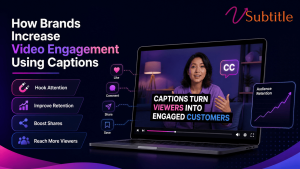
The best-performing brand video in 2026 isn’t necessarily the best-produced. It’s the video that still works with the sound off.
Video marketing has reached near-universal adoption — the large majority of businesses now use it as a core part of their strategy — which means the competitive question for brands has quietly shifted. It’s no longer whether to use video, but how to make video actually perform once everyone is already using it. One lever shows up across nearly every 2026 study on the subject as one of the highest-leverage, lowest-cost ways to move that needle: captions.
This isn’t an accessibility footnote anymore. Brands running captions as a default, not an afterthought, report measurably higher completion rates, stronger recall, and better brand affinity scores than the same content without them. This article breaks down exactly why captions move these numbers, what the current data shows, and the specific strategies brands are using to turn a basic accessibility feature into a genuine engagement lever.
What the 2026 Data Actually Shows
The starting fact behind all of this is simple: most branded video is watched without sound. On LinkedIn specifically, roughly 80% of video is watched muted, which is why the large majority of video published there is now deliberately designed for silent viewing with on-screen text or captions built in from the start rather than added afterward. That pattern holds broadly across platforms, not just LinkedIn.
| Finding | Source Context |
|---|---|
| 85% of social media video is watched without sound | Consistent across multiple 2026 video marketing datasets |
| Captioned videos see roughly 40% higher completion rates on average | Short-form video performance research, 2026 |
| 80% of LinkedIn video is watched with no sound; 70% of video is designed for silent viewing as a result | LinkedIn-specific video marketing data, 2026 |
| 50% of silent-viewing audiences rely on captions to understand video content at all | General video marketing statistics, 2026 |
| TikTok ad videos with captions see a 95% boost in brand affinity, a 58% increase in recall, and a 25% jump in perceived uniqueness | TikTok ad performance data, 2026 |
| Completion rate, not view count, is the metric platforms increasingly weight in distribution | Cross-platform algorithm behavior noted across multiple 2026 sources |
The pattern across every one of these numbers is the same: captions aren’t just making video accessible to a wider audience, they’re materially changing how much of that audience actually finishes watching, remembers what they saw, and forms a favorable impression of the brand behind it. For a discipline as metric-driven as modern marketing, that’s a rare case of an accessibility improvement and a performance improvement being the exact same piece of work.
Why Captions Move Brand Engagement Metrics Specifically
They Remove the Single Biggest Barrier to Silent Viewing
With the substantial majority of social and feed-based video watched muted, a caption-free video is only reaching a minority of its actual audience with its full message. Everyone else gets visuals and, at best, an incomplete guess at the audio’s content — a gap captions close directly and immediately.
They Reinforce the Message Through a Second Channel
For the portion of the audience watching with sound on, captions don’t just repeat the audio — they reinforce it through a second, simultaneous channel. This dual-channel reinforcement is a well-documented driver of the recall lift brands see from captioned content: information delivered through both audio and matching text is retained better than audio alone, which directly explains why captioned ads outperform on brand recall specifically, not just completion.
They Feed Platform Algorithms Directly
Most major platforms now weight completion rate and watch time heavily in how widely a video gets distributed, and several read on-screen text through OCR to help categorize and match content to relevant searches or recommendations. A captioned video isn’t just more watchable — it’s giving the platform more signal to work with when deciding who else to show it to.
They Signal Production Quality and Brand Care
A large share of consumers say video quality directly affects how much they trust a brand. Clean, well-timed, accurately worded captions are part of that quality signal now, in the same way a shaky, poorly lit video used to read as low-effort — an uncaptioned video in 2026 increasingly reads the same way, regardless of how polished the footage itself is.
This connects directly to the SEO side of the same coin: our guide to AI subtitles and video SEO covers how the same caption and transcript work that lifts engagement also improves discoverability, meaning brands investing in captions are typically getting two separate performance gains from one piece of production work.
H2 Caption Strategies Brands Use to Drive Engagement
1. Design for Sound-Off From the Script Stage, Not as a Caption Afterthought
Leading brand video teams now treat captions as part of the creative brief, not a post-production checkbox — scripting the opening line with the assumption it needs to land as text on screen, not just as narration. A hook that only works with audio loses its entire effect on the majority of viewers who never unmute.
2. Use Animated, Word-Synced Captions for Short-Form and Social
Word-by-word or short-phrase animated captions, timed to match speech, have become a standard style for high-performing short-form brand content specifically because the motion keeps attention anchored the way a static caption block doesn’t. Bold, high-contrast fonts optimized for mobile screens consistently outperform thinner, more decorative styles once a video is actually watched on a phone rather than previewed on a desktop editor.
3. Treat Caption Styling as Part of Brand Identity
Consistent caption fonts, colors, and animation style across a brand’s video output function similarly to a consistent color palette or logo placement — viewers start to recognize the brand’s content by its caption style alone, especially on platforms where content from many creators and brands blends together in a single feed. This is a detail smaller teams often skip, treating captions as purely functional rather than as a piece of visual identity worth designing deliberately.
4. Localize Captions for Global Campaigns
Brands running the same core video across multiple markets increasingly translate captions rather than producing entirely separate regional cuts, since translated captions deliver most of the localization value at a fraction of the cost and turnaround of a full re-shoot or dub.
The retention math behind this mirrors what’s documented in our piece on multilingual captions and YouTube watch time — translated captions extend a single video’s engagement lift into markets an English-only (or any single-language) version simply can’t reach.
5. Match Caption Style to Platform Norms
A caption treatment built for a polished LinkedIn thought-leadership video and one built for a fast-cut TikTok ad shouldn’t look identical — audience expectations and attention spans differ meaningfully by platform, and brands seeing the strongest engagement lift tend to adapt caption pacing and style per platform rather than exporting one caption treatment everywhere.
For teams producing vertical social content specifically, our Instagram Reel caption generator is built around exactly this kind of platform-specific caption sizing and safe-zone logic.
Why This Shift Happened Now, Not Earlier
Captions have existed as a video feature for decades, but their role shifting from accessibility add-on to core engagement lever is a relatively recent development, driven by two changes converging at once. First, mobile-first, feed-based viewing became the dominant way people encounter branded video — a fundamentally sound-off-by-default environment that didn’t exist in the same way when video marketing meant a YouTube pre-roll or a TV-style commercial. Second, platform algorithms shifted their own priorities toward completion rate and watch time as ranking signals, which meant a factor that used to only affect the viewer’s experience — whether they could follow a muted video — started directly affecting distribution too.
Brands that adapted early to this shift, treating every video as sound-off-first content by default, are the ones now showing up in the affinity and recall data above. The lag effect works against brands that haven’t adjusted: video built the old way, without captions and without a sound-off-first script, keeps losing to captioned content in the same feed, on the same platform, competing for the same attention — regardless of production budget.
Measuring the Engagement Lift From Captions
Sophisticated marketing teams in 2026 are moving past raw view counts toward what’s often called engagement depth — completion rate, average watch time, and the point in a video where drop-off actually happens — as the metrics that matter most, since platforms themselves increasingly weight these signals over view count in distribution decisions. A video with far fewer views but a high completion rate is now routinely outperforming one with many more views but shallow engagement.
- A/B test the same video with and without captions where platform tools allow it, comparing completion rate and average watch time directly rather than assuming the lift based on industry averages alone.
- Track brand recall and affinity through post-campaign surveys for paid video specifically, since these are the metrics captions have been shown to move most dramatically in ad performance data.
- Watch retention curves, not just final completion percentage, to see whether captions are helping viewers stay through a specific segment that previously saw heavy drop-off.
- Compare performance across platforms for the same core content, since caption impact — and the right caption style — can vary meaningfully between a LinkedIn feed video and a TikTok ad.
Common Mistakes That Limit the Engagement Lift
- Treating captions as a post-production add-on rather than part of the creative brief, missing the chance to design the hook and pacing around on-screen text from the start.
- Using the same caption style across every platform instead of adapting pacing and format to where the video is actually being watched.
- Publishing unreviewed auto-generated captions with errors, which undercuts the exact trust and quality signal well-made captions are supposed to build.
- Skipping caption translation on campaigns already running in multiple markets, missing an inexpensive way to extend a video’s engagement lift internationally.
- Measuring only view count instead of completion rate and watch time, which are the metrics captions actually move most directly.
Making Captioning Standard Practice, Not a Bottleneck
The brands seeing the strongest results from this treat captioning the way they treat any other standard production step — applied to every video by default, not selectively added to a few flagship pieces. That consistency is hard to maintain manually at any real content volume, which is exactly where AI-assisted captioning tools change the economics.
vSubtitle’s AI subtitle generator produces accurate, editable captions directly from a video’s audio, supports the brand-consistent styling that turns captions into part of a visual identity rather than a generic overlay, and translates into 100+ languages for brands running campaigns across multiple markets — all from the same source file, without a separate production pass for each output.
The same underlying discipline also compounds with organic performance: published transcripts have been shown to increase time on page, and our broader look at where AI subtitling is headed in 2026 covers how captioning is increasingly treated as core marketing infrastructure rather than a late-stage accessibility pass.
Key Takeaways
- The majority of branded social video is watched without sound, and captions are the most direct, lowest-cost way to close that gap rather than lose most of the audience’s attention by default.
- Captioned videos see meaningfully higher completion rates, and captioned ads specifically have been linked to large gains in brand affinity, recall, and perceived uniqueness.
- Captions work through several mechanisms at once: removing the sound-off barrier, reinforcing the message through a second channel, feeding platform algorithms via OCR, and signaling production quality.
- The strongest results come from treating captions as part of the creative brief and brand identity — scripted for sound-off from the start, styled consistently, and adapted per platform — not bolted on after editing is finished.
- Completion rate and watch time, not raw view count, are the metrics captions move most directly and the ones increasingly weighted by platform distribution algorithms.
Video engagement in 2026 isn’t primarily a production-quality problem — it’s a comprehension problem, solved for most of the audience the moment captions are treated as standard rather than optional. For brands still weighing whether captioning every video is worth the extra step, the data has largely already answered the question.
Frequently Asked Questions (FAQs)
How much do captions actually improve brand video engagement?
Data from 2026 shows captioned videos achieving roughly 40% higher completion rates on average, with TikTok ad data specifically showing a 95% boost in brand affinity, a 58% increase in recall, and a 25% increase in perceived uniqueness for captioned versus uncaptioned ads.
Why do so many brands design video for silent viewing now?
Because the majority of social video is watched muted — around 85% across social platforms broadly, and roughly 80% on LinkedIn specifically. Designing for sound-off viewing, with captions and on-screen text built in from the start, ensures the video’s message actually reaches the audience watching without sound.
Do captions affect brand recall, or just watch time?
Both. Captions reinforce a video’s message through a second, simultaneous channel for viewers watching with sound on, which is part of why captioned ads have been shown to significantly increase recall and brand affinity, not just completion rate.
Should caption style be consistent across all of a brand’s videos?
Generally yes, within platform-appropriate variation. Consistent caption fonts, colors, and animation style function similarly to other brand identity elements, helping viewers recognize a brand’s content in a crowded feed — though pacing and format should still adapt to what performs on each specific platform.
Is it worth translating captions for brand campaigns running in multiple markets?
Often yes. Translated captions extend a video’s engagement and comprehension benefits into new-language markets at a fraction of the cost and turnaround of a full regional re-shoot or dub, making it one of the more efficient localization levers available to a global campaign.
What metrics should brands track to measure caption impact?
Completion rate and average watch time are the most directly affected metrics, followed by retention-curve position (where in the video drop-off happens) and, for paid campaigns, brand recall and affinity through post-campaign surveys — all more informative than raw view count alone.
Can AI captioning tools keep up with a brand’s full video output?
Yes — this is one of the main reasons captioning has become standard practice rather than a selective, flagship-content-only step. AI tools like vSubtitle generate accurate, editable, brand-styleable captions automatically and support translation into 100+ languages, making consistent captioning realistic across a brand’s entire video output rather than a handful of priority pieces.