
vSubtitle

New Here? Get Your First 30 Minutes FREE - Limited Time Only!

Streaming & OTT

netflix-subtitle-guidelines-explained
Subtitling, Standards, Streaming & OTT, Video Localization

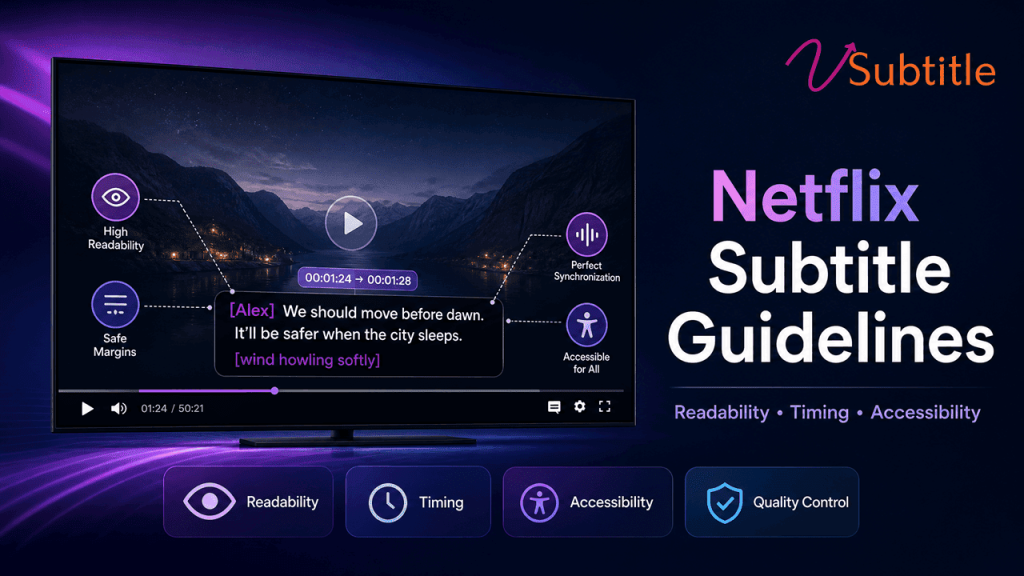
Netflix Subtitle Guidelines Explained

The document that quietly became the industry’s shared definition of a well-made subtitle — and the exact numbers behind it. Netflix’s Timed Text Style Guide (TTSG) is one of the most detailed, publicly available subtitle specifications in the streaming industry, and it has become something close to a de facto standard well beyond Netflix’s own platform. Reading-speed limits, line-length rules, and timing conventions that originated in Netflix’s internal specification now show up, in close to identical form, across other streamers, YouTube style guides, and independent creators’ subtitle workflows — not because those platforms coordinated with Netflix, but because the guide represents some of the most rigorously tested public thinking on what makes a subtitle actually readable. This breakdown walks through what the TTSG actually requires — file format, reading speed, character limits, timing, positioning, and SDH — and explains why so much of it has been adopted well outside Netflix’s own delivery pipeline. Whether the goal is delivering to Netflix directly, or simply borrowing from the most tested subtitle standard available, understanding these rules in detail is useful for almost anyone producing subtitles professionally. Why Netflix’s Guide Became the Industry Benchmark Netflix publishes its Timed Text Style Guide openly through its Partner Help Center, broken into a general requirements document plus dozens of language-specific guides covering grammar, punctuation, and formality conventions unique to each language. That level of public detail and language-by-language granularity is unusual — most streaming platforms manage subtitle specifications through closed vendor relationships rather than a searchable public knowledge base — and it’s a major reason the TTSG gets referenced, adapted, and quoted well outside Netflix’s own vendor network. The guide is also unusually rigorous about the mechanics of readability specifically. Its reading-speed and timing figures didn’t emerge from guesswork; they reflect extensive testing on how quickly viewers can actually process on-screen text without falling behind or losing track of the picture. That’s the underlying reason so many of these numbers keep reappearing verbatim across other platforms’ specifications and independent style guides. File Format and Technical Requirements Netflix’s subtitle delivery format is built on TTML (Timed Text Markup Language), with strict rules about how styling is expressed inside the file. Two technical details stand out because they trip up files built for other platforms: For teams working across multiple delivery formats, not just Netflix’s, our SRT vs VTT vs ASS subtitle format guide is a useful companion to this section, since it covers how the more common general-purpose subtitle formats differ from the strict TTML-based delivery format Netflix specifically requires. Reading Speed and Timing Rules This is the part of the TTSG most frequently cited outside Netflix, because the numbers have become something close to an unofficial industry default: Rule Netflix Specification Maximum reading speed (adult content) Up to 17 characters per second (CPS) for most languages Maximum reading speed (kids’ content) Up to 13 CPS for most languages Minimum subtitle duration 5/6 of a second per event (e.g. 20 frames at 24fps) Maximum subtitle duration 7 seconds per event Minimum gap between subtitles 2 frames, to prevent consecutive subtitles from appearing to flash or blur together Line count One line preferred; two lines only when needed to stay within the character limit Files that exceed these thresholds get flagged automatically during Netflix’s quality-control process, before a human reviewer ever looks at the content — meaning a technically accurate translation with a reading-speed violation still fails delivery. The standard fix for a CPS violation is to split the line or trim the wording, not to speed up the timing, since compressing the display duration further only makes the reading-speed problem worse. Character Limits and Segmentation Netflix’s 42-character-per-line limit is probably the single most widely copied number from the entire guide — it shows up, often unchanged, in YouTube’s own subtitle recommendations and in countless independent creator style guides. Text should generally be kept to one line unless it exceeds that limit, and when a line does need to break into two, segmentation has to happen at a clause level so each line reads as a complete, logically self-contained thought rather than an arbitrary word-count split. For subtitles split across two consecutive events because a sentence continues, timing and punctuation both follow specific rules: ellipses are generally not used when the pause between the two parts is under two seconds, but are used when the pause is longer or when dialogue trails off. Netflix additionally specifies the single smart ellipsis character (U+2026) rather than three separate periods — a small detail, but one that automated QC checks for directly. Punctuation Conventions Differ Even Within English One detail that surprises people encountering the TTSG for the first time: Netflix maintains separate style guides for different English variants, and they don’t always agree with each other. US English uses double hyphens to indicate an abrupt interruption by another speaker or a sudden sound; UK English uses an ellipsis for the same situation instead of hyphens. Getting this backward — using US conventions on a UK-English delivery, or vice versa — is exactly the kind of detail that looks like a stylistic quirk but is actually a hard specification difference that automated and human QC both check for. This regional specificity extends throughout the guide: each language-specific TTSG covers its own conventions for quotation marks, italics, numbers, currency, and formality — currency mentioned in dialogue, for instance, is kept in its original currency rather than converted, regardless of the target language. Positioning Rules Subtitles are required to be center-justified and placed at either the top or bottom of the screen — Netflix doesn’t support left- or right-aligned subtitle blocks for standard delivery. The one documented exception is Japanese content, where vertical positioning is permitted under Netflix’s Japanese-specific Timed Text Style Guide, reflecting the vertical reading conventions native to the language. When on-screen text (like a sign or a letter shown in the frame) overlaps with spoken dialogue, Netflix’s guidance is to prioritize whichever message is more plot-pertinent, and specifically warns
disney-plus-vs-amazon-prime-video-subtitle-standards
Subtitling Standards, Streaming & OTT, Video Localization

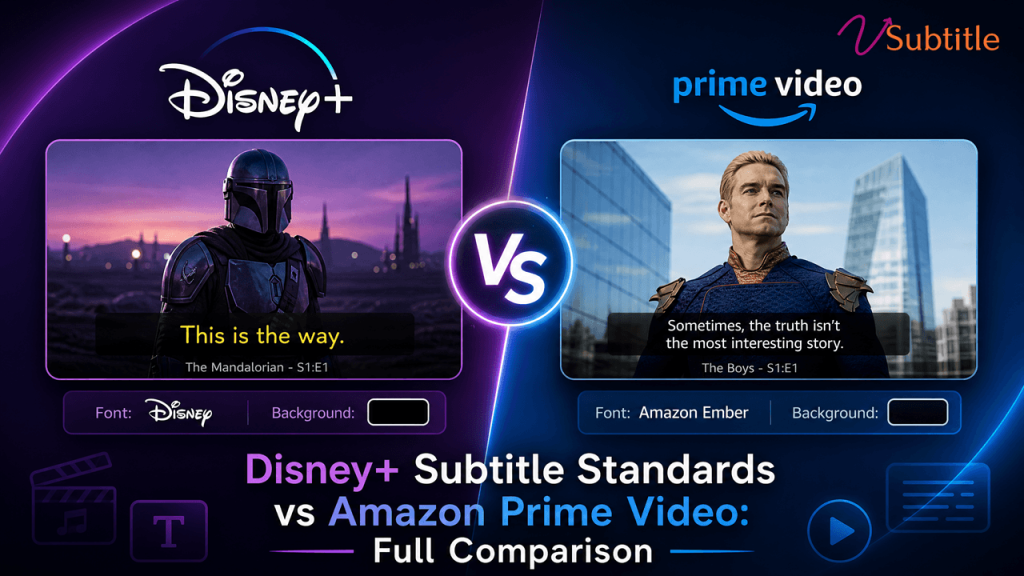
Disney+ Subtitle Standards vs Amazon Prime Video: What’s Actually Different

Both platforms agree on how fast a viewer should read. They disagree on almost everything about how that text has to be delivered. Streaming platforms don’t just accept subtitle files — they enforce detailed technical specifications, and a file built for one platform routinely fails automated quality control on another. Disney+ and Amazon Prime Video are a useful pair to compare because they sit close together on the fundamentals that actually affect how a subtitle reads — speed, line length, duration — while diverging sharply on the formats, delivery mechanics, and territory rules that determine whether a technically correct file is even accepted in the first place. This comparison breaks down exactly where Disney+ and Amazon Prime Video align, where they differ, and what that means in practice for anyone delivering subtitles to either platform — whether that’s a studio localization team, an independent filmmaker using Prime Video Direct, or a production house preparing deliverables for both at once. It’s worth noting up front that neither platform publishes every detail of its specification as openly as Netflix does with its Timed Text Style Guide. Disney+ manages much of its documentation through approved vendor relationships, and Amazon’s Video Central portal is the authoritative source for delivery partners rather than a single public style guide. The comparison below reflects the technical specifications and requirements that are documented and consistently reported across industry sources, and any team preparing an actual delivery should confirm current details directly with the platform or an approved vendor before submission, since these specifications are updated periodically. Why the Differences Matter A subtitle file is typically rejected before a human reviewer ever sees it. Automated quality-control systems check format compliance, encoding, timing, and reading speed against the platform’s exact specification, and a mismatch — the wrong container format, a timecode that doesn’t start where the platform expects, an unsupported character — fails the file outright, regardless of how accurate or well-timed the translation is. Understanding precisely where Disney+ and Amazon’s requirements diverge is what prevents a deliverable built for one platform from bouncing off the other’s QC system on the first submission. File Format: The Biggest Practical Difference This is where the two platforms differ most. Disney+ standardizes on IMSC 1.1, a TTML profile purpose-built for subtitle and caption delivery, as its primary format across most content. Amazon Prime Video takes a broader approach, accepting several formats depending on whether the file is a closed caption or a dialogue-only subtitle: DFXP/TTML, SRT, and iTT for subtitles, with STL, DFXP, SCC, and SRT accepted for closed captions. That flexibility on Amazon’s side is convenient but comes with a caveat worth flagging clearly: SCC is accepted for captions only and will be rejected if submitted as a standard subtitle file. Disney+, by contrast, offers far less format flexibility — content built outside the IMSC 1.1 profile generally needs to be reconformed before it will pass Disney’s delivery pipeline. Japanese content adds another layer of divergence. Disney+ publishes its own Japanese Subtitles IMSC 1.1 specification, keeping Japanese inside the same TTML family used for its other languages. Amazon instead requires Japanese timed text to be delivered as Lambda Cap (.cap) — a distinct format with no equivalent requirement on Disney+. Side-by-Side: Core Technical Requirements Requirement Disney+ Amazon Prime Video Primary format IMSC 1.1 DFXP/TTML, SRT, or iTT (subtitles); STL, DFXP, SCC, or SRT (captions) Japanese format IMSC 1.1 (Disney’s own Japanese spec) Lambda Cap (.cap) — required, no alternative Minimum duration 1 second 1 second Maximum duration 7 seconds 7 seconds Max reading speed 20 CPS 20 CPS Max characters per line 42 42 Max lines per event 2 2 (up to 3 for closed captions) Encoding UTF-8 UTF-8 (mandatory, no alternative accepted) Timecode start Platform-conformed via approved vendors Must start at 00:00:00:00 — no offset supported SDH / captions Required for accessibility Preferred over standard subtitles; mandatory in the US Where Disney+ and Amazon Actually Agree Strip away the formatting and delivery mechanics, and the two platforms are nearly identical on the metrics that determine how a subtitle actually reads on screen: This convergence isn’t a coincidence — it reflects a broader industry standardization around what makes subtitles genuinely readable, largely shaped by the same research and viewer-testing that produced Netflix’s widely referenced Timed Text Style Guide. Where the platforms diverge is almost entirely in delivery mechanics rather than the reading experience itself. Amazon’s Territory-Specific Rules Amazon Prime Video’s requirements shift by region in a way Disney+’s published specifications don’t emphasize to the same degree: Amazon also requires a separate Forced Narrative file for every dubbed audio track included in a multi-audio package — text that displays automatically based on the viewer’s audio selection, not as an optional subtitle. The locale of that file has to match the corresponding audio track exactly; a mismatch means it silently fails to appear when subtitles are turned off, a notoriously hard failure to catch after the fact. What’s Distinctive About Disney+’s Requirements Disney+’s public-facing documentation is comparatively narrower than Amazon’s — delivery specifications are managed primarily through its network of approved vendors rather than a broadly published self-serve technical portal. In practice, this means: The net effect is a platform that’s less flexible on format but, once a vendor is aligned with its IMSC 1.1 pipeline and style guide, highly consistent — precisely because there are fewer accepted variants to manage in the first place. Where Deliverables Most Often Go Wrong A Practical Approach for Delivering to Both Platforms Teams preparing subtitles for both Disney+ and Amazon Prime Video generally get the best results by building once against the strictest shared baseline, then branching for platform-specific delivery rather than starting from scratch for each: vSubtitle supports this exact branch-once, deliver-many workflow. It generates accurate source captions and translations across 100+ languages, keeps every event’s timing intact through the translation process, and exports to the SRT, VTT, TXT, and DFXP formats that cover the bulk of Amazon’s accepted formats and the reformatting starting point

Scroll to Top