vSubtitle

New Here? Get Your First 30 Minutes FREE - Limited Time Only!

Video Localization

netflix-subtitle-guidelines-explained
Subtitling, Standards, Streaming & OTT, Video Localization

Netflix Subtitle Guidelines Explained

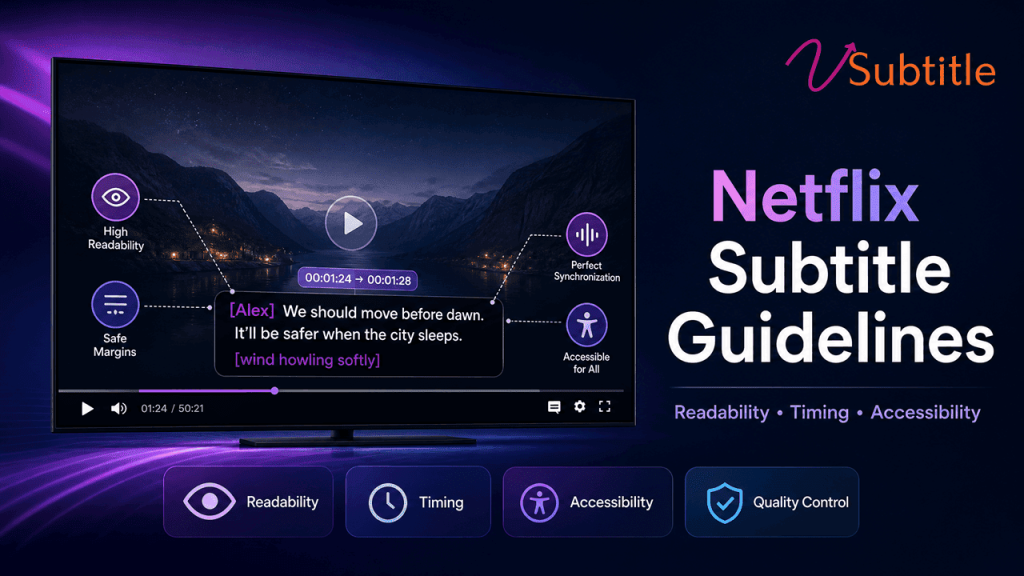
The document that quietly became the industry’s shared definition of a well-made subtitle — and the exact numbers behind it. Netflix’s Timed Text Style Guide (TTSG) is one of the most detailed, publicly available subtitle specifications in the streaming industry, and it has become something close to a de facto standard well beyond Netflix’s own platform. Reading-speed limits, line-length rules, and timing conventions that originated in Netflix’s internal specification now show up, in close to identical form, across other streamers, YouTube style guides, and independent creators’ subtitle workflows — not because those platforms coordinated with Netflix, but because the guide represents some of the most rigorously tested public thinking on what makes a subtitle actually readable. This breakdown walks through what the TTSG actually requires — file format, reading speed, character limits, timing, positioning, and SDH — and explains why so much of it has been adopted well outside Netflix’s own delivery pipeline. Whether the goal is delivering to Netflix directly, or simply borrowing from the most tested subtitle standard available, understanding these rules in detail is useful for almost anyone producing subtitles professionally. Why Netflix’s Guide Became the Industry Benchmark Netflix publishes its Timed Text Style Guide openly through its Partner Help Center, broken into a general requirements document plus dozens of language-specific guides covering grammar, punctuation, and formality conventions unique to each language. That level of public detail and language-by-language granularity is unusual — most streaming platforms manage subtitle specifications through closed vendor relationships rather than a searchable public knowledge base — and it’s a major reason the TTSG gets referenced, adapted, and quoted well outside Netflix’s own vendor network. The guide is also unusually rigorous about the mechanics of readability specifically. Its reading-speed and timing figures didn’t emerge from guesswork; they reflect extensive testing on how quickly viewers can actually process on-screen text without falling behind or losing track of the picture. That’s the underlying reason so many of these numbers keep reappearing verbatim across other platforms’ specifications and independent style guides. File Format and Technical Requirements Netflix’s subtitle delivery format is built on TTML (Timed Text Markup Language), with strict rules about how styling is expressed inside the file. Two technical details stand out because they trip up files built for other platforms: For teams working across multiple delivery formats, not just Netflix’s, our SRT vs VTT vs ASS subtitle format guide is a useful companion to this section, since it covers how the more common general-purpose subtitle formats differ from the strict TTML-based delivery format Netflix specifically requires. Reading Speed and Timing Rules This is the part of the TTSG most frequently cited outside Netflix, because the numbers have become something close to an unofficial industry default: Rule Netflix Specification Maximum reading speed (adult content) Up to 17 characters per second (CPS) for most languages Maximum reading speed (kids’ content) Up to 13 CPS for most languages Minimum subtitle duration 5/6 of a second per event (e.g. 20 frames at 24fps) Maximum subtitle duration 7 seconds per event Minimum gap between subtitles 2 frames, to prevent consecutive subtitles from appearing to flash or blur together Line count One line preferred; two lines only when needed to stay within the character limit Files that exceed these thresholds get flagged automatically during Netflix’s quality-control process, before a human reviewer ever looks at the content — meaning a technically accurate translation with a reading-speed violation still fails delivery. The standard fix for a CPS violation is to split the line or trim the wording, not to speed up the timing, since compressing the display duration further only makes the reading-speed problem worse. Character Limits and Segmentation Netflix’s 42-character-per-line limit is probably the single most widely copied number from the entire guide — it shows up, often unchanged, in YouTube’s own subtitle recommendations and in countless independent creator style guides. Text should generally be kept to one line unless it exceeds that limit, and when a line does need to break into two, segmentation has to happen at a clause level so each line reads as a complete, logically self-contained thought rather than an arbitrary word-count split. For subtitles split across two consecutive events because a sentence continues, timing and punctuation both follow specific rules: ellipses are generally not used when the pause between the two parts is under two seconds, but are used when the pause is longer or when dialogue trails off. Netflix additionally specifies the single smart ellipsis character (U+2026) rather than three separate periods — a small detail, but one that automated QC checks for directly. Punctuation Conventions Differ Even Within English One detail that surprises people encountering the TTSG for the first time: Netflix maintains separate style guides for different English variants, and they don’t always agree with each other. US English uses double hyphens to indicate an abrupt interruption by another speaker or a sudden sound; UK English uses an ellipsis for the same situation instead of hyphens. Getting this backward — using US conventions on a UK-English delivery, or vice versa — is exactly the kind of detail that looks like a stylistic quirk but is actually a hard specification difference that automated and human QC both check for. This regional specificity extends throughout the guide: each language-specific TTSG covers its own conventions for quotation marks, italics, numbers, currency, and formality — currency mentioned in dialogue, for instance, is kept in its original currency rather than converted, regardless of the target language. Positioning Rules Subtitles are required to be center-justified and placed at either the top or bottom of the screen — Netflix doesn’t support left- or right-aligned subtitle blocks for standard delivery. The one documented exception is Japanese content, where vertical positioning is permitted under Netflix’s Japanese-specific Timed Text Style Guide, reflecting the vertical reading conventions native to the language. When on-screen text (like a sign or a letter shown in the frame) overlaps with spoken dialogue, Netflix’s guidance is to prioritize whichever message is more plot-pertinent, and specifically warns
subtitle-translation-vs-video-dubbing-which-should-you-choose
Video Localization, Content Strategy, Subtitling & Translation

Subtitle Translation vs Video Dubbing: Which Should You Choose?

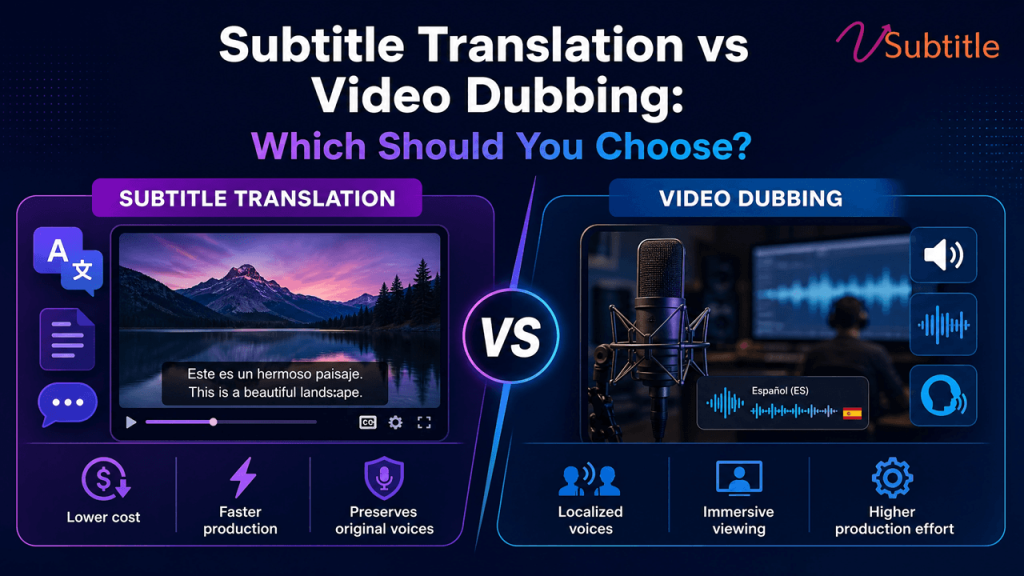
If you’re taking video content to a global audience, you’ll eventually hit the same fork in the road: subtitle translation or dubbing? Both methods break the language barrier, but they do it in very different ways — and the right choice depends on your budget, timeline, content type, and audience. This guide walks through how each method works, where each one shines, and how to decide which fits your next project. What Is Subtitle Translation? Subtitle translation takes the original spoken dialogue in a video, translates it into a target language, and displays it as timed on-screen text — while the original audio track stays untouched. Viewers hear the source language and read the translation, usually as SRT or VTT subtitle files layered onto the video. Because the process is text-based, it’s generally faster and less expensive than dubbing. It also produces a machine-readable file that search engines and platforms like YouTube can crawl, which gives translated content an SEO advantage that dubbed-only audio doesn’t have on its own. What Is Video Dubbing? Dubbing replaces the original audio track entirely with a new voice recording in the target language. It’s a more involved production process: the script is translated and adapted, voice actors are cast, dialogue is recorded in a studio, and the new audio is mixed and synced to match lip movements and on-screen timing as closely as possible. The payoff is an immersive, “native-feeling” viewing experience — the audience never has to read anything, and for many entertainment formats (especially content aimed at children or casual viewers), that translates directly into higher watch time and completion rates. Subtitle Translation vs. Video Dubbing: At a Glance Factor Subtitle Translation Video Dubbing Original audio Preserved Replaced Typical cost Lower Higher (voice talent, studio time) Turnaround time Faster Slower (casting, recording, mixing) Viewer effort Requires reading Passive listening Accessibility (deaf/HoH) Yes, directly No, needs separate captions SEO / indexing benefit Strong (crawlable text) Indirect (needs its own subtitle file) Best for Tutorials, corporate video, social/short-form, budget-conscious projects Entertainment, kids’ content, film, high-immersion storytelling Pros and Cons of Subtitle Translation Pros and Cons of Video Dubbing Cost, Turnaround Time, and Team Requirements Subtitle translation typically involves a translator (or an AI-assisted workflow with human review) and a time-coder — sometimes the same person. Turnaround for a single video can range from a few hours to a couple of days depending on length and language pair. Dubbing requires considerably more coordination: script adaptation, voice casting, a recording studio, sound engineers for mixing, and a quality-control pass to check sync accuracy. For longer-form content — films, TV series, multi-episode courses — this adds up in both cost and calendar time. If dubbing is the right call for your project, working with an established localization studio rather than assembling the pipeline yourself usually saves both money and headaches. Audience Preferences: Who Prefers What Preferences vary a lot by region and content type. Countries such as the Netherlands, Sweden, and much of the Nordic region lean strongly toward subtitles, while Germany, Japan, Italy, France, and Spain have historically favored dubbing, especially for film and TV. Documentary and art-house audiences tend to prefer subtitles to preserve the original performance, while mass-market entertainment and children’s programming skew toward dubbing. For online video specifically — tutorials, product demos, corporate training, YouTube content — subtitles (and translated subtitles) are usually the default, both because of cost and because they’re easier to update when content changes. Which Should You Choose? A quick way to think about it: match the method to the content and the audience, not the other way around. Can You Use Both? Yes — and for larger projects, it’s often the smartest approach. Offering a dubbed audio track alongside translated subtitles (or captions in the dub language) covers accessibility requirements, caters to viewer preference, and maximizes searchability, since the subtitle file still gives search engines text to index even when most viewers are listening to the dub. How vSubtitle Helps With Subtitle Translation If subtitle translation is the right fit for your project, vSubtitle generates accurate, properly timed subtitle files and can translate them into multiple languages, so you get search-ready SRT/VTT output without manually re-timing every version. Our piece on how multilingual captions double YouTube watch time looks at the real engagement lift translated subtitles can produce for channels expanding into new language markets. If you’re weighing accuracy trade-offs, our comparison of AI vs. human captioning walks through when AI-generated subtitles are good enough and when a human review pass is worth the extra time. New to subtitling altogether? Start with our AI subtitling for beginners guide, or try the free subtitle generator comparison to find a starting workflow that fits your budget. How DUBnSUB Helps With Video Dubbing If your project calls for full dubbing instead — or alongside subtitles — that’s a different production discipline, involving voice casting, studio recording, and audio-visual sync work that goes well beyond a subtitle file. For that side of localization, DUBnSUB is a dedicated dubbing, voice-over, and subtitling agency working across 70+ languages, with native voice talent and studio partners handling everything from script adaptation to final audio mix. Their own breakdown of subtitles vs. dubbing digs deeper into the production workflow differences from a dubbing studio’s perspective — useful reading if you’re scoping a larger localization project. If you already know dubbing is the way to go, their guide to choosing the right dubbing studio covers what to evaluate — casting process, translation quality, and turnaround — before committing to a vendor. Frequently Asked Questions (FAQs) Conclusion There’s no single right answer in the subtitle translation vs. dubbing debate — the best choice depends on your content, audience, budget, and timeline. Subtitle translation is faster, cheaper, and better for search visibility; dubbing delivers a more immersive experience where budget and market preference support it. For many creators and brands, the smartest long-term strategy is starting with translated subtitles and layering in dubbing for the markets and content

subtitling-real-estate-multilingual-tours-global-deals
Real Estate Marketing, Industry Use Cases, Video Localization

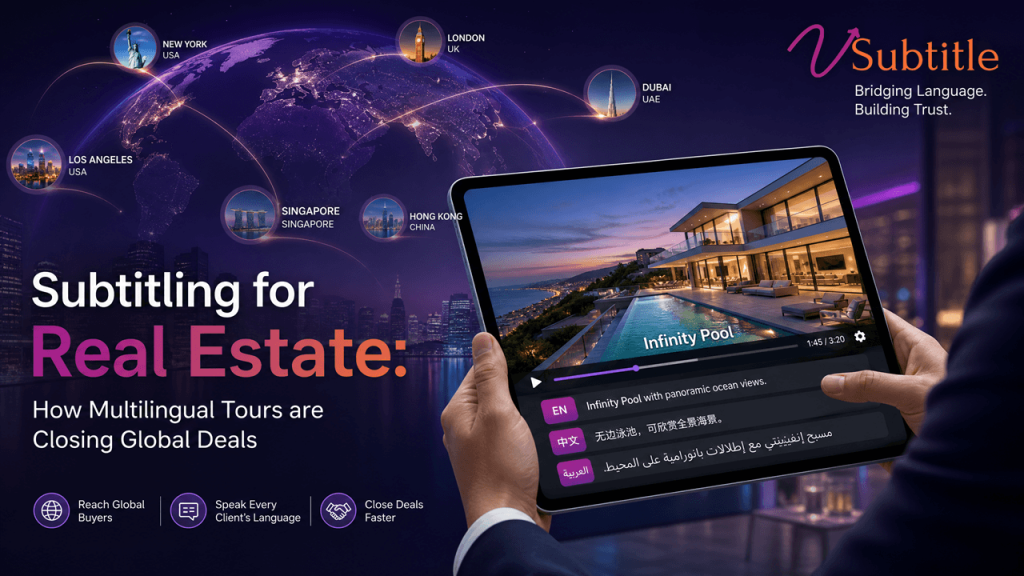
Subtitling for Real Estate: How Multilingual Tours Are Closing Global Deals

A buyer in Seoul or Mexico City can already see the property. What they can’t do is understand the agent describing it — until the video is subtitled. Real estate has quietly become one of the most international transaction categories in consumer purchasing. Foreign buyers purchased tens of billions of dollars’ worth of U.S. existing homes over a recent 12-month period alone, with a large share paying entirely in cash and moving fast once a property earns their confidence. Similar patterns show up across other markets with international demand — Swiss cantons bordering three language regions, Gulf-facing luxury markets, and vacation-property hotspots that draw buyers from a dozen countries for a single development. Video has already become the default way these buyers evaluate a property before ever booking a flight. Listings with video draw dramatically more inquiries than listings without, and video walkthroughs now rank as the single most useful content type for buyers, ahead of photos and floor plans. What most of that video still doesn’t do is speak the buyer’s language. A property tour narrated only in English, or only in the local listing language, quietly excludes a large and often highly qualified share of the exact audience it’s trying to reach. Subtitling — not necessarily full dubbing — is the fastest, most practical fix, and it’s becoming a genuine competitive differentiator for agents and developers working international pipelines. Why Video Already Closes Deals — and Why Language Is the Remaining Gap The case for real estate video itself is no longer in question. Listings with video receive substantially more inquiries than listings without, generate significantly more organic search traffic, and are associated with homes selling for a measurable premium over comparable properties marketed without it. The large majority of buyers say they’d watch a video tour if one were available, and an overwhelming share of buyers who use a video walkthrough report being more likely to move forward with a purchase. Finding Why It Matters for International Buyers Video listings receive far more inquiries and organic search traffic than listing without video International buyers researching remotely rely on video even more heavily, since a site visit isn’t an option early in their search Homes marketed with video sell for a measurable premium over comparable listings The premium logic extends further when video actually reaches — and is understood by — the full pool of qualified buyers, not just local-language ones Video walkthroughs are the single most useful content type for buyers, ahead of photos and floor plans A walkthrough only delivers that value if the narration is actually comprehensible to the viewer watching it Tens of billions of dollars in existing-home purchases came from foreign buyers in a recent 12-month period, with roughly half paying cash This is not a marginal segment — it represents a sizable, well-resourced, remote-first buyer pool that transacts quickly once confident A large share of international buyers researching a property never see it in person before making an offer Video is effectively standing in for the in-person walkthrough — and if it isn’t understandable, it fails at exactly the moment trust needs to be built Put together, these numbers describe an audience that’s already primed to buy remotely, already relying heavily on video to do it, and already large enough to matter to any agent or developer with genuine international exposure. The missing piece isn’t more video — it’s video that a non-native-language buyer can actually follow. Why Subtitles Are the Right First Move — Not Full Dubbing Full multilingual dubbing exists and works well for high-end developments with the budget to support it, but for the majority of listings and agencies, subtitles deliver most of the benefit at a fraction of the cost and turnaround time: What Multilingual Subtitles Actually Signal to a Buyer Beyond comprehension, subtitling a property tour sends a specific, trust-building message to an international buyer: this agent, developer, or brokerage is set up to work with someone like them. For a transaction where a buyer may be moving tens or hundreds of thousands of dollars across currencies and time zones without ever setting foot on the property beforehand, that signal matters as much as the production quality of the video itself. Reports on international buyer behavior consistently point to the same underlying pattern: if a property and the process around it can’t be understood remotely, it struggles to earn serious consideration from a buyer evaluating it from another country — no matter how strong the property itself is. This is especially pronounced in regions with inherent linguistic diversity even within a single national market. Property marketing across Swiss cantons, for example, routinely needs German, French, and Italian versions depending on the canton, with English added for the expatriate and foreign-investor audience that increasingly drives premium transactions — a pattern that repeats, in different language combinations, across most markets with meaningful cross-border buyer activity. Where This Matters Most: Market Patterns Worth Knowing Luxury and Resort Markets High-value vacation and resort properties routinely draw buyers from a dozen or more countries for a single development. Here, subtitled tours in the top four or five buyer languages — often English plus regional variants like Mandarin, Arabic, Russian, or Spanish depending on the destination — can meaningfully widen the qualified buyer pool for a listing that would otherwise lean on English alone. Multilingual Domestic Markets Countries or regions with multiple official or widely spoken languages — Switzerland’s cantons, Canada’s English/French split, parts of Belgium — need multilingual video even for buyers who never cross a border. A German-language tour of a Geneva property, or an English-only tour of a Ticino listing, can lose a domestic buyer just as easily as an international one. Investment and Cash-Buyer Segments Foreign cash buyers, who represent a substantial share of international real estate purchasing activity, often move quickly once confident in a property and are more likely to transact remotely without an in-person visit. For this segment specifically, a clear, subtitled walkthrough often functions

top-youtubers-ai-captions-international-audience-growth
YouTube Growth, Creator Strategy, Video Localization

How Top YouTubers Use AI Captions to Grow International Audiences

The biggest creators didn’t grow globally by making more videos. They grew by making their existing videos readable — and watchable — in languages they don’t speak. English-language creators have long treated their subscriber count as a ceiling set by however many English speakers happen to find their channel. The biggest names in YouTube have quietly proven that ceiling was never real. English speakers make up a modest share of the global online population, and the audiences waiting on the other side of that gap are enormous — they’re just unreachable to a channel that only publishes in one language. The creators who’ve capitalized on this hardest haven’t necessarily made different content. They’ve made their existing content legible to more of the world, starting with the cheapest and fastest lever available: captions. This article looks at what the data shows about localized growth at the top of YouTube, why captions specifically are the foundation that strategy is built on, and the practical workflow — including where a tool like vSubtitle fits in — that any channel can use to replicate it at a much smaller scale. What the Numbers Show About Localized Growth The clearest public evidence of this comes from the creators who’ve localized most aggressively. MrBeast built dedicated international channels publishing dubbed versions of his content in Spanish, Portuguese, Hindi, and other languages, and that strategy has driven substantial subscriber and viewership growth in each of those markets specifically because the content finally arrived in a language those audiences could follow without effort. When YouTube rolled out its native multi-language audio track feature, MrBeast’s Spanish-dubbed content reportedly pulled in over 20 million views in its first week alone, and testing among participating creators showed dubbed videos gaining a meaningful boost in watch time compared with the English-only version of the same upload. Mark Rober, known for high-production science content, saw a reported 40% increase in global subscribers after adding multilingual options — a jump that came from broadening who could access content that already existed, not from producing more of it. These are dubbing-specific numbers, and dubbing is a bigger production investment than captions. But the underlying signal applies just as strongly to captions, and arguably more usefully for most channels: the growth in these examples didn’t come from better content. It came from removing the language barrier standing between existing content and a new audience. Captions are the fastest, lowest-cost way to start removing that barrier — well before a channel is ready to invest in full dubbing. Why Captions Come Before Dubbing, Not After It’s tempting to look at MrBeast’s dubbed international channels and conclude that dubbing is the strategy. In practice, captions do most of the foundational work dubbing later builds on, for a few concrete reasons: Seen this way, captions aren’t a smaller, cheaper substitute for dubbing — they’re the first, necessary step in the same strategy, and the step that tells a creator which languages are worth dubbing at all. The AI Caption Workflow Behind International Growth The channels succeeding at this internationally tend to follow a version of the same repeatable process, whether it’s run by a large production team or a single creator: This is close to a compressed version of what MrBeast’s international expansion did at a much larger scale: start with the cheapest form of localization, measure what actually resonates, and reinvest in the languages that prove themselves. Captions are simply the version of that first step that’s realistic for a channel without a dedicated localization team. Captions vs. Dubbing: Where Each Fits in the Strategy Factor Translated Captions Full Dubbing Typical cost per video Low — largely automated with review High — voice talent, direction, mixing Turnaround time Hours to a day Days to weeks Serves muted viewers Yes No Improves search/discovery in target language Yes, directly Indirectly, via engagement signals Best use Testing demand across many languages quickly Doubling down on languages already proven to perform Risk if skipped Video stays invisible to non-native readers and search in that language Missed opportunity to fully match audio to top-performing markets Most channels don’t need to choose one over the other — they need to sequence them correctly. Captions across many candidate languages first, dubbing reserved for the smaller number of languages the caption data actually justifies. The Pattern Behind Every Successful Localization Story Strip away the production budgets, and the creators who’ve grown internationally share a consistent pattern rather than a secret technique: they treat language as a distribution problem, not a content problem. The video that already exists is usually good enough — what’s missing is a version of it a non-English-speaking viewer can actually follow. Mark Rober’s science content didn’t need to change to perform well with a Spanish-speaking audience; it needed to be legible to one. The same logic scales down to any channel: a well-performing English video is very often a well-performing video in several other languages too, provided the caption and translation work gets done. This is also why AI captioning tools have become central to this strategy rather than a nice-to-have add-on. Manually translating and syncing subtitles across a dozen languages, for every upload, isn’t realistic for the vast majority of channels — including many with substantial production budgets. Automating the transcription and translation step, while keeping a human review pass for accuracy and tone, is what makes testing five or ten languages at once actually feasible instead of a multi-week project reserved for a handful of a channel’s best-performing videos. Why This Is a Platform-Wide Shift, Not Just a Few Big Channels MrBeast and Mark Rober are the most-cited examples because their scale makes the results easy to measure, but the underlying shift is broader than a handful of mega-channels. YouTube’s own decision to build native multi-language audio tracks directly into the platform — rather than leaving localization entirely to third-party workarounds — reflects a recognition that language was leaving substantial viewership on the table across the platform, not just

disney-plus-vs-amazon-prime-video-subtitle-standards
Subtitling Standards, Streaming & OTT, Video Localization

Disney+ Subtitle Standards vs Amazon Prime Video: What’s Actually Different

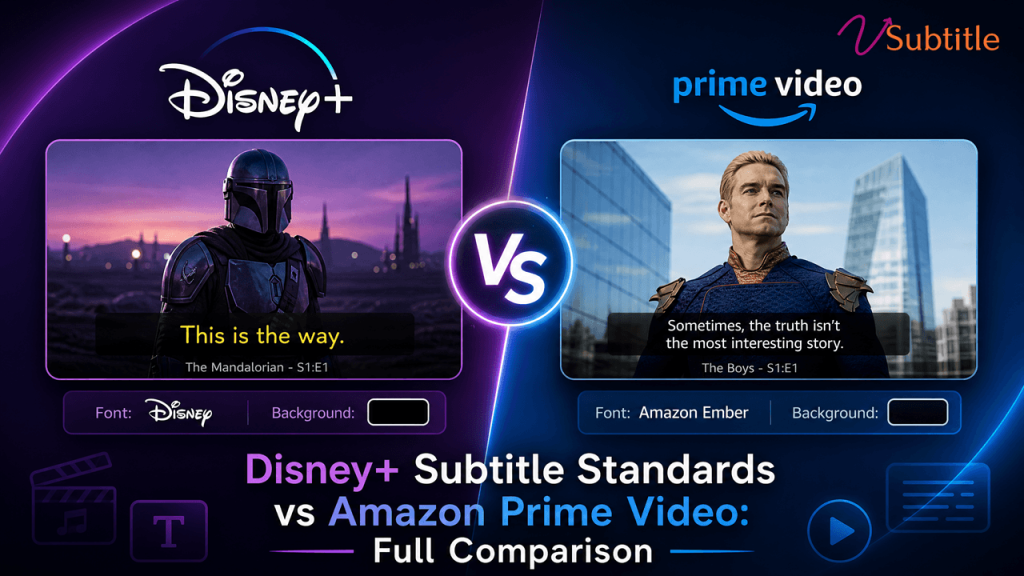
Both platforms agree on how fast a viewer should read. They disagree on almost everything about how that text has to be delivered. Streaming platforms don’t just accept subtitle files — they enforce detailed technical specifications, and a file built for one platform routinely fails automated quality control on another. Disney+ and Amazon Prime Video are a useful pair to compare because they sit close together on the fundamentals that actually affect how a subtitle reads — speed, line length, duration — while diverging sharply on the formats, delivery mechanics, and territory rules that determine whether a technically correct file is even accepted in the first place. This comparison breaks down exactly where Disney+ and Amazon Prime Video align, where they differ, and what that means in practice for anyone delivering subtitles to either platform — whether that’s a studio localization team, an independent filmmaker using Prime Video Direct, or a production house preparing deliverables for both at once. It’s worth noting up front that neither platform publishes every detail of its specification as openly as Netflix does with its Timed Text Style Guide. Disney+ manages much of its documentation through approved vendor relationships, and Amazon’s Video Central portal is the authoritative source for delivery partners rather than a single public style guide. The comparison below reflects the technical specifications and requirements that are documented and consistently reported across industry sources, and any team preparing an actual delivery should confirm current details directly with the platform or an approved vendor before submission, since these specifications are updated periodically. Why the Differences Matter A subtitle file is typically rejected before a human reviewer ever sees it. Automated quality-control systems check format compliance, encoding, timing, and reading speed against the platform’s exact specification, and a mismatch — the wrong container format, a timecode that doesn’t start where the platform expects, an unsupported character — fails the file outright, regardless of how accurate or well-timed the translation is. Understanding precisely where Disney+ and Amazon’s requirements diverge is what prevents a deliverable built for one platform from bouncing off the other’s QC system on the first submission. File Format: The Biggest Practical Difference This is where the two platforms differ most. Disney+ standardizes on IMSC 1.1, a TTML profile purpose-built for subtitle and caption delivery, as its primary format across most content. Amazon Prime Video takes a broader approach, accepting several formats depending on whether the file is a closed caption or a dialogue-only subtitle: DFXP/TTML, SRT, and iTT for subtitles, with STL, DFXP, SCC, and SRT accepted for closed captions. That flexibility on Amazon’s side is convenient but comes with a caveat worth flagging clearly: SCC is accepted for captions only and will be rejected if submitted as a standard subtitle file. Disney+, by contrast, offers far less format flexibility — content built outside the IMSC 1.1 profile generally needs to be reconformed before it will pass Disney’s delivery pipeline. Japanese content adds another layer of divergence. Disney+ publishes its own Japanese Subtitles IMSC 1.1 specification, keeping Japanese inside the same TTML family used for its other languages. Amazon instead requires Japanese timed text to be delivered as Lambda Cap (.cap) — a distinct format with no equivalent requirement on Disney+. Side-by-Side: Core Technical Requirements Requirement Disney+ Amazon Prime Video Primary format IMSC 1.1 DFXP/TTML, SRT, or iTT (subtitles); STL, DFXP, SCC, or SRT (captions) Japanese format IMSC 1.1 (Disney’s own Japanese spec) Lambda Cap (.cap) — required, no alternative Minimum duration 1 second 1 second Maximum duration 7 seconds 7 seconds Max reading speed 20 CPS 20 CPS Max characters per line 42 42 Max lines per event 2 2 (up to 3 for closed captions) Encoding UTF-8 UTF-8 (mandatory, no alternative accepted) Timecode start Platform-conformed via approved vendors Must start at 00:00:00:00 — no offset supported SDH / captions Required for accessibility Preferred over standard subtitles; mandatory in the US Where Disney+ and Amazon Actually Agree Strip away the formatting and delivery mechanics, and the two platforms are nearly identical on the metrics that determine how a subtitle actually reads on screen: This convergence isn’t a coincidence — it reflects a broader industry standardization around what makes subtitles genuinely readable, largely shaped by the same research and viewer-testing that produced Netflix’s widely referenced Timed Text Style Guide. Where the platforms diverge is almost entirely in delivery mechanics rather than the reading experience itself. Amazon’s Territory-Specific Rules Amazon Prime Video’s requirements shift by region in a way Disney+’s published specifications don’t emphasize to the same degree: Amazon also requires a separate Forced Narrative file for every dubbed audio track included in a multi-audio package — text that displays automatically based on the viewer’s audio selection, not as an optional subtitle. The locale of that file has to match the corresponding audio track exactly; a mismatch means it silently fails to appear when subtitles are turned off, a notoriously hard failure to catch after the fact. What’s Distinctive About Disney+’s Requirements Disney+’s public-facing documentation is comparatively narrower than Amazon’s — delivery specifications are managed primarily through its network of approved vendors rather than a broadly published self-serve technical portal. In practice, this means: The net effect is a platform that’s less flexible on format but, once a vendor is aligned with its IMSC 1.1 pipeline and style guide, highly consistent — precisely because there are fewer accepted variants to manage in the first place. Where Deliverables Most Often Go Wrong A Practical Approach for Delivering to Both Platforms Teams preparing subtitles for both Disney+ and Amazon Prime Video generally get the best results by building once against the strictest shared baseline, then branching for platform-specific delivery rather than starting from scratch for each: vSubtitle supports this exact branch-once, deliver-many workflow. It generates accurate source captions and translations across 100+ languages, keeps every event’s timing intact through the translation process, and exports to the SRT, VTT, TXT, and DFXP formats that cover the bulk of Amazon’s accepted formats and the reformatting starting point

translate-youtube-subtitles-100-languages
Subtitling Tips, Video Localization, YouTube Growth

How to Translate YouTube Subtitles into 100+ Languages

One upload, dozens of markets: the complete workflow for turning a single video into subtitles your global audience can actually read. YouTube is watched in more than 100 countries and close to 80 languages, but most channels publish subtitles in exactly one — the language the video was recorded in. That gap is one of the simplest, highest-return opportunities left in video growth: a single upload can already unlock most of the world’s internet-connected audience the moment its subtitles exist in the languages that audience actually reads. Getting there isn’t complicated, but doing it well takes more than clicking YouTube’s built-in auto-translate button. This guide walks through exactly how to translate YouTube subtitles into 100+ languages — what YouTube’s native tools can and can’t do, how AI-assisted translation with a tool like vSubtitle fits into the workflow, how to upload multilingual subtitle tracks properly, and how to keep translated captions accurate, readable, and on-brand rather than just technically present. Why Multilingual Subtitles Are Worth the Effort Captioned videos already earn more watch time than uncaptioned ones, since a large share of viewing happens with the sound off. Translated subtitles extend that same effect across language markets that would otherwise skip a video entirely, regardless of how strong the content is. Spanish and Portuguese alone open up Latin America, Spain, and Brazil; Hindi unlocks one of YouTube’s largest markets by daily active users. Creators who prioritize just three or four of the right languages for their audience commonly see their reachable audience multiply several times over — not from making new content, but from making existing content legible to people who were never excluded by interest, only by language. This is also, increasingly, an SEO and AI-visibility play, not just a viewer-experience one. Translated subtitle tracks give YouTube’s own search system, Google, and AI answer engines like ChatGPT and Perplexity a version of your content’s text in the exact language a viewer is searching in — something a single-language transcript can never do, no matter how well-optimized it is. Method 1: YouTube’s Built-In Auto-Translate (Viewer Side) YouTube offers a native auto-translate feature that any viewer can turn on: click the CC icon, open Settings, choose Subtitles, select Auto-translate, and pick a language. It works on any video that already has captions — auto-generated or manual — and covers over 100 languages. It’s the fastest option, but it comes with real limits worth knowing before relying on it: Auto-translate is genuinely useful for a casual viewer who just wants the gist. It’s not a substitute for creator-published translated subtitles, which is the option that actually improves discoverability, accessibility compliance, and the experience for a returning audience in a specific language. Method 2: Manually Uploading Translated Subtitle Files Creators can add their own translated subtitle tracks directly in YouTube Studio: open Subtitles, select the video, click Add Language, and upload a translated .srt or .vtt file for that language, or type translations manually. Each language becomes its own selectable track in the CC menu, downloadable and fully controlled by the creator — this is what actually shows up as a permanent, publishable option rather than a one-time viewer setting. The bottleneck is producing those files. Hand-translating a caption track means working sentence by sentence while keeping every timecode intact, and doing that across dozens of languages — each with its own line-length norms, character sets, and reading-speed limits — is not a task most channels can realistically do by hand at scale. Method 3: AI-Assisted Translation With vSubtitle (Recommended) This is where AI subtitle tools close the gap between YouTube’s quick-but-limited auto-translate and slow, fully manual translation. vSubtitle is built specifically for this workflow: it takes an existing subtitle file or a video’s audio, generates or imports the source-language captions, and translates them into 100+ languages while preserving the original timecodes — so every translated line still lands exactly where the matching dialogue occurs, without the manual re-syncing that hand-translation requires. Because the output is a standard, editable caption file rather than a live, in-player-only translation, it solves the core limitation of YouTube’s native auto-translate: the translated subtitles can be reviewed, corrected, and then uploaded directly to YouTube Studio as a permanent, creator-owned language track — searchable, downloadable, and consistent for every viewer in that language, not just the one currently watching. Step-by-Step: Translating and Publishing Multilingual YouTube Subtitles Which Languages Should You Translate First? Translating into all 100+ supported languages at once is rarely the right first move. A shortlist based on audience size, content type, and existing traffic gets far more return per translation than blanket coverage: Language Why It’s Often a High-Priority Pick Spanish Opens Latin America and Spain simultaneously — one of the largest combined YouTube audiences outside English Portuguese Brazil alone represents one of YouTube’s largest single-country audiences Hindi One of YouTube’s largest markets by daily active users Arabic Right-to-left; strong demand for educational, news, and entertainment content across a wide region Persian High demand for educational and entertainment content; also right-to-left Japanese / Korean Large, high-engagement audiences, but heavily context- and politeness-dependent — budget extra time for review Chinese Very large potential audience; requires a choice between Simplified and Traditional characters depending on target region Indonesian / Vietnamese / Thai Fast-growing Southeast Asian audiences with comparatively less translated content competing for attention A practical starting shortlist for most channels: 3–5 languages that match either an existing pocket of non-native viewers already showing up in analytics, or a market your content topic naturally travels well in (tutorials and how-to content, for example, tend to translate especially well). Expand from there once you can see which languages are actually converting into watch time. Keeping Translated Captions Accurate and Readable Subtitle File Formats YouTube Accepts Whichever translation method you use, the output needs to land in a format YouTube Studio will actually accept. The most common and reliable choices: Format Best For .srt (SubRip) The most universally supported format; a safe default for most uploads .vtt (WebVTT) Similar to

Scroll to Top