

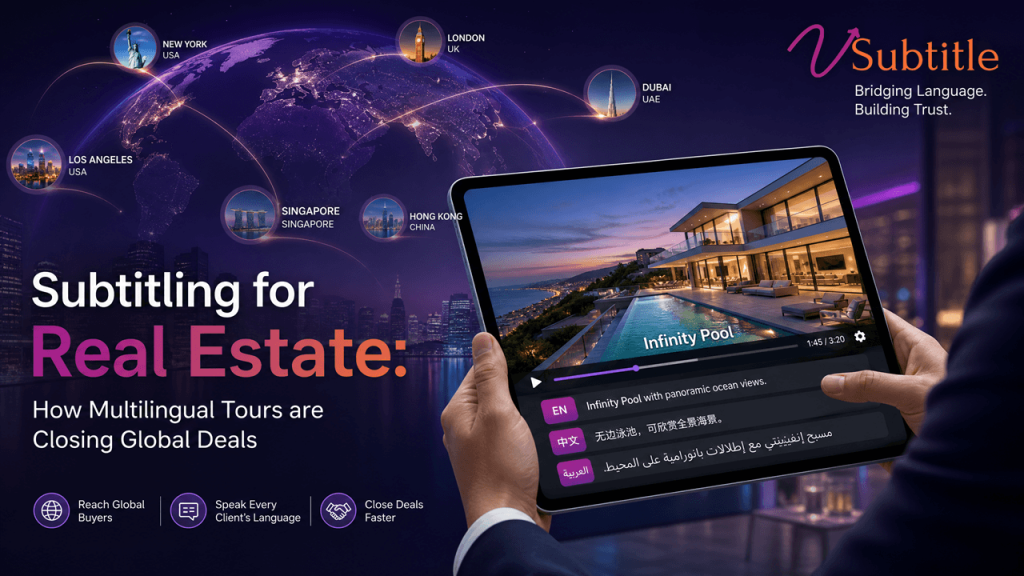
Subtitling for Real Estate: How Multilingual Tours Are Closing Global Deals
A buyer in Seoul or Mexico City can already see the property. What they can’t do is understand the agent describing it — until the video is subtitled. Real estate has quietly become one of the most international transaction categories in consumer purchasing. Foreign buyers purchased tens of billions of dollars’ worth of U.S. existing homes over a recent 12-month period alone, with a large share paying entirely in cash and moving fast once a property earns their confidence. Similar patterns show up across other markets with international demand — Swiss cantons bordering three language regions, Gulf-facing luxury markets, and vacation-property hotspots that draw buyers from a dozen countries for a single development. Video has already become the default way these buyers evaluate a property before ever booking a flight. Listings with video draw dramatically more inquiries than listings without, and video walkthroughs now rank as the single most useful content type for buyers, ahead of photos and floor plans. What most of that video still doesn’t do is speak the buyer’s language. A property tour narrated only in English, or only in the local listing language, quietly excludes a large and often highly qualified share of the exact audience it’s trying to reach. Subtitling — not necessarily full dubbing — is the fastest, most practical fix, and it’s becoming a genuine competitive differentiator for agents and developers working international pipelines. Why Video Already Closes Deals — and Why Language Is the Remaining Gap The case for real estate video itself is no longer in question. Listings with video receive substantially more inquiries than listings without, generate significantly more organic search traffic, and are associated with homes selling for a measurable premium over comparable properties marketed without it. The large majority of buyers say they’d watch a video tour if one were available, and an overwhelming share of buyers who use a video walkthrough report being more likely to move forward with a purchase. Finding Why It Matters for International Buyers Video listings receive far more inquiries and organic search traffic than listing without video International buyers researching remotely rely on video even more heavily, since a site visit isn’t an option early in their search Homes marketed with video sell for a measurable premium over comparable listings The premium logic extends further when video actually reaches — and is understood by — the full pool of qualified buyers, not just local-language ones Video walkthroughs are the single most useful content type for buyers, ahead of photos and floor plans A walkthrough only delivers that value if the narration is actually comprehensible to the viewer watching it Tens of billions of dollars in existing-home purchases came from foreign buyers in a recent 12-month period, with roughly half paying cash This is not a marginal segment — it represents a sizable, well-resourced, remote-first buyer pool that transacts quickly once confident A large share of international buyers researching a property never see it in person before making an offer Video is effectively standing in for the in-person walkthrough — and if it isn’t understandable, it fails at exactly the moment trust needs to be built Put together, these numbers describe an audience that’s already primed to buy remotely, already relying heavily on video to do it, and already large enough to matter to any agent or developer with genuine international exposure. The missing piece isn’t more video — it’s video that a non-native-language buyer can actually follow. Why Subtitles Are the Right First Move — Not Full Dubbing Full multilingual dubbing exists and works well for high-end developments with the budget to support it, but for the majority of listings and agencies, subtitles deliver most of the benefit at a fraction of the cost and turnaround time: What Multilingual Subtitles Actually Signal to a Buyer Beyond comprehension, subtitling a property tour sends a specific, trust-building message to an international buyer: this agent, developer, or brokerage is set up to work with someone like them. For a transaction where a buyer may be moving tens or hundreds of thousands of dollars across currencies and time zones without ever setting foot on the property beforehand, that signal matters as much as the production quality of the video itself. Reports on international buyer behavior consistently point to the same underlying pattern: if a property and the process around it can’t be understood remotely, it struggles to earn serious consideration from a buyer evaluating it from another country — no matter how strong the property itself is. This is especially pronounced in regions with inherent linguistic diversity even within a single national market. Property marketing across Swiss cantons, for example, routinely needs German, French, and Italian versions depending on the canton, with English added for the expatriate and foreign-investor audience that increasingly drives premium transactions — a pattern that repeats, in different language combinations, across most markets with meaningful cross-border buyer activity. Where This Matters Most: Market Patterns Worth Knowing Luxury and Resort Markets High-value vacation and resort properties routinely draw buyers from a dozen or more countries for a single development. Here, subtitled tours in the top four or five buyer languages — often English plus regional variants like Mandarin, Arabic, Russian, or Spanish depending on the destination — can meaningfully widen the qualified buyer pool for a listing that would otherwise lean on English alone. Multilingual Domestic Markets Countries or regions with multiple official or widely spoken languages — Switzerland’s cantons, Canada’s English/French split, parts of Belgium — need multilingual video even for buyers who never cross a border. A German-language tour of a Geneva property, or an English-only tour of a Ticino listing, can lose a domestic buyer just as easily as an international one. Investment and Cash-Buyer Segments Foreign cash buyers, who represent a substantial share of international real estate purchasing activity, often move quickly once confident in a property and are more likely to transact remotely without an in-person visit. For this segment specifically, a clear, subtitled walkthrough often functions