

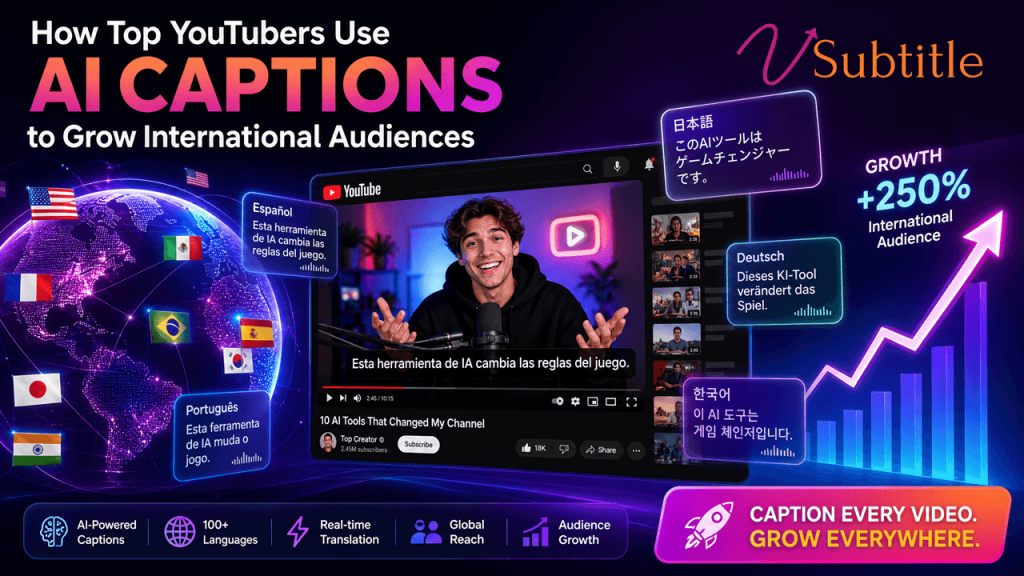
How Top YouTubers Use AI Captions to Grow International Audiences
The biggest creators didn’t grow globally by making more videos. They grew by making their existing videos readable — and watchable — in languages they don’t speak. English-language creators have long treated their subscriber count as a ceiling set by however many English speakers happen to find their channel. The biggest names in YouTube have quietly proven that ceiling was never real. English speakers make up a modest share of the global online population, and the audiences waiting on the other side of that gap are enormous — they’re just unreachable to a channel that only publishes in one language. The creators who’ve capitalized on this hardest haven’t necessarily made different content. They’ve made their existing content legible to more of the world, starting with the cheapest and fastest lever available: captions. This article looks at what the data shows about localized growth at the top of YouTube, why captions specifically are the foundation that strategy is built on, and the practical workflow — including where a tool like vSubtitle fits in — that any channel can use to replicate it at a much smaller scale. What the Numbers Show About Localized Growth The clearest public evidence of this comes from the creators who’ve localized most aggressively. MrBeast built dedicated international channels publishing dubbed versions of his content in Spanish, Portuguese, Hindi, and other languages, and that strategy has driven substantial subscriber and viewership growth in each of those markets specifically because the content finally arrived in a language those audiences could follow without effort. When YouTube rolled out its native multi-language audio track feature, MrBeast’s Spanish-dubbed content reportedly pulled in over 20 million views in its first week alone, and testing among participating creators showed dubbed videos gaining a meaningful boost in watch time compared with the English-only version of the same upload. Mark Rober, known for high-production science content, saw a reported 40% increase in global subscribers after adding multilingual options — a jump that came from broadening who could access content that already existed, not from producing more of it. These are dubbing-specific numbers, and dubbing is a bigger production investment than captions. But the underlying signal applies just as strongly to captions, and arguably more usefully for most channels: the growth in these examples didn’t come from better content. It came from removing the language barrier standing between existing content and a new audience. Captions are the fastest, lowest-cost way to start removing that barrier — well before a channel is ready to invest in full dubbing. Why Captions Come Before Dubbing, Not After It’s tempting to look at MrBeast’s dubbed international channels and conclude that dubbing is the strategy. In practice, captions do most of the foundational work dubbing later builds on, for a few concrete reasons: Seen this way, captions aren’t a smaller, cheaper substitute for dubbing — they’re the first, necessary step in the same strategy, and the step that tells a creator which languages are worth dubbing at all. The AI Caption Workflow Behind International Growth The channels succeeding at this internationally tend to follow a version of the same repeatable process, whether it’s run by a large production team or a single creator: This is close to a compressed version of what MrBeast’s international expansion did at a much larger scale: start with the cheapest form of localization, measure what actually resonates, and reinvest in the languages that prove themselves. Captions are simply the version of that first step that’s realistic for a channel without a dedicated localization team. Captions vs. Dubbing: Where Each Fits in the Strategy Factor Translated Captions Full Dubbing Typical cost per video Low — largely automated with review High — voice talent, direction, mixing Turnaround time Hours to a day Days to weeks Serves muted viewers Yes No Improves search/discovery in target language Yes, directly Indirectly, via engagement signals Best use Testing demand across many languages quickly Doubling down on languages already proven to perform Risk if skipped Video stays invisible to non-native readers and search in that language Missed opportunity to fully match audio to top-performing markets Most channels don’t need to choose one over the other — they need to sequence them correctly. Captions across many candidate languages first, dubbing reserved for the smaller number of languages the caption data actually justifies. The Pattern Behind Every Successful Localization Story Strip away the production budgets, and the creators who’ve grown internationally share a consistent pattern rather than a secret technique: they treat language as a distribution problem, not a content problem. The video that already exists is usually good enough — what’s missing is a version of it a non-English-speaking viewer can actually follow. Mark Rober’s science content didn’t need to change to perform well with a Spanish-speaking audience; it needed to be legible to one. The same logic scales down to any channel: a well-performing English video is very often a well-performing video in several other languages too, provided the caption and translation work gets done. This is also why AI captioning tools have become central to this strategy rather than a nice-to-have add-on. Manually translating and syncing subtitles across a dozen languages, for every upload, isn’t realistic for the vast majority of channels — including many with substantial production budgets. Automating the transcription and translation step, while keeping a human review pass for accuracy and tone, is what makes testing five or ten languages at once actually feasible instead of a multi-week project reserved for a handful of a channel’s best-performing videos. Why This Is a Platform-Wide Shift, Not Just a Few Big Channels MrBeast and Mark Rober are the most-cited examples because their scale makes the results easy to measure, but the underlying shift is broader than a handful of mega-channels. YouTube’s own decision to build native multi-language audio tracks directly into the platform — rather than leaving localization entirely to third-party workarounds — reflects a recognition that language was leaving substantial viewership on the table across the platform, not just
