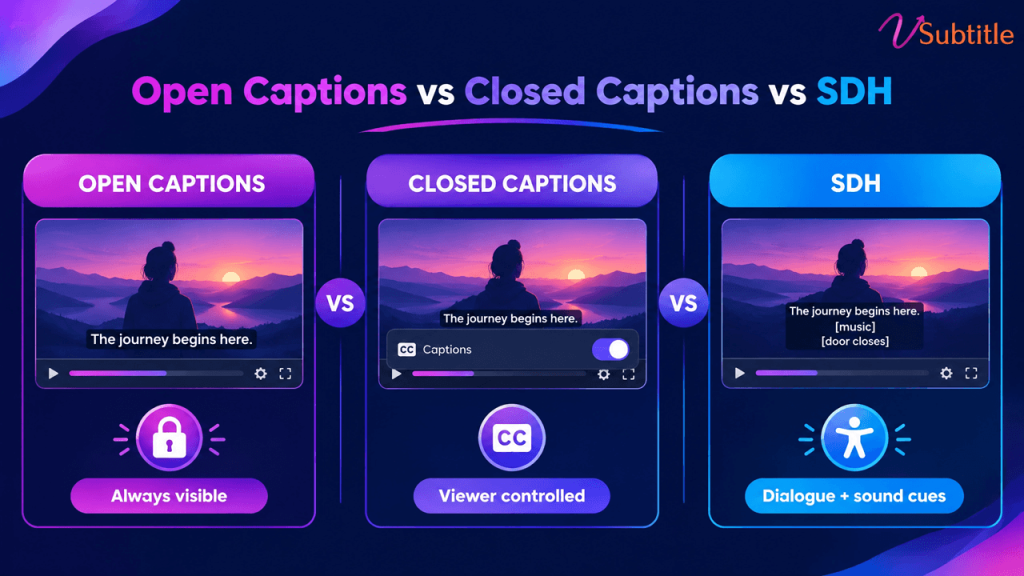
Open Captions vs Closed Captions vs SDH
Open a streaming menu and you’ll see “English,” “English [CC],” and “English SDH” listed like three flavors of the same thing. They’re not — and mixing them up in a delivery brief is one of the more expensive mistakes in video production. “Captions,” “subtitles,” and “SDH” get used interchangeably in everyday conversation, but they describe genuinely different things — different content, different technical delivery, and in many cases, different legal requirements. The confusion isn’t just semantic. Deliver translated subtitles when a broadcaster specifically asked for closed captions, and the file gets rejected, because it’s missing the non-speech audio information a deaf viewer actually needs. Caption use overall has grown enormously in recent years — by some measures over 500% since 2021 — which means more teams than ever are producing these files without necessarily knowing which one they’re supposed to be making. This guide breaks the three terms apart cleanly: what each one actually contains, how each is technically delivered, when each is legally required, and how to decide which one a given piece of content actually needs. Two Separate Questions Hiding Inside These Labels Most of the confusion clears up once it’s clear that “open vs. closed” and “captions vs. subtitles vs. SDH” are actually answering two different questions: These two questions are independent of each other. A file can be closed (toggleable) and contain subtitle-only content, or closed and contain full caption-level detail, or — as with SDH — be delivered as a subtitle-style file that actually carries caption-level content. Keeping the two questions separate is the single fastest way to stop the terms from blurring together. Open Captions Open captions are burned permanently into the video image itself. There’s no separate track and no toggle — the text is part of the picture, indistinguishable from the rest of the frame to the video player. Whoever watches the video sees the captions; there’s no way to turn them off. This is the format used almost universally across TikTok, Reels, and YouTube Shorts content, precisely because it guarantees the text shows up regardless of device, app, or whether a viewer even knows captions exist as a feature to enable. For a format built around muted, scroll-past viewing, that guarantee is the entire point — a viewer who scrolls past with the sound off sees the text immediately, with zero extra steps. Open captions are also gaining ground beyond social video specifically: several US states and cities have passed legislation requiring movie theaters to offer a set number of open-caption screenings, reflecting a push to make accessibility the default experience in at least some showings rather than something that requires a special device. For creators producing vertical social content where open captions are standard, our Instagram Reel caption generator is built specifically around this burned-in format and the safe-zone placement it requires. Closed Captions (CC) Closed captions are stored as a separate track from the video and decoded on request — the viewer can toggle them on or off, and they’re delivered as caption data rather than baked into the video image. Content-wise, closed captions are built for viewers who can’t hear the audio at all: they include not just dialogue, but speaker identification, sound effects, and music cues — everything a hearing viewer would otherwise pick up from the audio track itself. Closed captions carry real legal weight in the US specifically. The 21st Century Communications and Video Accessibility Act (CVAA) requires that video previously aired on television include closed captions when distributed online, following broadcast technical standards like CEA-608 or CEA-708, enforced by the FCC. This is distinct from WCAG-driven web accessibility requirements, which apply more broadly to any prerecorded video with synchronized audio, regardless of broadcast history. SDH: Subtitles for the Deaf and Hard of Hearing SDH is where the content question and the delivery question intersect in a way that trips people up the most. SDH delivers caption-level content — dialogue, sound effects, speaker labels — inside a subtitle-style file format, rather than through a broadcast-style closed-caption track. It was created specifically to bridge a gap traditional subtitles couldn’t fill: subtitles assume the viewer can hear everything except the dialogue, while SDH assumes the viewer can’t hear any of it, but still gets delivered in the more flexible, easily portable subtitle file format. This is why streaming platforms overwhelmingly use SDH rather than traditional broadcast-style closed captions: subtitle files travel far more easily across different streaming apps and devices than a broadcast CC signal does, and SDH — unlike traditional closed captions — can also be translated into other languages while retaining its full caption-level content. On a service like Netflix, what’s often labeled “English [CC]” in the menu is, technically, SDH. For a deeper look at why this distinction matters for genuine accessibility — not just technical compliance — our guide to making video content deaf-friendly covers what separates a merely-present caption track from one that actually serves a deaf or hard-of-hearing viewer well. Side-by-Side Comparison Factor Open Captions Closed Captions (CC) SDH Can the viewer turn it off? No — burned into the video Yes — separate toggleable track Yes — separate toggleable track Content included Varies by use — often dialogue only Dialogue, speaker IDs, sound effects Dialogue, speaker IDs, sound effects Can it be translated? Rarely, without a new burned-in version Not typically Yes — a key advantage over traditional CC Common file formats Burned-in MP4 (no separate file) SCC, CEA-608/708 TTML, SRT, VTT (subtitle-style formats) Typical use case Social video (TikTok, Reels, Shorts), some theater screenings US broadcast and previously-aired content distributed online Streaming platforms (Netflix, Amazon Prime Video, and similar) Governed by Platform norms, some local theater legislation CVAA / FCC (for prior-broadcast content) Platform-specific delivery specs; WCAG-aligned Which One Do You Actually Need? The right choice depends on the platform, the audience, and — increasingly — the specific legal framework the content falls under, rather than a single universal answer: For a fuller walkthrough of how these accessibility