

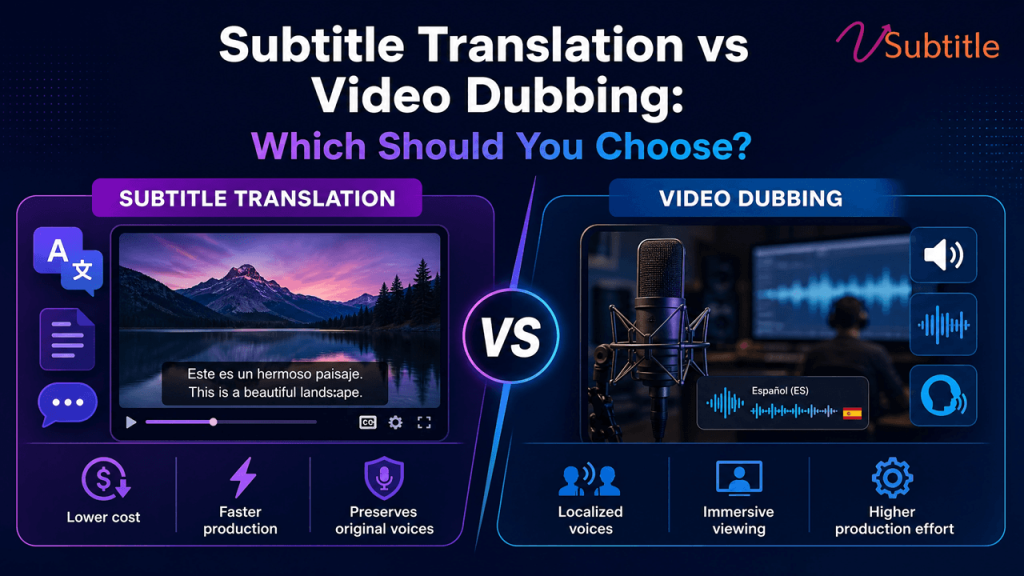
Subtitle Translation vs Video Dubbing: Which Should You Choose?
If you’re taking video content to a global audience, you’ll eventually hit the same fork in the road: subtitle translation or dubbing? Both methods break the language barrier, but they do it in very different ways — and the right choice depends on your budget, timeline, content type, and audience. This guide walks through how each method works, where each one shines, and how to decide which fits your next project. What Is Subtitle Translation? Subtitle translation takes the original spoken dialogue in a video, translates it into a target language, and displays it as timed on-screen text — while the original audio track stays untouched. Viewers hear the source language and read the translation, usually as SRT or VTT subtitle files layered onto the video. Because the process is text-based, it’s generally faster and less expensive than dubbing. It also produces a machine-readable file that search engines and platforms like YouTube can crawl, which gives translated content an SEO advantage that dubbed-only audio doesn’t have on its own. What Is Video Dubbing? Dubbing replaces the original audio track entirely with a new voice recording in the target language. It’s a more involved production process: the script is translated and adapted, voice actors are cast, dialogue is recorded in a studio, and the new audio is mixed and synced to match lip movements and on-screen timing as closely as possible. The payoff is an immersive, “native-feeling” viewing experience — the audience never has to read anything, and for many entertainment formats (especially content aimed at children or casual viewers), that translates directly into higher watch time and completion rates. Subtitle Translation vs. Video Dubbing: At a Glance Factor Subtitle Translation Video Dubbing Original audio Preserved Replaced Typical cost Lower Higher (voice talent, studio time) Turnaround time Faster Slower (casting, recording, mixing) Viewer effort Requires reading Passive listening Accessibility (deaf/HoH) Yes, directly No, needs separate captions SEO / indexing benefit Strong (crawlable text) Indirect (needs its own subtitle file) Best for Tutorials, corporate video, social/short-form, budget-conscious projects Entertainment, kids’ content, film, high-immersion storytelling Pros and Cons of Subtitle Translation Pros and Cons of Video Dubbing Cost, Turnaround Time, and Team Requirements Subtitle translation typically involves a translator (or an AI-assisted workflow with human review) and a time-coder — sometimes the same person. Turnaround for a single video can range from a few hours to a couple of days depending on length and language pair. Dubbing requires considerably more coordination: script adaptation, voice casting, a recording studio, sound engineers for mixing, and a quality-control pass to check sync accuracy. For longer-form content — films, TV series, multi-episode courses — this adds up in both cost and calendar time. If dubbing is the right call for your project, working with an established localization studio rather than assembling the pipeline yourself usually saves both money and headaches. Audience Preferences: Who Prefers What Preferences vary a lot by region and content type. Countries such as the Netherlands, Sweden, and much of the Nordic region lean strongly toward subtitles, while Germany, Japan, Italy, France, and Spain have historically favored dubbing, especially for film and TV. Documentary and art-house audiences tend to prefer subtitles to preserve the original performance, while mass-market entertainment and children’s programming skew toward dubbing. For online video specifically — tutorials, product demos, corporate training, YouTube content — subtitles (and translated subtitles) are usually the default, both because of cost and because they’re easier to update when content changes. Which Should You Choose? A quick way to think about it: match the method to the content and the audience, not the other way around. Can You Use Both? Yes — and for larger projects, it’s often the smartest approach. Offering a dubbed audio track alongside translated subtitles (or captions in the dub language) covers accessibility requirements, caters to viewer preference, and maximizes searchability, since the subtitle file still gives search engines text to index even when most viewers are listening to the dub. How vSubtitle Helps With Subtitle Translation If subtitle translation is the right fit for your project, vSubtitle generates accurate, properly timed subtitle files and can translate them into multiple languages, so you get search-ready SRT/VTT output without manually re-timing every version. Our piece on how multilingual captions double YouTube watch time looks at the real engagement lift translated subtitles can produce for channels expanding into new language markets. If you’re weighing accuracy trade-offs, our comparison of AI vs. human captioning walks through when AI-generated subtitles are good enough and when a human review pass is worth the extra time. New to subtitling altogether? Start with our AI subtitling for beginners guide, or try the free subtitle generator comparison to find a starting workflow that fits your budget. How DUBnSUB Helps With Video Dubbing If your project calls for full dubbing instead — or alongside subtitles — that’s a different production discipline, involving voice casting, studio recording, and audio-visual sync work that goes well beyond a subtitle file. For that side of localization, DUBnSUB is a dedicated dubbing, voice-over, and subtitling agency working across 70+ languages, with native voice talent and studio partners handling everything from script adaptation to final audio mix. Their own breakdown of subtitles vs. dubbing digs deeper into the production workflow differences from a dubbing studio’s perspective — useful reading if you’re scoping a larger localization project. If you already know dubbing is the way to go, their guide to choosing the right dubbing studio covers what to evaluate — casting process, translation quality, and turnaround — before committing to a vendor. Frequently Asked Questions (FAQs) Conclusion There’s no single right answer in the subtitle translation vs. dubbing debate — the best choice depends on your content, audience, budget, and timeline. Subtitle translation is faster, cheaper, and better for search visibility; dubbing delivers a more immersive experience where budget and market preference support it. For many creators and brands, the smartest long-term strategy is starting with translated subtitles and layering in dubbing for the markets and content