

Why Multilingual Captions Double Your YouTube Watch Time (With Data)
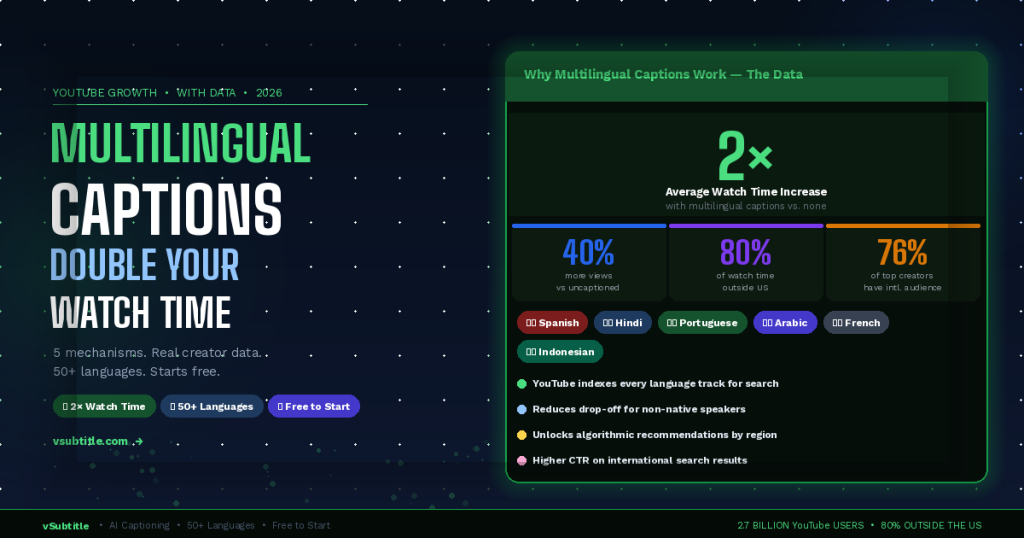
Most YouTube creators optimise endlessly — thumbnails, titles, SEO descriptions, upload schedules, hooks, chapter markers. And yet one of the single biggest levers for watch time growth is almost universally ignored: multilingual captions. The data is clear. Creators who add captions in multiple languages consistently see significant gains in watch time, subscriber growth, and international reach — often without changing a single frame of their videos. In this post, we’ll walk through the evidence, explain exactly why multilingual captions work so powerfully on YouTube, and show you the fastest way to implement them using vSubtitle. 📊 This isn’t a theoretical argument. The relationship between multilingual captions and YouTube watch time is well-documented by YouTube’s own research and supported by data from thousands of creators. Let’s look at the numbers. 1. The Data: What Multilingual Captions Actually Do to Watch Time Let’s start with the headline numbers before we dig into the why. 2×Average Watch Time Increase With Multilingual CaptionsCreators who add captions in the top languages of their audience regularly report watch time doubling — with some seeing 3–4× increases on individual videos. 40%More views on captioned videos vs. uncaptioned 80%Of YouTube watch time comes from outside the US 76%Of top YouTube creators have non-English-speaking audiences YouTube’s own Creator Academy notes that videos with captions receive significantly more views and engagement than those without. But when you go beyond single-language captions and add subtitles in the languages your international audience actually speaks, the effect compounds dramatically. Here’s why the numbers are so significant: YouTube is not primarily an English-language platform. Despite English being the most common language for content creation, the majority of YouTube’s 2.7 billion users do not speak English as their first language. Spanish, Hindi, Portuguese, Arabic, Indonesian, and French together account for hundreds of millions of active YouTube viewers — viewers who are actively searching for content in their own language, or content that has been made accessible to them. 🔑 Key insight: When you add multilingual captions, you’re not just helping existing viewers watch more of your video. You’re making your video discoverable to entire new audiences who would never have found it otherwise. 2. Why Multilingual Captions Increase Watch Time: 5 Mechanisms The watch time boost from multilingual captions isn’t a coincidence or a quirk of the algorithm. There are five distinct mechanisms driving it: Mechanism 1: YouTube Indexes Caption Text for Search When you upload a caption file (SRT or VTT) to a YouTube video, YouTube indexes every word in that file. This means your video can rank in search results for keywords that appear in your captions — even if those words never appear in your title, description, or tags. Add multilingual captions and this effect multiplies across languages. A Spanish-language caption file means your video can surface in Spanish-language YouTube searches. A Hindi caption file means Hindi speakers searching for your topic can find your video. You effectively multiply the number of search queries your video is eligible to rank for — often by 5× to 10× depending on how many languages you add. Mechanism 2: Reduced Drop-Off for Non-Native Speakers Non-native English speakers watching English-language content often struggle to keep up with fast speech, accents, idioms, and colloquialisms. Without captions, many of these viewers drop off early — reducing your average view duration and signalling to YouTube’s algorithm that your content isn’t holding attention. Add captions in their language and the drop-off disappears. Viewers who would previously leave at the 30-second mark now watch to completion. This directly increases your average view duration — one of YouTube’s strongest ranking signals — which in turn drives more impressions and more organic reach. Mechanism 3: Algorithmic Recommendations Across Regions YouTube’s recommendation algorithm factors in viewer location and language preference when deciding which videos to suggest. A video with English-only captions is primarily recommended to English-speaking regions. A video with Spanish, Hindi, and Portuguese captions alongside English becomes eligible for recommendation in Spain, Mexico, Brazil, India, and dozens of other markets. This is how multilingual captions create compounding growth. Every new language you add opens up a new recommendation pool — and each recommendation that leads to a watched video sends positive engagement signals back to the algorithm. Mechanism 4: Higher Click-Through Rates on International Searches When a Spanish speaker searches YouTube and sees a video with a Spanish caption track available, they are significantly more likely to click on it than a video with no captions or English-only captions. The availability of native-language subtitles is a strong selection signal for international audiences, particularly in markets where English proficiency is lower. Mechanism 5: Community Sharing and Cross-Language Virality Content that is accessible in a viewer’s language is far more likely to be shared within their community. A viewer who watches your video with Spanish captions is more likely to share it with Spanish-speaking friends and family — creating a viral loop within that language community. Without multilingual captions, this organic sharing across language groups simply doesn’t happen. ⚡ All five of these mechanisms are cumulative. Adding multilingual captions doesn’t just improve one metric — it improves search ranking, watch time, recommendations, CTR, and shareability simultaneously. 3. Which Languages Should You Add First? You don’t need to caption your videos in 50 languages to see results. Adding even 2–3 high-priority languages can produce a significant and measurable impact. Here’s how to prioritise: Step 1: Check Your YouTube Analytics Go to YouTube Studio → Analytics → Audience → Geography. This shows you exactly where your existing viewers are coming from. If you already have significant viewership from Brazil, Spain, or India without multilingual captions, adding Portuguese, Spanish, or Hindi will have an immediate impact on those audiences. Step 2: Target the Highest-Volume Non-English Languages If you’re starting from scratch with no international audience data, prioritise the languages with the largest YouTube user bases after English: Language YouTube User Base & Why It Matters Spanish 500M+ speakers globally. Largest non-English YouTube audience. Covers Spain, Mexico, Colombia,