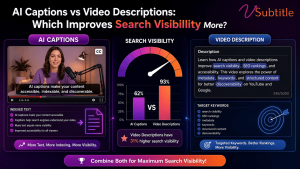
Both show up in the SEO checklist. They don’t do the same job — and search engines don’t treat them the same way.
Ask ten video creators what actually moves the needle for search visibility, and most will mention two things: writing a solid description and turning on captions. Both are standard advice. Both appear near the top of every video SEO checklist. And both get treated, more often than not, as roughly interchangeable line items — two boxes to tick before hitting publish.
They aren’t interchangeable, and the difference matters more in 2026 than it used to. A video description is a few hundred words you write about your video. An AI-generated caption file is a complete, word-for-word transcript of everything actually said in it — often ten times the length, and built from the video’s real content rather than a summary of it. When search engines and AI answer engines decide what a video is about and whether to surface it, these two text sources carry very different weight. This article compares them directly: what each one does, what the data says about their impact, and how to use both together instead of picking one over the other.
What Each One Actually Is
Video Descriptions
A video description is manually written summary text that sits below the video on YouTube or alongside the embed on a website. It typically includes a short overview of the video, relevant keywords, links, timestamps or chapter markers, and calls to action. Best-practice guidance generally recommends at least 250 words, with important keywords placed in the first 25 words, since that opening segment is what displays before a viewer clicks “show more.”
Descriptions are written for two audiences at once: the human scanning before they click play, and the search engine trying to categorize the video before it’s indexed. That dual purpose is also their limitation — a description can only say what the creator chooses to write, in the length the creator is willing to write it.
AI Captions and Transcripts
An AI caption file is generated directly from the audio of the video itself, using automatic speech recognition to convert every spoken word into timestamped text. The output is a caption track (SRT or VTT) that can be displayed on screen, and — critically for search — the same underlying text can be published as a full transcript on the page. Unlike a description, a transcript isn’t a summary written after the fact; it’s the complete, unfiltered content of the video, often running several thousand words for a video that’s just a few minutes long.
That length and completeness is exactly what separates the two as SEO assets. A description tells a search engine what you say your video is about. A transcript shows it.
Head-to-Head: What Each Format Contributes
| Factor | Video Description | AI Captions / Transcript |
|---|---|---|
| Typical length | 150–300 words, creator-written | 500–3,000+ words, generated from actual spoken content |
| Source of content | Creator’s summary and framing | Verbatim record of what’s actually said |
| Keyword coverage | Limited to what the creator thinks to include | Naturally covers every term, phrase, and variation actually spoken |
| Effect on accessibility | None directly | Required for deaf/hard-of-hearing viewers and legal compliance in many regions |
| Effect on watch time / engagement | Indirect, via clearer expectations before clicking | Captions increase view completion and comprehension, especially for muted viewing |
| Usefulness to AI answer engines | Provides context and framing, but limited depth | Primary source AI systems read to understand and cite spoken content |
| Effort required | A few minutes of writing per video | Automated generation, plus review time for accuracy |
| Risk if skipped | Video is harder to categorize and may underperform in click-through | Video becomes largely unreadable to search crawlers and AI systems |
Why Transcripts Carry More Search Weight
Search engines cannot watch a video and understand what’s said inside it — they can only read text. A description gives them a small, curated sample of text written after the video exists. A transcript gives them the entire spoken content of the video, in the creator’s actual words, at whatever length the content naturally runs. For a search engine trying to match a video to a specific, long-tail query, that difference in raw text volume and specificity is significant: a five-minute video might yield a 250-word description but a 700-900 word transcript, and every one of those extra words is a potential match point for a search query the description never anticipated.
This gap is why transcripts are frequently described as doing “double duty.” Closed captions serve the accessibility and engagement side — they widen the audience and keep muted viewers watching. But the transcript version of that same text is what hands search engines and AI systems the full content of the video, letting it be understood and indexed for far more than its title and description alone could cover.
The gap widens further with AI answer engines. When ChatGPT, Perplexity, or Google’s AI Overviews evaluate a video for citation, they’re generally working from whatever transcript or caption data is attached to it. A well-written description helps them understand framing and intent; a transcript is what lets them quote a specific claim, cite a specific statistic, or answer a question your video actually addresses in detail. Research tracking YouTube visibility inside AI Overviews found that brand mentions in video titles and transcripts were the strongest single correlating signal measured — a result descriptions alone, however well written, can’t replicate at that scale.
Where Descriptions Still Do Real Work
None of this makes descriptions optional. They do things a transcript can’t:
- Framing and intent: A description tells a search engine (and a human) what the video is for, not just what’s said in it — useful when the same topic could be interpreted several different ways.
- Click-through rate: The first line or two of a description often appears in search results and video previews, directly influencing whether someone clicks. A transcript dump isn’t built for that job.
- Links and calls to action: Descriptions are the natural home for links to related content, products, or resources — content transcripts don’t include and shouldn’t be cluttered with.
- Editorial control: A creator can highlight the single most important point of a video in a description’s first sentence. A transcript treats every sentence with equal weight until it’s manually structured.
- Timestamps and chapters: Well-labeled chapters in a description improve navigation and have been shown to help videos qualify for timestamp-based rich results and suggested clips.
In short, descriptions are a precision tool for framing and clicks. Transcripts are a volume tool for comprehension and depth. Neither substitutes for the other.
The Real Answer: They Compound, They Don’t Compete
Treating this as a choice between captions and descriptions misreads how search engines actually evaluate a video page. Guidance across current video SEO research points the same direction: titles, descriptions, and captions each tell search engines and AI systems something different, and together they form the full “language” a system uses to understand, categorize, and potentially cite a video. Structured data like VideoObject schema adds a fourth, explicit layer on top of both. Skipping any one of them doesn’t just lose that layer’s contribution — it can weaken how confidently a search engine interprets the other two.
A practical way to think about it: the description is the pitch, the transcript is the proof. A search engine (or a human) reads the pitch to decide whether the video is relevant. It reads the transcript to confirm the pitch is accurate and to find the specific detail buried three minutes in that a viewer is actually searching for. Videos that provide only one or the other are working with half the available signal.
A Practical Workflow for Using Both
- Write a description of 250+ words with your primary keyword in the first 25 words, a clear one-sentence summary of what the video covers, and relevant links or timestamps below it.
- Generate an AI transcript from the video’s actual audio, then review it for accuracy — names, statistics, and niche terminology are the most common places auto-generated text gets it wrong.
- Publish the caption file (SRT/VTT) with the video for accessibility and engagement, and publish a readable version of the same transcript as text on the page for search and AI crawlers to read directly.
- Add VideoObject schema referencing both the description and the transcript, so the relationship between them is explicit rather than inferred.
- Keep the two aligned: if the description promises a topic, make sure the transcript actually delivers it — search engines increasingly check spoken content against stated metadata, and a mismatch undercuts both.
Does the Balance Shift by Platform?
The relative weight of descriptions versus transcripts isn’t identical everywhere a video lives.
YouTube
YouTube’s own search and recommendation system leans heavily on engagement data — watch time, click-through rate, and session behavior — alongside metadata. A sharp, well-written description directly influences the click-through half of that equation, while captions influence watch time by keeping muted or non-native-speaking viewers engaged longer. On YouTube specifically, the two feed different halves of the same ranking system rather than competing for the same signal.
Video Embedded on Your Own Website
Off YouTube, the calculus shifts further toward transcripts. A self-hosted or embedded video lives inside a normal webpage, and Google’s understanding of that page depends heavily on the crawlable text surrounding the video — the transcript chief among it. A short description next to an embed gives a search engine some context, but it’s the transcript, structured data, and surrounding page copy that determine whether Google treats the page as a strong, indexable answer to a specific query.
AI Answer Engines
Across ChatGPT, Perplexity, and Google’s AI Overviews, the pattern is the most one-sided: these systems are built to extract and cite specific claims, and a transcript is what makes a specific claim extractable. A description can earn a video visibility in the first place, but it’s rarely detailed enough to be the actual source of a quoted answer. For creators specifically chasing AI citations, the transcript is doing most of the work once the video has been discovered at all.
How to Tell Which Is Actually Moving Your Numbers
Because descriptions and transcripts influence different parts of the funnel, they should be measured differently rather than judged by a single shared metric:
- For descriptions, track click-through rate from search and suggested results, and watch for changes after rewriting the opening line or keyword placement.
- For transcripts, track impressions and rankings for long-tail queries that match phrases spoken in the video but never written in the description — a rise there is a clear sign the transcript is being indexed and matched.
- For AI visibility specifically, periodically test whether ChatGPT, Perplexity, or Google’s AI Overview surface or cite the video or page when asked a question the video directly answers, and note whether the cited detail traces back to the description or the transcript.
Run both changes separately where possible — publish a transcript update in one cycle and a description rewrite in the next — rather than changing both at once, since that’s the only reliable way to see which lever actually produced the movement.
Common Mistakes to Avoid
- Writing a strong description and skipping captions entirely, leaving the video’s actual content invisible to text-based crawlers.
- Turning on auto-captions but never publishing a transcript version anywhere search engines can crawl it directly.
- Copy-pasting the description as the only on-page text and assuming that covers what a transcript would.
- Publishing unedited auto-captions full of errors, which corrupts the exact text search engines and AI systems will read and potentially cite.
- Writing a thin, keyword-stuffed description with no real framing, on the assumption that the transcript alone will carry the video.
Getting Both Without Doubling the Work
The best-performing video pages aren’t choosing between a good description and a good transcript — they’re producing both without treating it as two separate jobs. vSubtitle’s AI subtitle generator handles the transcript side automatically: accurate, editable captions and full transcripts in 100+ languages, generated directly from a video’s audio and ready to review before publishing. Exports cover SRT, VTT, TXT, and DFXP, so the same source video can produce a clean caption track for viewers and a crawlable transcript for the page — leaving creators free to spend their writing time where it matters most: a sharp, well-framed description that earns the click in the first place.
Key Takeaways
- Descriptions are short, creator-written framing text. Transcripts are the complete, verbatim content of the video — often ten times the length.
- Search engines and AI systems can’t read a video’s audio directly; transcripts are the primary way they access what’s actually said.
- Brand mentions in video transcripts correlate more strongly with AI Overview visibility than most other measured signals.
- Descriptions still matter for click-through, framing, links, and chapters — none of which a raw transcript handles well on its own.
- The two aren’t competitors. A video with only a strong description or only a transcript is working with half the signal a search engine can use.
- Keep descriptions and transcripts aligned — search systems increasingly cross-check what a video claims against what it actually says.
The question isn’t which one to prioritize — it’s whether both are present, accurate, and pointed at the same story. Get that right, and a video stops relying on a single text signal to be found and starts giving search engines and AI systems every reasonable reason to surface it.
Frequently Asked Questions
Do I need both captions and a description, or is one enough?
Both. They serve different purposes — the description frames the video and drives click-through, while the transcript gives search engines and AI systems the complete spoken content to index and potentially cite. Skipping either one leaves a real gap in how well the video can be found.
Which one has a bigger impact on ranking: captions or descriptions?
Transcripts generally carry more weight for search and AI visibility because they provide far more text, drawn directly from what’s actually said, rather than a creator’s summary. Research on AI Overview visibility has found transcript mentions to be one of the strongest correlating signals measured. Descriptions still matter, particularly for click-through rate and framing.
Can AI-generated captions replace a well-written description?
No. A transcript is comprehensive but unstructured — it wasn’t written to summarize or sell the video the way a description is. A strong description still does the job of setting expectations and improving the click, which a raw transcript isn’t built for.
How long should a video description be for SEO?
General guidance suggests at least 250 words, with the primary keyword or topic stated within the first 25 words, since that opening segment is what displays before a viewer expands the full description.
Do auto-generated captions need to be reviewed before publishing?
Yes. Auto-generated captions can misinterpret names, statistics, and niche terminology, and those errors become part of the text search engines and AI systems index. Reviewing captions for accuracy — especially around anything specific to your topic — protects the quality of that signal.
Do AI answer engines like ChatGPT use video descriptions or transcripts to cite content?
Primarily transcripts. When AI systems reference a video, they’re generally working from caption or transcript data rather than a short description, since the transcript is what lets them quote a specific detail or answer a specific question the video addresses.
Should the transcript be published as visible text on the page, not just as a caption file?
Yes, where possible. A caption file attached to the video player primarily serves viewers. A separate, visible transcript published as text on the page gives search engines and AI crawlers a more direct, reliable path to the same content.