
vSubtitle

New Here? Get Your First 30 Minutes FREE - Limited Time Only!

Video Marketing

mute-generation-gen-z-watch-video-without-sound
Video Marketing, Content Strategy, Social Media Trends

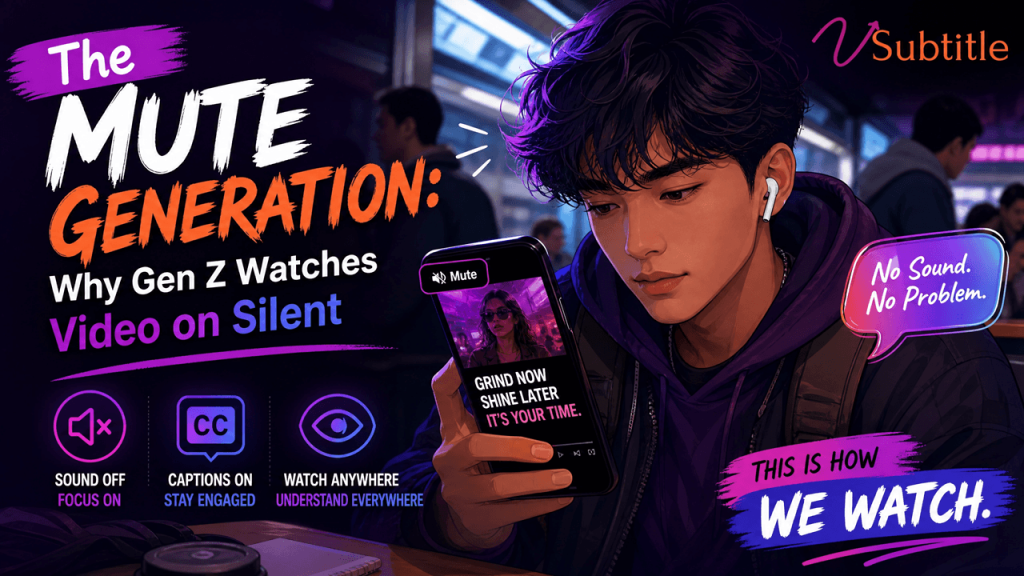
The “Mute” Generation: Why 90% of Gen Z Watches Video Without Sound

Open TikTok or Instagram right now, in almost any public place, and you’ll see the same thing: someone scrolling through videos with their phone speaker off and their earbuds nowhere in sight. This isn’t a fluke or a phase. Multiple industry studies now peg silent video consumption at somewhere between 75% and 92% of all mobile video views, and Gen Z sits at the top of that curve. For a generation that grew up with video as its native language, the sound has quietly become optional. This shift has enormous implications for anyone making video content — brands, creators, educators, and marketers alike. If the majority of your audience never hears a single word of your video, then everything you thought you knew about “good” video — a punchy voiceover, dramatic music, witty dialogue — needs to be rethought from the ground up. Welcome to the age of the Mute Generation. Just How Big Is the Mute Trend? The numbers vary slightly depending on the study, but the direction is unmistakable. Research from Sharethrough and other mobile-ad analytics firms has repeatedly found that the vast majority of people keep their phones on silent by default, and that this habit carries directly into video viewing. Multiple more recent industry reports put silent viewing on social platforms at around 85%, with Gen Z and younger Millennials skewing even higher than older cohorts. What makes this more than a passing statistic is what sits behind it: captions. Surveys of TV and streaming habits show that a majority of viewers across all age groups now watch with subtitles turned on regardless of whether the sound is playing, and that habit is strongest among the youngest viewers. In other words, Gen Z isn’t just tolerating silence — they’re actively building a caption-first way of consuming media, on everything from Netflix to a 15-second Reel. Why Did This Happen? Five Real Reasons 1. Scrolling Is a Public, Social Act Gen Z consumes video everywhere: in class, on the bus, in the school cafeteria, in bed next to a sleeping sibling. Sound is often simply unavailable or inappropriate. Muted-by-default is the path of least friction, and platforms have built around that reality rather than against it. 2. Platforms Trained Them to Expect Silence Autoplay feeds on Instagram, TikTok, and Facebook have defaulted to muted playback for years. An entire generation’s first hundred thousand video impressions arrived without sound, which means silent viewing isn’t a workaround for Gen Z — it’s the baseline experience they were raised on. 3. Captions Are Faster to Process Mid-Scroll Reading text on screen lets a viewer decide in under two seconds whether a video is worth their attention, without waiting for a sentence to be spoken aloud. In a feed built for rapid judgment, on-screen text simply outperforms audio for grabbing and holding attention. 4. Multitasking Is the Default State Gen Z rarely watches one thing at a time. A video plays in one tab while a group chat, a homework assignment, and a second app compete for attention. Sound is often the first sense sacrificed to keep the peace across all those open windows. 5. Captions Widened Who Gets to Watch Growing awareness of accessibility, combined with a genuine appetite for inclusive design, has normalized captions as a default rather than an accommodation. Many young viewers now say they simply prefer reading along, whether or not they need to. What This Means for Creators and Brands If nine out of ten viewers may never hear your audio, a video that depends entirely on narration or dialogue to land its message is quietly failing most of its audience before it even gets watched to the end. A handful of practical shifts follow directly from that reality. This is exactly why accurate, well-timed subtitles have gone from a nice-to-have to a non-negotiable part of the video production workflow. A caption file that’s poorly timed, riddled with errors, or missing entirely doesn’t just hurt accessibility — it directly costs watch time, comprehension, and conversions, because it’s speaking to the 85-90% of the audience that’s actually there. The Business Case: Captions Aren’t Optional Anymore Marketers who’ve adapted to silent viewing are seeing the payoff. Ad agencies and platforms studying feed behavior have found that captioned, visually self-sufficient content holds attention longer and communicates more clearly than audio-dependent creative, precisely because it meets viewers where they actually are: scrolling, in public, with the sound off. Brands that keep shipping dialogue-heavy, caption-free videos are effectively advertising to an empty room. For creators, the lesson is similar. A tutorial, a story-time video, or a product demo that relies on narration alone is invisible to most of the feed. Add clean, accurately synced captions, and that same video suddenly works in a lecture hall, a waiting room, or a late-night scroll session under the covers — all the places Gen Z is actually watching. Myths About Silent Viewing, Debunked “They’ll turn the sound on if the content is good enough” This is the single most expensive assumption in video marketing today. Viewers don’t weigh up whether a video deserves audio — they simply skip it if it doesn’t communicate instantly on mute. The bar isn’t quality, it’s speed of comprehension. A brilliant script that only reveals itself through narration never gets the chance to prove it’s brilliant. “Captions are only for accessibility” Captions absolutely matter for viewers who are Deaf or hard of hearing, and that alone would justify using them. But the data shows something broader: most hearing viewers are choosing captions too, because reading is often just a faster, more convenient way to consume a feed. Treating captions purely as a compliance checkbox undersells what they actually do for reach and watch time. “This is just a TikTok thing” Muted-first viewing habits have spread well beyond short-form apps. Gen Z carries the same expectations into YouTube, LinkedIn, streaming platforms, and even paid ad placements. A video built assuming sound-on viewing is increasingly the exception across the
Subtitles Increase Time on Page & Boost SEO Rankings
SEO, Video Marketing

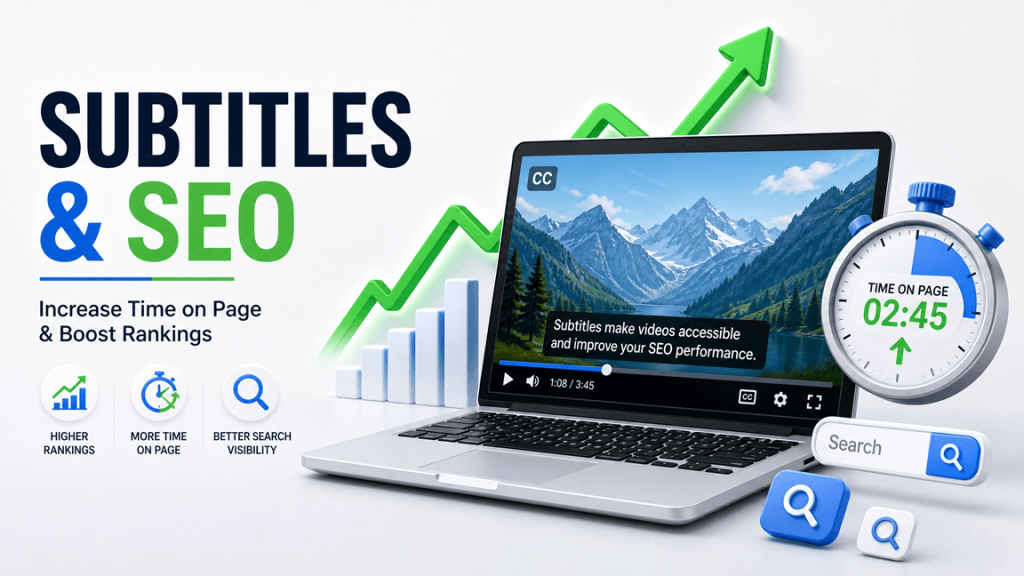
How Subtitles Increase “Time on Page” and Boost Your Website’s SEO Rankings

If you’ve embedded video on your website, you already know the engagement math: video keeps people on the page longer than text alone — if they actually watch it. The problem is, most visitors don’t turn the sound on. And when they can’t follow what’s happening in the first three seconds, they leave. Subtitles fix that gap. They turn a video most people would scroll past into content they can follow on mute, in a noisy office, or on a train with one earbud in. The result shows up in one of the metrics search engines quietly pay attention to: how long a visitor actually stays on your page. Here’s how subtitles move that number, why it matters for your rankings, and exactly how to add them to your site without slowing down your workflow. What “Time on Page” Actually Means (and Why Google Cares) “Time on page” is simply how long a visitor spends on a URL before leaving — whether they navigate away, close the tab, or hit the back button. It’s closely related to dwell time, which specifically measures how long someone stays before returning to the search results they came from. Google has never officially confirmed dwell time as a direct ranking factor, and its engineers have repeatedly said the algorithm doesn’t plug raw analytics numbers straight into rankings. But a 2024 leak of internal Google API documentation showed that Google tracks something very close to it internally — a “long click,” meaning a visitor who clicks a result and doesn’t rush back to the search page. That’s a strong signal that the page satisfied the search intent. In practice, here’s the chain that matters for your SEO strategy: So while you shouldn’t treat time on page as a magic lever you can pull in isolation, it’s a real proxy for genuine engagement — and engagement is exactly what modern search algorithms are built to detect. That makes it worth optimizing for its own sake, not just as an SEO trick. The catch: the average visitor doesn’t give you much time to prove your page is worth staying on. Some engagement studies put the number of visitors who leave within 15 seconds above 50%. Video is one of the few content formats that can change that curve — but only if people can actually follow it. The Silent-Scrolling Problem: Why Video Without Subtitles Loses Visitors Fast Most websites still publish video the way they would have in 2015: autoplay on, sound off by default, and no captions. That’s a mismatch with how people actually browse today. Multiple independent studies converge on the same range: somewhere between 75% and 92% of video views on mobile happen with the sound off. People are in open offices, in waiting rooms, on public transport, or simply scrolling out of habit with the phone muted. Browsers and platforms reinforce this by autoplaying video on mute as the default behavior. If your embedded video depends on audio to make its point, a large majority of your visitors are getting nothing from it. They watch a few silent seconds, get no payoff, and leave — taking your time-on-page number down with them. Subtitles close that gap immediately. A visitor on mute can still follow the narrative, understand the product demo, or catch the key takeaway from your explainer video — which means they have a reason to keep watching instead of clicking away. How Subtitles Directly Increase Time on Page Subtitles don’t just make video accessible — they change viewing behavior in ways that map directly onto the metric you’re trying to improve. They raise completion rates. Several independent studies on caption performance report that viewers are substantially more likely to watch a video through to the end when captions are present, compared with the same video left uncaptioned. A longer watch means a longer session on the page hosting that video. They increase average watch time. Internal platform data (Facebook’s engagement research is the most cited example) has shown double-digit increases in average view duration once captions are added — and case studies from individual brands have reported even larger gains. More time watching is, almost by definition, more time on the page. They reduce comprehension friction. Viewers reading along while listening (or just reading) retain more of what they see. When people understand a video easily, they don’t bail out of confusion or rewatch sections out of frustration — they keep moving forward, which keeps the session alive. They give the eye something to anchor on. A captioned video creates a natural reading rhythm — visitors track text the same way they’d read a paragraph, which holds attention longer than a silent, static-feeling clip. They make your content usable for more people, for longer. Non-native speakers, viewers with hearing loss, and anyone in a sound-restricted environment can all engage with subtitled video. A bigger usable audience means more of your traffic actually sticks around instead of bouncing immediately. The Hidden SEO Bonus: Subtitles Turn Video Into Crawlable Text This is the part most teams miss. Search engines can’t “watch” your video — they can only read what’s around it. A subtitle file (or the transcript generated from it) gives crawlers actual text to index: your keywords, your product terminology, your topic context, all in the language your visitors search in. A well-known experiment from Discovery Digital Networks tested this directly. They added a phrase to a video’s captions that appeared nowhere else — not in the title, description, or tags — and that video still surfaced for searches on that exact phrase. The captions alone made it discoverable. This compounds a few ways on your own website: In short: subtitles aren’t just an accessibility add-on. They’re one of the only ways to make video content’s substance machine-readable. What the Data Says, at a Glance Pulling from caption-performance research across platforms and brands: No single number here is a guarantee — engagement studies vary by platform, audience, and content type. But

Scroll to Top