vSubtitle

New Here? Get Your First 30 Minutes FREE - Limited Time Only!

Social Media

linkedin-video-captions-why-b2b-videos-need-them
B2B Marketing, Social Media, Video SEO

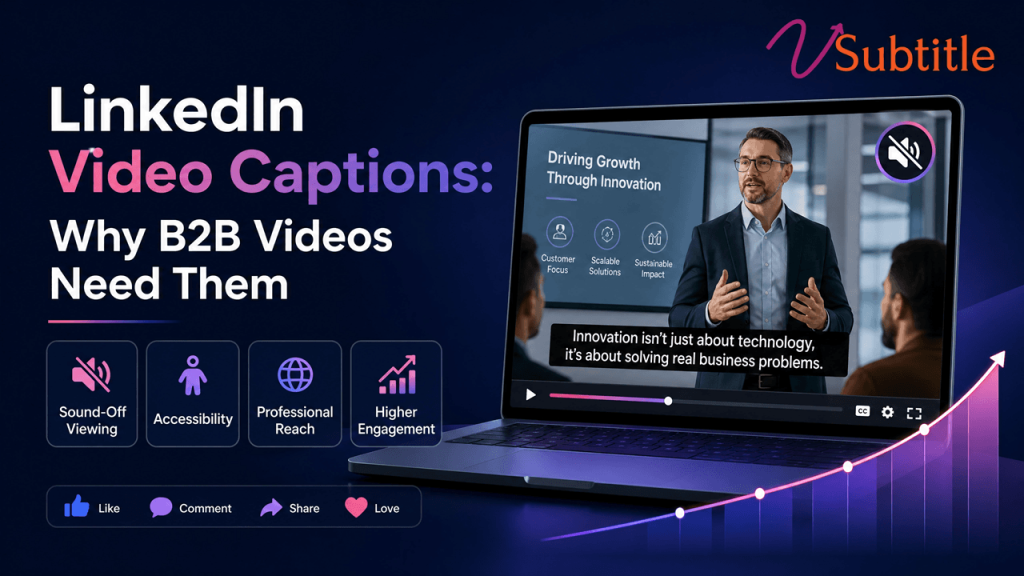
LinkedIn Video Captions: Why B2B Videos Need Them

Your buyer is watching your video between meetings, on a commute, or with a laptop muted in an open office. If it isn’t captioned, your pitch never actually reaches them. LinkedIn video has moved from a nice-to-have format to one of the platform’s fastest-growing content categories, with video uploads climbing at double-digit rates for several consecutive quarters and paid video ad spend up roughly 30% year over year. For B2B marketers specifically, that growth matters more than the equivalent shift on a consumer platform, because LinkedIn’s audience skews heavily toward exactly the buyers, decision-makers, and specialists a B2B pipeline depends on — professionals in B2B companies make up the majority of the platform’s video-viewing audience. None of that growth matters if the video isn’t actually being understood. Somewhere between 75% and 85% of LinkedIn video is watched with the sound off — a habit driven by exactly the professional contexts B2B buyers are in: an open office, a meeting room between calls, a phone scrolled quietly during a commute. A B2B video without captions isn’t reaching a smaller audience on LinkedIn specifically — it’s reaching a smaller version of the exact audience the format is supposed to be built for. This article covers what the current data shows about captions and LinkedIn video performance, and the specific ways B2B marketers are using them to turn muted scrolling into real pipeline engagement. What the Data Shows About Captions on LinkedIn Finding Why It Matters for B2B 75–85% of LinkedIn video is watched with sound off The overwhelming majority of a B2B video’s audience never hears the narration unless captions are present Captioned videos retain viewers 32% longer than non-captioned videos Directly protects watch time on content built to explain a product, case study, or point of view in detail Captioned, autoplay-enabled videos see 29% more engagement LinkedIn’s feed autoplays muted by default, making captions the first and often only content a scrolling viewer sees LinkedIn video generates 1.4x more engagement than other content formats Video is already an above-average format on LinkedIn; captions protect and extend that advantage rather than undermine it Shorter videos under 15 seconds see 57% completion rates Reinforces that B2B hooks need to land fast and land as readable text, not just narration 61% of LinkedIn’s video-viewing audience works in B2B companies, with marketing, sales, and tech professionals making up 47% of all interactions This is precisely the audience segment most B2B content is trying to reach — losing them to a muted scroll has an outsized cost LinkedIn’s own Creative Labs research, based on an analysis of more than 13,000 B2B video ads and over 550,000 video frames, points the same direction: face-to-camera, vertical-friendly formats paired with captions consistently align with stronger creative performance, reflecting a broader shift in what works on the platform — a mix of LinkedIn’s traditional “professional utility” content (explainers, expert takes, proof points) with the shorter, faster-paced, caption-driven norms of feed-based social video more broadly. Why B2B Video Needs Captions More Than Most Content This connects to a broader pattern worth understanding across any embedded video content: our guide to AI subtitles and video SEO covers how the same captioning discipline that protects watch time on LinkedIn also extends a video’s discoverability wherever else it’s published or embedded. Caption Strategies That Work Specifically for LinkedIn B2B Video 1. Write the Opening Line to Work as Text Alone Since feed autoplay starts muted, the first caption a viewer sees functions as the actual hook — not a supporting element beneath a spoken hook they haven’t heard yet. Scripting the opening statement so it lands clearly as on-screen text, independent of audio, is one of the highest-leverage changes a B2B video team can make. 2. Keep Videos Short and Caption for Fast Completion With sub-15-second videos already seeing notably higher completion rates than longer content, and LinkedIn’s own guidance pointing toward the 30–90 second range for feed video, captions need to be timed for quick, confident reading rather than a slower, more deliberate pace — every extra second a caption asks a viewer to linger works against the completion window LinkedIn’s shorter formats are built around. 3. Prioritize Captioning on Testimonials and Demos Testimonials and product demos are consistently cited as the highest-converting B2B video formats, since they offer the fastest route to credibility with a prospective buyer. These are also the formats where a caption error is most costly — a misheard statistic or client name on a testimonial undercuts the exact trust the format is meant to build, making an accuracy review non-negotiable here even when time is tight elsewhere. 4. Caption Personal-Profile Video, Not Just Company Page Content Posts from individual profiles on LinkedIn draw substantially more engagement than identical content posted from a company page — a gap large enough that B2B organizations increasingly route video through founders, executives, and subject-matter experts rather than the brand account alone. Captioning discipline needs to extend to this content too; a well-captioned company-page video and an uncaptioned executive video from the same campaign are giving up real performance on the higher-engagement channel. 5. Upload Natively and Caption for LinkedIn’s Own Environment LinkedIn consistently favors natively uploaded video over links to YouTube or other platforms, and native upload means captions need to be prepared for LinkedIn’s own player and safe zones specifically, rather than reused directly from a YouTube version without checking placement and formatting. How Captions Feed Back Into LinkedIn’s Own Distribution The retention and completion gains captions produce aren’t just a viewer-experience improvement — they directly influence how much distribution a video earns. LinkedIn’s algorithm, like most feed-based platforms in 2026, weights watch time and completion heavily in deciding how far a post travels beyond a creator’s immediate network. A captioned video that holds attention for 32% longer than its uncaptioned equivalent isn’t just performing better with the audience it reaches — it’s earning the engagement signal that leads to a wider one. This same dynamic — captions improving both
how-brands-increase-video-engagement-captions
Video SEO, Marketing & Branding, Social Media

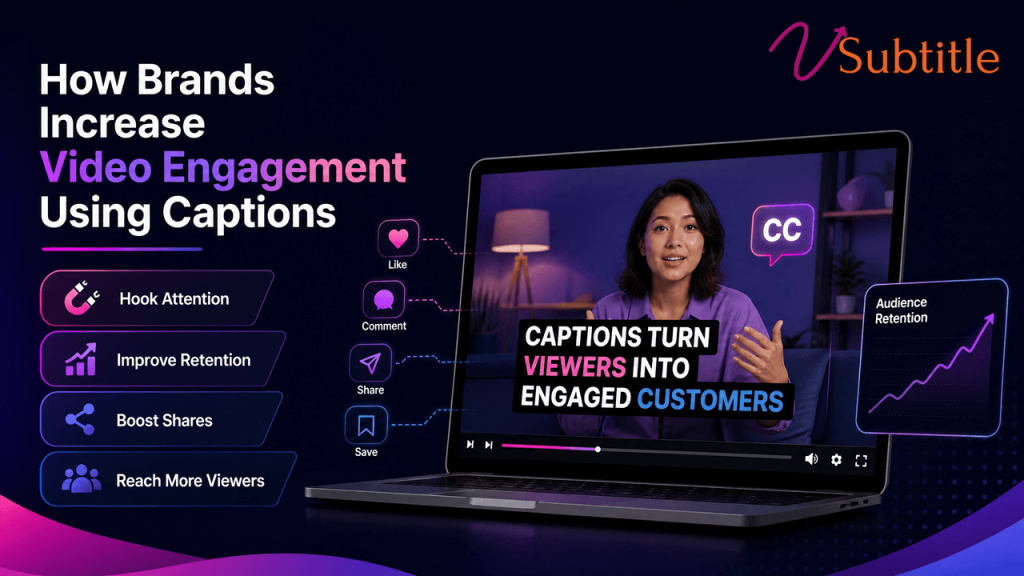
How Brands Increase Video Engagement Using Captions

The best-performing brand video in 2026 isn’t necessarily the best-produced. It’s the video that still works with the sound off. Video marketing has reached near-universal adoption — the large majority of businesses now use it as a core part of their strategy — which means the competitive question for brands has quietly shifted. It’s no longer whether to use video, but how to make video actually perform once everyone is already using it. One lever shows up across nearly every 2026 study on the subject as one of the highest-leverage, lowest-cost ways to move that needle: captions. This isn’t an accessibility footnote anymore. Brands running captions as a default, not an afterthought, report measurably higher completion rates, stronger recall, and better brand affinity scores than the same content without them. This article breaks down exactly why captions move these numbers, what the current data shows, and the specific strategies brands are using to turn a basic accessibility feature into a genuine engagement lever. What the 2026 Data Actually Shows The starting fact behind all of this is simple: most branded video is watched without sound. On LinkedIn specifically, roughly 80% of video is watched muted, which is why the large majority of video published there is now deliberately designed for silent viewing with on-screen text or captions built in from the start rather than added afterward. That pattern holds broadly across platforms, not just LinkedIn. Finding Source Context 85% of social media video is watched without sound Consistent across multiple 2026 video marketing datasets Captioned videos see roughly 40% higher completion rates on average Short-form video performance research, 2026 80% of LinkedIn video is watched with no sound; 70% of video is designed for silent viewing as a result LinkedIn-specific video marketing data, 2026 50% of silent-viewing audiences rely on captions to understand video content at all General video marketing statistics, 2026 TikTok ad videos with captions see a 95% boost in brand affinity, a 58% increase in recall, and a 25% jump in perceived uniqueness TikTok ad performance data, 2026 Completion rate, not view count, is the metric platforms increasingly weight in distribution Cross-platform algorithm behavior noted across multiple 2026 sources The pattern across every one of these numbers is the same: captions aren’t just making video accessible to a wider audience, they’re materially changing how much of that audience actually finishes watching, remembers what they saw, and forms a favorable impression of the brand behind it. For a discipline as metric-driven as modern marketing, that’s a rare case of an accessibility improvement and a performance improvement being the exact same piece of work. Why Captions Move Brand Engagement Metrics Specifically They Remove the Single Biggest Barrier to Silent Viewing With the substantial majority of social and feed-based video watched muted, a caption-free video is only reaching a minority of its actual audience with its full message. Everyone else gets visuals and, at best, an incomplete guess at the audio’s content — a gap captions close directly and immediately. They Reinforce the Message Through a Second Channel For the portion of the audience watching with sound on, captions don’t just repeat the audio — they reinforce it through a second, simultaneous channel. This dual-channel reinforcement is a well-documented driver of the recall lift brands see from captioned content: information delivered through both audio and matching text is retained better than audio alone, which directly explains why captioned ads outperform on brand recall specifically, not just completion. They Feed Platform Algorithms Directly Most major platforms now weight completion rate and watch time heavily in how widely a video gets distributed, and several read on-screen text through OCR to help categorize and match content to relevant searches or recommendations. A captioned video isn’t just more watchable — it’s giving the platform more signal to work with when deciding who else to show it to. They Signal Production Quality and Brand Care A large share of consumers say video quality directly affects how much they trust a brand. Clean, well-timed, accurately worded captions are part of that quality signal now, in the same way a shaky, poorly lit video used to read as low-effort — an uncaptioned video in 2026 increasingly reads the same way, regardless of how polished the footage itself is. This connects directly to the SEO side of the same coin: our guide to AI subtitles and video SEO covers how the same caption and transcript work that lifts engagement also improves discoverability, meaning brands investing in captions are typically getting two separate performance gains from one piece of production work. H2 Caption Strategies Brands Use to Drive Engagement 1. Design for Sound-Off From the Script Stage, Not as a Caption Afterthought Leading brand video teams now treat captions as part of the creative brief, not a post-production checkbox — scripting the opening line with the assumption it needs to land as text on screen, not just as narration. A hook that only works with audio loses its entire effect on the majority of viewers who never unmute. 2. Use Animated, Word-Synced Captions for Short-Form and Social Word-by-word or short-phrase animated captions, timed to match speech, have become a standard style for high-performing short-form brand content specifically because the motion keeps attention anchored the way a static caption block doesn’t. Bold, high-contrast fonts optimized for mobile screens consistently outperform thinner, more decorative styles once a video is actually watched on a phone rather than previewed on a desktop editor. 3. Treat Caption Styling as Part of Brand Identity Consistent caption fonts, colors, and animation style across a brand’s video output function similarly to a consistent color palette or logo placement — viewers start to recognize the brand’s content by its caption style alone, especially on platforms where content from many creators and brands blends together in a single feed. This is a detail smaller teams often skip, treating captions as purely functional rather than as a piece of visual identity worth designing deliberately. 4. Localize Captions for Global

caption-strategies-tiktok-completion-rates
Short-Form Video, Social Media, Subtitling Tips, Video Optimization

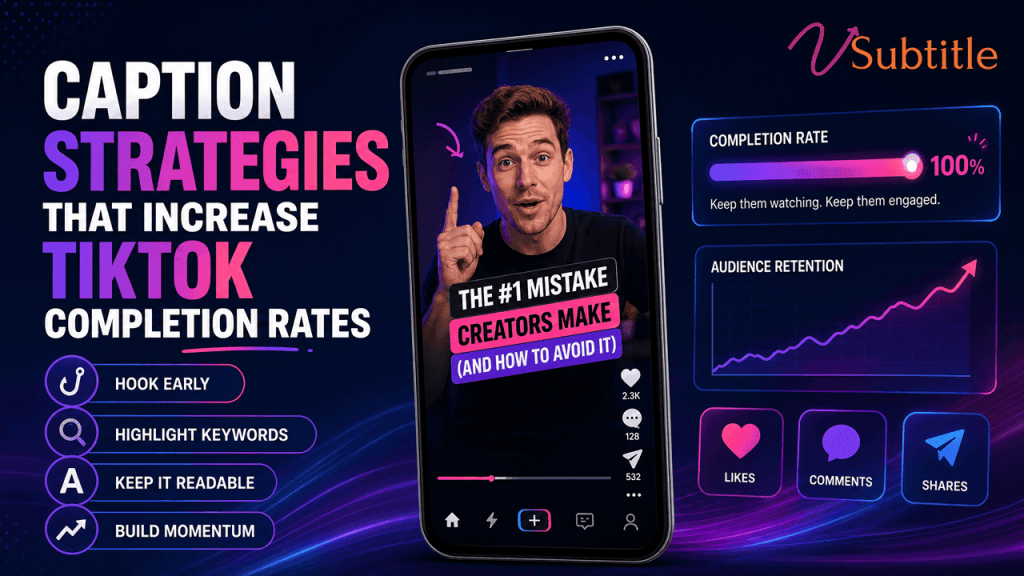
Caption Strategies That Increase TikTok Completion Rates

TikTok’s algorithm in 2026 cares about one thing above all else: whether people watch to the end. Captions are one of the few levers that move that number directly. Completion rate has become the dominant signal in TikTok’s 2026 ranking system, and the bar for triggering wider distribution has risen sharply — reports now put the viral-push threshold at roughly 70% completion, up from closer to 50% just a couple of years ago. Likes and comments still matter, but they trail far behind one blunt question the algorithm keeps asking of every upload: did the person who started watching actually stay? Captions are one of the most direct, controllable levers a creator has over that answer. Independent research into 2026 TikTok performance puts the completion-rate lift from adding captions at roughly 32%, with subtitled videos also seeing a reported 24% increase in shares — numbers large enough that caption strategy deserves the same deliberate attention as the hook or the edit, not an afterthought bolted on right before posting. This guide breaks down exactly which caption strategies move completion rate, and why, along with a practical workflow for applying them consistently. Why Completion Rate Dominates TikTok’s Algorithm in 2026 TikTok’s ranking system has consolidated around watch-through behavior as its clearest signal of genuine interest, ahead of likes, comments, or even shares. A video with far fewer views but a high completion rate consistently earns more distribution per impression than a video with many more views but a low completion rate, because completion is read as proof the content was actually worth the time it asked for. Benchmark 2026 Figure Completion rate needed to trigger viral-push distribution ~70%, up from roughly 50% in 2024 Typical completion target for videos under 15 seconds 60–70% Typical completion target for videos 30–60 seconds 40–50% Share of viewer retention decided in the first 2 seconds Over 70% Completion-rate lift from adding captions ~32% Increase in shares for captioned vs. uncaptioned videos ~24% Two things follow from this. First, the hook matters more than almost anything else, since losing a viewer in the first two seconds removes any chance captions or pacing later in the video can recover. Second, once someone is past the hook, captions become one of the steadiest tools available for keeping them there — they reduce the cognitive effort needed to follow the video, which is exactly the kind of friction that causes a mid-video scroll-away. Why Captions Specifically Move Completion Rate This mirrors a pattern that shows up across nearly every platform once captions are added — our piece on multilingual captions doubling YouTube watch time covers the same underlying mechanic on a longer-form platform, where the retention math works similarly even though the specific numbers differ from TikTok’s short-form environment. Caption Strategies That Actually Move Completion Rate 1. Put the Hook’s Promise in Text, Not Just Audio Since over 70% of retention is decided in the first two seconds, the opening caption needs to restate or reinforce the hook visually — not repeat it word for word, but make sure a muted viewer scrolling past gets the same scroll-stopping promise a listening viewer gets from the audio. A hook that only exists in spoken word loses its entire effect on anyone who hasn’t unmuted yet, which on TikTok is a meaningful share of the audience encountering the video for the first time. 2. Use Word-by-Word or Short-Phrase Sync for High-Energy Content Karaoke-style captions — text that highlights, bounces, or reveals word by word in sync with speech — have become one of the most consistently effective formats for fast-paced TikTok content specifically because they double as the micro-movement that resets a viewer’s attention every couple of seconds. For calmer, more explanatory content, short full-sentence blocks capped at roughly two lines still perform well; the choice should match the content’s actual pace rather than defaulting to one style for everything. 3. Build Open Loops Into the Caption Text Itself Captions can carry curiosity-gap structure on their own — a line that poses a question or teases a reveal (‘but here’s what happened next’) gives a viewer a specific reason to keep watching that exists independently of the audio. Planting one of these roughly every 10–15 seconds helps offset the natural drop-off that occurs as initial hook-driven attention fades partway through a video. 4. Keep Every On-Screen Block Short Ten words or fewer per caption block is a reliable ceiling for something meant to be read in a second or two of glance time — the same principle that applies to Reels captions, just enforced even more strictly given TikTok’s typically faster pacing and shorter average watch time. Long, dense captions ask for more reading effort exactly when the video is trying to move quickly, creating friction that works directly against completion. 5. Change Caption Style or Position to Create Pattern Interrupts A caption that shifts emphasis, color, or position at a key moment — a punchline, a reveal, a number — functions as a pattern interrupt in the same category as a jump cut or a zoom, resetting the viewer’s attention right when momentum might otherwise start to fade. This works best used sparingly, at genuinely important moments, rather than applied to every line, where the effect quickly becomes noise instead of emphasis. 6. Respect the Safe Zone So Captions Never Get Covered TikTok’s interaction icons and caption-field text occupy real space on the right side and bottom of the frame, and a caption that lands underneath them is simply lost — a completion-rate cost that has nothing to do with the caption’s wording and everything to do with placement. Centering captions in the upper two-thirds of the frame by default, and previewing on an actual phone before publishing, avoids this entirely preventable failure mode. 7. Match Reading Speed to the Content’s Actual Pace Fast-cut, high-energy TikToks can support quicker caption timing than slower, explanatory content, but captions that outrun a viewer’s actual reading speed create the exact friction that

Scroll to Top