

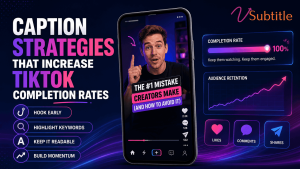
TikTok’s algorithm in 2026 cares about one thing above all else: whether people watch to the end. Captions are one of the few levers that move that number directly.
Completion rate has become the dominant signal in TikTok’s 2026 ranking system, and the bar for triggering wider distribution has risen sharply — reports now put the viral-push threshold at roughly 70% completion, up from closer to 50% just a couple of years ago. Likes and comments still matter, but they trail far behind one blunt question the algorithm keeps asking of every upload: did the person who started watching actually stay?
Captions are one of the most direct, controllable levers a creator has over that answer. Independent research into 2026 TikTok performance puts the completion-rate lift from adding captions at roughly 32%, with subtitled videos also seeing a reported 24% increase in shares — numbers large enough that caption strategy deserves the same deliberate attention as the hook or the edit, not an afterthought bolted on right before posting. This guide breaks down exactly which caption strategies move completion rate, and why, along with a practical workflow for applying them consistently.
Why Completion Rate Dominates TikTok’s Algorithm in 2026
TikTok’s ranking system has consolidated around watch-through behavior as its clearest signal of genuine interest, ahead of likes, comments, or even shares. A video with far fewer views but a high completion rate consistently earns more distribution per impression than a video with many more views but a low completion rate, because completion is read as proof the content was actually worth the time it asked for.
| Benchmark | 2026 Figure |
|---|---|
| Completion rate needed to trigger viral-push distribution | ~70%, up from roughly 50% in 2024 |
| Typical completion target for videos under 15 seconds | 60–70% |
| Typical completion target for videos 30–60 seconds | 40–50% |
| Share of viewer retention decided in the first 2 seconds | Over 70% |
| Completion-rate lift from adding captions | ~32% |
| Increase in shares for captioned vs. uncaptioned videos | ~24% |
Two things follow from this. First, the hook matters more than almost anything else, since losing a viewer in the first two seconds removes any chance captions or pacing later in the video can recover. Second, once someone is past the hook, captions become one of the steadiest tools available for keeping them there — they reduce the cognitive effort needed to follow the video, which is exactly the kind of friction that causes a mid-video scroll-away.
Why Captions Specifically Move Completion Rate
- Sound-off viewing is still the default. A large share of TikTok is watched muted — in public, at work, in bed next to someone sleeping — and a video with no captions is simply unfollowable for that entire audience, regardless of how strong the content is.
- Dual-channel processing keeps attention anchored. Viewers following both the audio and matching on-screen text process the content through two reinforcing channels at once, which measurably reduces the moments of confusion or drifting attention that lead to an early scroll.
- Captions function as a pacing tool, not just a comprehension aid. Text that changes, highlights, or animates in sync with speech acts as a steady micro-movement that resets a viewer’s attention every few seconds — the same principle behind cuts, zooms, and B-roll, just delivered through text.
- On-screen text is read by TikTok’s own systems. The algorithm processes on-screen text through OCR alongside the spoken audio and written caption field, meaning accurate captions also help TikTok understand and correctly categorize the content — connecting completion rate to discoverability rather than treating them as separate problems.
This mirrors a pattern that shows up across nearly every platform once captions are added — our piece on multilingual captions doubling YouTube watch time covers the same underlying mechanic on a longer-form platform, where the retention math works similarly even though the specific numbers differ from TikTok’s short-form environment.
Caption Strategies That Actually Move Completion Rate
1. Put the Hook’s Promise in Text, Not Just Audio
Since over 70% of retention is decided in the first two seconds, the opening caption needs to restate or reinforce the hook visually — not repeat it word for word, but make sure a muted viewer scrolling past gets the same scroll-stopping promise a listening viewer gets from the audio. A hook that only exists in spoken word loses its entire effect on anyone who hasn’t unmuted yet, which on TikTok is a meaningful share of the audience encountering the video for the first time.
2. Use Word-by-Word or Short-Phrase Sync for High-Energy Content
Karaoke-style captions — text that highlights, bounces, or reveals word by word in sync with speech — have become one of the most consistently effective formats for fast-paced TikTok content specifically because they double as the micro-movement that resets a viewer’s attention every couple of seconds. For calmer, more explanatory content, short full-sentence blocks capped at roughly two lines still perform well; the choice should match the content’s actual pace rather than defaulting to one style for everything.
3. Build Open Loops Into the Caption Text Itself
Captions can carry curiosity-gap structure on their own — a line that poses a question or teases a reveal (‘but here’s what happened next’) gives a viewer a specific reason to keep watching that exists independently of the audio. Planting one of these roughly every 10–15 seconds helps offset the natural drop-off that occurs as initial hook-driven attention fades partway through a video.
4. Keep Every On-Screen Block Short
Ten words or fewer per caption block is a reliable ceiling for something meant to be read in a second or two of glance time — the same principle that applies to Reels captions, just enforced even more strictly given TikTok’s typically faster pacing and shorter average watch time. Long, dense captions ask for more reading effort exactly when the video is trying to move quickly, creating friction that works directly against completion.
5. Change Caption Style or Position to Create Pattern Interrupts
A caption that shifts emphasis, color, or position at a key moment — a punchline, a reveal, a number — functions as a pattern interrupt in the same category as a jump cut or a zoom, resetting the viewer’s attention right when momentum might otherwise start to fade. This works best used sparingly, at genuinely important moments, rather than applied to every line, where the effect quickly becomes noise instead of emphasis.
6. Respect the Safe Zone So Captions Never Get Covered
TikTok’s interaction icons and caption-field text occupy real space on the right side and bottom of the frame, and a caption that lands underneath them is simply lost — a completion-rate cost that has nothing to do with the caption’s wording and everything to do with placement. Centering captions in the upper two-thirds of the frame by default, and previewing on an actual phone before publishing, avoids this entirely preventable failure mode.
7. Match Reading Speed to the Content’s Actual Pace
Fast-cut, high-energy TikToks can support quicker caption timing than slower, explanatory content, but captions that outrun a viewer’s actual reading speed create the exact friction that causes a scroll-away. If a caption disappears before an average viewer could plausibly finish reading it, it’s actively working against retention rather than for it — this is worth checking directly rather than assuming pacing that looks good in the editor will read the same way on a real device.
Choosing a Caption Style for the Content
| Caption Style | Best For | Watch For |
|---|---|---|
| Word-by-word / karaoke | Fast-paced, high-energy content; hooks and punchlines | Needs slightly larger font and strong contrast to stay readable at speed |
| Short full-sentence blocks | Explanatory, tutorial, or calmer storytelling content | Cap at two lines; don’t let sentences run long just because they technically fit |
| Highlighted keyword style | Content built around a specific claim, number, or reveal | Overuse flattens the effect — reserve emphasis for genuinely important words |
| Static single-line captions | Simple, low-production or voiceover-driven content | Least dynamic option; pair with other pacing tools like cuts or zooms to avoid feeling static |
How to Tell If a Caption Change Actually Helped
TikTok Studio’s analytics expose retention curves, average watch time, and completion rate per video, which makes it possible to test caption strategy the same way any other variable gets tested — one change at a time, rather than overhauling hook, pacing, visuals, and captions simultaneously and having no way to isolate what actually moved the number.
- Compare completion rate on near-identical videos where only the caption style changed — word-by-word versus block captions, for instance — to see which pacing your specific audience responds to.
- Watch the retention curve, not just the final completion percentage. A steep early drop points to a hook problem captions can’t fix; a steady mid-video decline is more often a pacing or caption-timing issue worth testing directly.
- Track shares and re-watches alongside completion rate, since well-placed open-loop captions and satisfying end-screen moments tend to move these together rather than in isolation.
Changing one variable at a time is slower than overhauling everything at once, but it’s the only reliable way to know whether a caption strategy is actually responsible for a completion-rate improvement, rather than a stronger hook or a trending sound that happened to land in the same upload.
Common Mistakes That Quietly Hurt Completion Rate
- Publishing raw auto-generated captions with no review — a misheard word doesn’t just look sloppy, it also gets read by TikTok’s OCR-based discovery system and can misdirect the content’s own topic signal.
- Using the same caption style and pacing for every video regardless of tone, instead of matching karaoke-style timing to fast content and full-sentence blocks to slower content.
- Letting captions sit under TikTok’s interaction icons or caption-field text because the video was only previewed on desktop, not an actual phone.
- Dumping the entire hook’s value in the first few seconds with nothing held back, removing any reason to keep watching past the opening line.
- Cramming long, complete thoughts into single dense caption blocks instead of splitting them into shorter, better-paced pieces.
A Practical Captioning Workflow for Completion-Rate Optimization
- Script and shoot with the hook’s core promise in mind, since captions can reinforce a strong hook but can’t manufacture one that isn’t there in the first two seconds of footage.
- Generate an accurate transcript automatically rather than typing captions by hand for every video — a manual process that doesn’t scale at the posting cadence TikTok rewards.
- Review the transcript for misheard words, especially names, slang, and niche terms, since these errors compound into both a readability problem and a discoverability one.
- Choose a caption style — word-by-word, short block, or highlighted keyword — based on the video’s actual pace rather than a default template.
- Position captions in the upper two-thirds of the frame, keeping clear of TikTok’s right-side icon stack and bottom caption-field area.
- Preview on an actual phone before publishing, checking both placement and whether reading speed genuinely matches the pacing of the cut.
vSubtitle supports this exact workflow: it transcribes a video’s audio into accurate, editable captions automatically, and the same Instagram Reel caption generator workflow — built around the same 1080×1920 vertical frame TikTok uses — applies directly to TikTok captioning, since both platforms share nearly identical sizing and safe-zone fundamentals even where their exact UI layouts differ slightly.
For teams captioning at a higher volume or across multiple platforms, vSubtitle’s auto subtitle generator and beginner’s guide to AI subtitling are useful starting points, and our broader look at AI subtitling trends heading into 2026 covers where caption-driven retention strategy is headed as short-form platforms keep converging on similar rules.
Key Takeaways
- Completion rate is TikTok’s dominant ranking signal in 2026, with a viral-push threshold of roughly 70%, up sharply from around 50% just a couple of years earlier.
- Captions deliver a measurable, well-documented lift to completion rate — reported around 32% — by removing the sound-off barrier and reinforcing content through a second, reading-based channel.
- The specific caption strategy matters: hook reinforcement, word-by-word sync for fast content, built-in open loops, and short on-screen blocks all directly support retention, not just comprehension.
- Placement and reading speed are just as important as wording — a caption hidden behind TikTok’s UI or timed faster than a viewer can read works against the exact metric it’s meant to help.
- Because TikTok reads on-screen text through OCR, accurate captions also feed the platform’s own understanding of the content, tying completion rate and discoverability together rather than treating them separately.
Completion rate isn’t won in a single dramatic moment — it’s the sum of dozens of small decisions about how easy a video is to follow, second by second. Captions, done deliberately rather than as an afterthought, are one of the most reliable tools available for making that easier without changing anything else about the content itself.
Frequently Asked Questions (FAQs)
How much do captions actually improve TikTok completion rate?
Recent industry data puts the completion-rate lift from adding captions at roughly 32%, with captioned videos also seeing about 24% more shares than uncaptioned ones — a large enough effect that caption strategy deserves deliberate planning rather than being treated as an afterthought.
What completion rate does a TikTok video need to go viral in 2026?
Reports put the viral-push distribution threshold at roughly 70% completion in 2026, a meaningful increase from around 50% in 2024. Shorter videos under 15 seconds typically need to hit 60–70% completion, while videos in the 30–60 second range are often judged against a lower 40–50% target.
Should I use word-by-word karaoke captions or full-sentence blocks?
It depends on pacing. Fast, high-energy content tends to perform well with word-by-word or short-phrase karaoke-style captions, which double as a pattern interrupt that keeps attention refreshed. Calmer, more explanatory content usually reads more clearly with short, full-sentence blocks capped at two lines.
Where should captions be positioned on a TikTok video?
In the upper two-thirds of the frame by default, kept clear of TikTok’s right-side interaction icons and the bottom caption-field text. A caption hidden behind the platform’s own interface loses its entire effect on completion rate regardless of how well it’s written.
Do captions affect TikTok’s algorithm beyond just viewer retention?
Yes. TikTok reads on-screen text through OCR alongside the spoken audio and written caption field, using it to help categorize and match content to relevant searches and For You Page recommendations. Accurate captions support both completion rate and discoverability at the same time.
How long should each on-screen caption block be?
Ten words or fewer per block is a reliable ceiling for something meant to be read in a second or two of glance time. Longer thoughts read more clearly split across two well-paced blocks than compressed into one dense line, even if that line technically fits on screen.
Can AI captioning tools keep up with a high TikTok posting cadence?
Yes — this is one of the main advantages over manual captioning. AI tools like vSubtitle transcribe a video’s audio into accurate, editable captions automatically, cutting a process that can take 30–60 minutes by hand down to a quick review-and-export step, which is what makes consistent, high-quality captioning realistic at the posting frequency TikTok’s algorithm rewards.

