AI engines don’t rank your video. They read it, judge it, and decide whether to quote it — and subtitles are the only part of a video built for that job.
Generative Engine Optimization, or GEO, is the practice of making content discoverable, trustworthy, and quotable to AI systems like ChatGPT, Perplexity, Gemini, and Google’s AI Overviews — a distinct discipline from traditional SEO, though built on many of the same foundations. The term was coined by Princeton researchers in 2023, and by 2026 it has become a core part of how any content-driven brand thinks about visibility, because a growing share of searches now resolve into a synthesized AI answer rather than a list of links to click.
Video sits in an unusual position inside this shift. It’s simultaneously one of the most trusted content types generative engines cite — YouTube transcripts show up constantly in AI-generated answers — and one of the most commonly invisible, because the systems doing the citing can’t watch a video the way a person can. They can only read whatever text is attached to it. That gap between video’s citation potential and its default invisibility is exactly where subtitles and transcripts do their work, and it’s the focus of this guide.
What GEO Actually Means for Content
Traditional SEO optimizes for ranking position in a list of search results. GEO optimizes for something different: being the source a generative engine actually pulls from, quotes, or names when it synthesizes an answer. The two disciplines share fundamentals — crawlability, structure, authority — but GEO adds requirements SEO never needed to worry about, because a ranking position and a citation are not the same prize.
A few principles specific to GEO matter directly for video:
- Factual density beats persuasive copy. Generative engines favor content with specific, verifiable claims — numbers, named findings, dated data — over vague marketing language, because specific claims are what’s actually extractable and quotable.
- The mention graph matters as much as the link graph. Generative engines are trained on, and often retrieve from, the open web in real time — meaning an unlinked mention in a transcript, forum thread, or review can influence citation likelihood almost as much as a backlink used to.
- Structure is read literally. Clear headings, short paragraphs, direct answers near the top of a section, and lists or tables all make content easier for a generative engine to parse and extract cleanly — the same structural logic that makes content easy for a human to skim.
- Dedicated crawlers now exist specifically for this purpose — GPTBot, PerplexityBot, ClaudeBot, Google-Extended — and a page or video transcript has to actually be reachable by them, not blocked or hidden, to be eligible for citation at all.
Why Video Is a GEO Blind Spot Without Subtitles
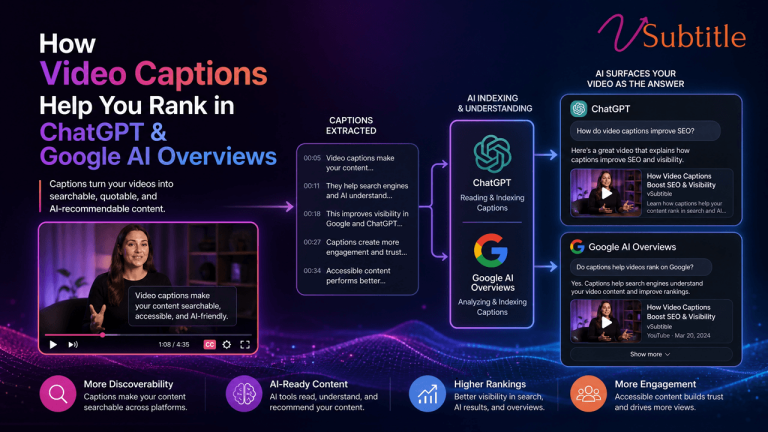
Every GEO principle above assumes there’s text to evaluate. That assumption breaks down for video the moment there’s no caption track or transcript attached to it. A generative engine encountering an uncaptioned video has almost nothing to work with — a title, maybe a thumbnail, and a short description if one exists. It cannot watch the footage, and it cannot listen to the audio the way a person does. Whatever isn’t captured in text simply doesn’t exist to the system trying to decide whether to cite it.
This is the same underlying dynamic covered in depth in our guide to AI subtitles and video SEO — the principle holds just as strongly, arguably more strongly, once the audience shifts from search engine crawlers to generative engines synthesizing an actual answer rather than just indexing a page.
The practical result: two videos covering the exact same topic, with the exact same production quality, can have completely different GEO outcomes based purely on whether one of them has an accurate, structured transcript attached. The captioned video is eligible to be read, understood, and quoted. The uncaptioned one is functionally mute to the systems that increasingly decide what gets surfaced.
How Generative Engines Actually Discover and Use Video Content
YouTube specifically occupies a privileged position in GEO research: transcripts hosted there are crawled and cited frequently enough that a handful of well-titled, well-described videos with clean transcripts can outperform a blog post for the same query. That’s a notable claim — video, historically treated as SEO’s afterthought behind written content, is now one of the more reliably cited formats, provided the transcript backing it is actually there and actually accurate.
This connects directly to something worth understanding about the platform itself: how AI subtitles compare to YouTube’s own auto-captions, since the accuracy and structure of that transcript — not just its existence — is what determines whether an engine trusts and reuses it.
For video embedded on a company’s own site rather than YouTube, the mechanics shift slightly but the principle doesn’t: the page needs a crawlable transcript, ideally paired with VideoObject structured data, so a generative engine’s crawler has explicit, machine-readable text to work from rather than having to infer content from a title and thumbnail alone.
What Makes a Video Transcript GEO-Friendly
Publishing any transcript at all is a meaningful first step, but GEO rewards specific structural choices within that transcript far more than a raw, undifferentiated wall of text:
Lead With a Direct Answer
Generative engines favor content that answers a clear question within the first sentence or two of a section, ideally in the 40–60 word range that tends to get pulled directly into AI-generated answer boxes. A transcript or accompanying summary that opens with the actual point, rather than warming up to it, is far more extractable.
Break Content Into Labeled Sections
A transcript structured to mirror a video’s chapters — with descriptive subheadings — gives a generative engine a map of what’s covered where, rather than forcing it to parse an undifferentiated block of spoken text to find the relevant part.
Use Lists and Tables Where They Fit
Steps, comparisons, and data points formatted as lists or tables are consistently easier for generative engines to extract cleanly than the same information buried in prose — a structural preference GEO shares directly with how featured snippets have always worked.
Increase Factual Density
A transcript that includes specific figures, named findings, or sourced claims gives a generative engine something concrete to quote. Vague claims about being “the best” or “industry-leading” provide nothing extractable — a generative engine has no way to verify or cite an unsupported superlative.
This same structural logic — short, scannable, answer-first sections — is also why on-page subtitles and transcripts have been shown to increase time on page: the format that makes content easiest for a generative engine to extract is very often the same format that keeps a human reader engaged.
A GEO Checklist for Video Content
- Generate an accurate transcript from the video’s actual audio — not a rough approximation, since factual errors here become the errors a generative engine might cite as fact.
- Publish the transcript as crawlable text on the page itself, not locked exclusively inside a video player’s caption track.
- Structure the transcript with descriptive subheadings that mirror the video’s chapters or key sections.
- Open each section with a direct, specific answer rather than a slow lead-in — the extractable sentence a generative engine is most likely to quote.
- Add VideoObject schema with title, description, duration, and thumbnail, giving generative engines explicit, structured facts rather than requiring inference.
- Include specific data points, named findings, or sourced statistics wherever the video discusses something measurable — factual density is directly citable in a way persuasive language isn’t.
- Confirm the page isn’t blocking known AI crawlers (GPTBot, PerplexityBot, ClaudeBot, Google-Extended) in robots.txt, since a technically perfect transcript is worthless if it’s unreachable.
- Keep the transcript current — if the video is updated or re-recorded, the published transcript needs to match, since a generative engine has no way to know which version is authoritative if they diverge.
Multilingual Transcripts Extend GEO Reach
GEO isn’t limited to a single language market, and neither is the query volume flowing through ChatGPT, Perplexity, and AI Overviews worldwide. A video with only an English transcript is only eligible to be cited for English-language queries, regardless of how strong the content is — the same underlying limitation that caps organic reach for untranslated video on traditional search.
This is the same dynamic explored in our piece on multilingual captions and YouTube watch time: translated transcripts don’t just serve human viewers in other languages, they open up an entirely separate set of generative-engine queries in those languages that an English-only transcript can never be cited for.
For channels and brands built around faceless or narration-driven content specifically — a format where the transcript often carries almost the entire informational weight of the video — this compounds further.
As covered in our guide to AI captions for faceless YouTube channels, the transcript effectively is the content for GEO purposes in this format, making transcript accuracy and structure even more directly tied to whether the video gets discovered and cited at all.
How to Tell If a Video’s GEO Is Working
Unlike traditional rank tracking, GEO visibility doesn’t show up in a single familiar dashboard yet, but a few practical checks give a reasonable read on whether a video’s transcript is actually earning citations:
- Periodically ask ChatGPT, Perplexity, or Google’s AI Overview a question the video directly answers, and check whether the video or its page is named, linked, or clearly the source of the answer given.
- Watch for referral traffic from AI platforms in analytics — a small but growing category that indicates a generative engine sent a reader through to the source page.
- Track long-tail, question-phrased search impressions tied to phrases spoken in the video but never written in the title or description — a rise here suggests the transcript itself is being indexed and matched.
- Confirm crawler access periodically, since AI crawler permissions in robots.txt and hosting configurations can change without a content team necessarily noticing.
Common Mistakes That Undermine Video GEO
- Publishing a video with no transcript at all, leaving generative engines with only a title and thumbnail to work from.
- Locking the transcript exclusively inside the video player’s caption track, with nothing crawlable published on the page itself.
- Leaving unedited, error-filled auto-captions as the source transcript — the exact errors a generative engine might repeat as fact if the video gets cited.
- Writing a transcript with no structure — no headings, no direct answers, no lists — that’s technically readable but hard for an engine to extract a clean, quotable answer from.
- Publishing only in the video’s original language, capping citation eligibility to a single language’s worth of queries.
- Treating GEO as a one-time setup rather than an ongoing discipline — letting transcripts go stale after a video is updated or re-recorded.
Building GEO-Ready Video Content at Scale
Every step in the checklist above is straightforward in isolation, but doing it consistently — accurate transcription, structured formatting, multilingual versions, current with every re-upload — across an entire video library is where most teams fall behind. This is precisely the operational gap AI subtitling tools are built to close.
vSubtitle’s auto subtitle generator produces accurate, editable transcripts directly from a video’s audio, ready to review, structure, and publish alongside the video rather than leaving it locked inside a caption file. Translation into 100+ languages extends the same transcript into new-language GEO eligibility without a separate production pass, and export formats covering SRT, VTT, TXT, and DFXP mean the same source file can serve the caption track, the page transcript, and any platform-specific delivery requirement from one pass.
For a closer look at where AI-driven video optimization is headed as generative search continues to evolve, our roundup of 2026 AI subtitling trends tracks the broader shift this guide sits inside, and our beginner’s guide to AI subtitling is a good starting point for teams just building out their captioning workflow from scratch.
Key Takeaways
- GEO optimizes for being cited and quoted by AI systems, not just ranked — a distinct goal from traditional SEO that rewards different structural and factual choices.
- Generative engines can’t watch a video; they can only read the text attached to it, making an accurate transcript the entire basis for a video’s GEO eligibility.
- YouTube transcripts are among the most frequently cited sources across generative engines, but only when the transcript itself is accurate and present.
- Structure matters as much as existence: direct answers, labeled sections, lists, tables, and factual density all increase how extractable a transcript is.
- Multilingual transcripts open up citation eligibility in entirely separate language markets that a single-language transcript can never reach.
- GEO is ongoing, not a one-time setup — transcripts need to stay accurate and current as videos are updated, and crawler access needs periodic confirmation.
Subtitles used to be framed mainly as an accessibility feature and, more recently, an SEO tactic. In the GEO era, they’ve become something closer to infrastructure — the layer that determines whether a video exists at all to the systems now standing between a video and the person searching for exactly what it explains.
Frequently Asked Questions (FAQs
What is Generative Engine Optimization (GEO)?
GEO is the practice of optimizing content so it’s discovered, trusted, and cited by AI-powered generative engines like ChatGPT, Perplexity, Gemini, and Google’s AI Overviews. Unlike traditional SEO, which focuses on ranking position, GEO focuses on whether a generative engine actually selects and quotes a piece of content when synthesizing an answer.
Why do subtitles matter specifically for GEO, not just traditional SEO?
Generative engines can’t watch or listen to a video directly — they can only process the text attached to it. Subtitles and transcripts are that text, making them the entire basis on which a generative engine can understand, summarize, or cite a video’s content. Without them, a video is effectively invisible to these systems regardless of its actual quality.
Is a caption file enough, or does the transcript need to be published on the page too?
Publishing a readable transcript directly on the page, in addition to the caption file used by the video player, gives generative engine crawlers a more reliable, directly accessible path to the content. A transcript locked exclusively inside a video player is harder for these systems to reach and use.
Does video structure really affect whether AI engines cite it?
Yes. Generative engines favor content with clear headings, direct answers near the start of a section, and factual, specific claims over unstructured or vague text. A transcript formatted this way is significantly more extractable and quotable than the same information presented as an undifferentiated block of spoken text.
Do translated subtitles help with GEO in other languages?
Yes. A transcript only makes a video eligible for citation in the language it’s written in. Translating that transcript into additional languages opens up an entirely separate set of queries in those languages that an English-only (or any single-language) transcript could never be cited for.
How can I check if my videos are actually being cited by AI engines?
Periodically ask ChatGPT, Perplexity, or Google’s AI Overview a question your video directly answers, and check whether it’s named or linked as a source. Watching for AI-platform referral traffic in analytics and tracking long-tail search impressions tied to spoken but unwritten phrases are also useful indirect signals.
Can AI subtitling tools help produce GEO-ready transcripts at scale?
Yes. Tools like vSubtitle generate accurate, editable transcripts directly from a video’s audio, support translation into 100+ languages, and export in formats suited to both the caption track and a publishable page transcript — making it realistic to keep an entire video library’s GEO foundation current rather than treating it as a one-off task.