

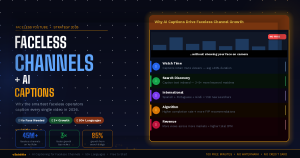
There’s a quiet revolution happening on YouTube in 2026. Channels with millions of subscribers — channels you’ve probably watched — have no host, no face, no personality to build a following around. They’re built on stock footage, voiceovers, AI-generated visuals, animated text, and tight editing. And almost all of them have one thing in common: they use AI captions on every single video.
This isn’t a coincidence. Faceless channels have discovered something that face-forward creators often overlook: captions are disproportionately valuable for content that doesn’t have a charismatic presenter to hold attention. When there’s no face to watch, no story to follow, no personality to connect with — the words on screen become the primary hook that keeps viewers watching.
In this post, we’ll break down exactly why AI captions have become a core part of the faceless channel playbook, what the data shows about their impact on watch time and growth, which niches benefit most, and how you can replicate the same workflow using vSubtitle — starting today, for free.
| 🎯 Whether you already run a faceless channel or are planning to start one, this post gives you the caption strategy that top faceless creators are using to compound their growth — and the exact tool to implement it. |
1. What Is a Faceless YouTube Channel — And Why Are They Exploding?
A faceless YouTube channel is exactly what it sounds like: a channel that produces video content without ever showing the creator’s face on camera. Instead of a traditional talking-head format, these channels use:
- Stock footage, B-roll, and licensed imagery paired with a voiceover narration
- AI-generated visuals, animations, or motion graphics
- Screen recordings with commentary (for tutorials, software reviews, coding)
- Text-on-screen formats (finance explainers, news commentary, top 10 lists)
- Podcast-style audio over still images or minimal animation
The appeal is obvious. Faceless channels let creators build audiences and generate significant revenue without:
- Camera equipment — no need for a studio setup, lighting, or high-end video gear
- On-camera confidence — many successful creators are deeply uncomfortable on camera
- Personal exposure — privacy, anonymity, and the ability to separate business from personal identity
- Geographic constraints — content can be produced from anywhere, often by distributed teams or solo operators
| 45M+Estimated faceless channels on YouTube in 2026 | 3×Faster average growth vs face-forward channels (top niches) | $10KMonthly revenue reported by mid-size faceless channels | 85%Of faceless channel growth tied to search & suggested video |
| 📊 Faceless channels are particularly dependent on algorithmic discovery — search rankings, suggested video placement, and browse features. These are precisely the metrics most directly influenced by captions. The connection between faceless channel growth and AI captioning is therefore especially strong. |
2. Why Captions Are More Valuable for Faceless Channels Than Any Other Format
Every YouTube creator benefits from captions. But for faceless channels specifically, captions deliver outsized value across every growth metric. Here’s why:
There’s No Face to Hold Attention — So the Words Must
In face-forward content, the presenter’s expressions, gestures, eye contact, and personality are powerful engagement tools. Viewers stay because they feel a human connection — they’re watching someone, not just consuming information.
Faceless content doesn’t have this advantage. The hook is the information itself — the narration, the data, the story being told. Captions make this information doubly accessible: viewers receive it through audio and see it reinforced on screen simultaneously. This dual-channel delivery keeps attention locked to the content in a way that audio alone cannot achieve, particularly for distracted or multitasking viewers.
Mute Viewing Is Especially Common for Faceless Content
Consider when and where faceless content is typically consumed: background listening while working, passive scrolling through YouTube feeds, late-night watching without disturbing others. These are high-mute-probability viewing contexts. A faceless finance explainer or history documentary is exactly the kind of content someone might have playing at low volume or on mute while doing something else.
Without captions, this viewer receives nothing — and leaves. With captions, they’re fully engaged even at zero volume. The difference in watch time between a muted uncaptioned video and a muted captioned video is the difference between a 5-second bounce and a 12-minute completed view.
SEO and Search Discovery Are Disproportionately Important
Most faceless channels grow through search and suggested video — not through a personal following that clicks a subscribe button because they love the host. This means YouTube SEO is absolutely critical to faceless channel growth in a way it isn’t for personality-driven channels.
Caption files are indexed by YouTube’s search algorithm. Every word spoken in a faceless channel video — the narration, the statistics cited, the topics covered — becomes searchable text when a caption file is uploaded. This dramatically expands the number of search queries a video can rank for, which is the primary growth engine for the faceless format.
International Audiences Are More Reachable
Faceless content — particularly in niches like finance, history, science, and technology — translates well across language barriers. The absence of culturally specific humour, idioms, and personality quirks means faceless content has genuine international appeal. Multilingual captions unlock this potential directly: a faceless finance channel can serve Spanish, Hindi, Portuguese, and French audiences with the same video and minimal additional effort.
| 🌍 The most successful faceless channels of 2026 are treating multilingual captions not as an accessibility add-on but as a growth strategy — systematically adding 3–5 language tracks to every video to capture international search traffic and recommended video placement across multiple markets. |
3. The Faceless Niches Where AI Captions Drive the Biggest Results
While every faceless channel benefits from AI captions, the impact varies by niche based on audience behaviour, content type, and viewing context. Here are the highest-impact niches:
| 💰 Finance & Investing📌 Why AI captions matter: Finance audiences are highly analytical. They pause, rewind, and take notes. Captions allow them to follow complex data, percentages, and terminology without missing anything. Finance content is also heavily searched — and caption indexing dramatically expands keyword reach.📈 Typical result: Channels with captions report 30–50% higher average view duration and significantly more search-driven discovery. Finance terms are often searched in exact phrases that match caption text. |
| 📚 History & Documentary📌 Why AI captions matter: History content involves dense narration with names, dates, places, and events. Viewers who are not native English speakers struggle with fast narration of unfamiliar historical names. Captions provide a visual anchor for every proper noun and timeline element — significantly improving comprehension and completion rates.📈 Typical result: Completion rates increase 25–40% with captions on history content. Multilingual caption tracks unlock large international audiences — history content is highly consumed in non-English-speaking markets. |
| 🔬 Science & Education📌 Why AI captions matter: Science channels use technical terminology that viewers actively want to see spelled out. Captions serve as a real-time glossary — viewers can pause and note a term they want to research further. Educational content is also heavily re-watched for revision, making captions valuable for navigation.📈 Typical result: Science channels with captions see more comments referencing specific facts from the video — a signal that captions are improving information retention and driving engagement. |
| 🎮 Gaming & Commentary📌 Why AI captions matter: Gaming content without a face is often narration over gameplay footage. The audio track carries all the commentary, jokes, and analysis — but gameplay audio competes with narration in a way that makes understanding difficult without captions. Gaming audiences also have high rates of watching content on second screens.📈 Typical result: Gaming faceless channels with captions retain viewers through complex gameplay sequences where audio clarity is poor. International gaming audiences — particularly in Southeast Asia and South America — are large and caption-responsive. |
| 💼 Business & Entrepreneurship📌 Why AI captions matter: Business content is consumed by ambitious, time-poor viewers who often watch at higher speeds or while multitasking. Captions allow these viewers to follow content at 1.5× or 2× speed without losing comprehension. Business topics are also heavily searched by professionals — caption indexing expands keyword reach into professional vocabulary.📈 Typical result: Business channel operators report captions as one of the top contributors to subscriber conversion — viewers who fully follow the content are more likely to subscribe for future value. |
| 🧘 Wellness, Meditation & Mindfulness📌 Why AI captions matter: Meditation and wellness content is almost exclusively watched in low-audio or no-audio environments — during breaks, before sleep, in shared spaces. Without captions, the entire value proposition of these videos (the guided narration) is inaccessible to mute viewers. Captions are essential, not optional.📈 Typical result: Wellness channels that add captions see immediate and dramatic improvements in watch time among mobile audiences. Meditation content with captions also performs strongly in Google search due to indexing of guided meditation text. |
4. The AI Caption Workflow Top Faceless Channels Are Using
The best faceless channel operators have developed production workflows where captioning is not an afterthought — it’s built into the pipeline from the start. Here’s the exact workflow that maximises both quality and efficiency:
| 🚀 Faceless Channel Caption Production Workflow |
Step 1: Write and Record the Voiceover Script First
The cleanest captioning results come from clean audio. Most faceless channel operators work from a script — which means the narration is clear, well-paced, and free of the fillers and stumbles that make AI transcription harder. Record in a quiet environment with a decent USB microphone. Clean audio at the source is the single biggest driver of AI captioning accuracy.
| 🎙️ Pro tip: Read your voiceover script at a slightly slower pace than feels natural. Faceless content is often narrated quickly to maximise information density — but 10% slower speech dramatically improves both viewer comprehension and AI captioning accuracy. |
Step 2: Upload to vSubtitle and Generate AI Captions
Once your video is assembled (voiceover + visuals), upload the final MP4 to vsubtitle.com. Create your free account — no credit card required — and generate AI captions. At 95%+ accuracy on clean narration audio, vSubtitle’s output is close to publication-ready with minimal review needed.
For a typical 10-minute faceless video, processing takes 3–5 minutes. For a 20-minute deep-dive, 8–10 minutes. You can queue multiple videos and process them in parallel.
Step 3: Review in the Built-in Editor (5 Minutes)
Open the project in vSubtitle’s timeline editor. For clean narration audio, the review pass is quick — scan for:
- Statistics, percentages, and numerical data — AI occasionally mis-transcribes these
- Proper nouns — names of people, companies, places, and historical events
- Industry-specific terminology — terms that are common in your niche but rare in everyday speech
- Any section with background music that competes with the narration
For most faceless channel content with clean audio, this review takes 5–10 minutes per 10 minutes of video. Far faster than any manual captioning approach.
Step 4: Generate Multilingual Caption Tracks
This is where faceless channel operators unlock their biggest growth opportunity. After generating and reviewing English captions, use vSubtitle’s translation feature to generate captions in your top target languages. For most English-language faceless channels, the highest-impact languages are:
- Spanish — 500M+ speakers, massive YouTube audience in Latin America and Spain
- Portuguese — Brazil is YouTube’s 2nd largest market by watch time
- Hindi — India is YouTube’s largest market by user count
- French — covers France, Belgium, Canada, and 29 African nations
- German — high average watch time per user, high advertiser CPM
| ⚡ Adding 3–5 language caption tracks to every video takes under 15 additional minutes per video in vSubtitle. The return — access to hundreds of millions of additional searchers and recommended video viewers — is one of the best time-to-growth ratios available to any faceless channel operator. |
Step 5: Export and Upload to YouTube
Export your caption files as SRT (one per language). In YouTube Studio:
- Go to your video → Subtitles
- Click Add Language for each language you want to add
- Upload the corresponding SRT file
- YouTube will index each caption track independently for search
This entire upload process takes 5–10 minutes regardless of how many language tracks you’re adding. Once done, YouTube’s algorithm begins indexing your video for all languages simultaneously.
Step 6: Build It Into Every Video — Make It a Standard
The compounding effect of AI captions on a faceless channel is most powerful when applied consistently across every video — not selectively. Operators who caption every upload, add multilingual tracks to every video, and maintain this as a standard production step see dramatically better cumulative results than those who caption occasionally.
Add vSubtitle to your production checklist as a mandatory step between video export and YouTube upload. It takes 15–20 minutes per video and pays dividends for the entire life of that video.
5. Caption Strategy by Faceless Channel Size
The caption workflow should evolve as your channel grows. Here’s how to prioritise at each stage:
| Channel Stage | Recommended Caption Strategy |
| Starting out (0–1K subs) | Caption every video in English. Focus on accuracy and clean SRT upload. Use vSubtitle’s free 100 minutes to test the workflow before committing. |
| Growing (1K–10K subs) | Add 2–3 multilingual caption tracks to every new video. Review YouTube Analytics geography data to identify your top non-English audiences and prioritise those languages. |
| Established (10K–100K subs) | Caption back catalogue — start with top 20 videos by watch time. Add multilingual tracks to all new videos at upload. Begin using transcript data for video descriptions and chapters. |
| Scaling (100K+ subs) | Full multilingual caption strategy across all content. Investigate translation quality with native-speaker review for top markets. Use caption data to identify which topics drive international discovery. |
| Enterprise / Network | Build captioning into the production pipeline as a standard deliverable. Consider vSubtitle volume plans for high-throughput operations producing 10+ videos per week. |
6. How AI Captions Create a Compounding SEO Advantage for Faceless Channels
One of the most powerful — and underappreciated — aspects of consistent captioning on a faceless channel is the compounding effect over time. Here’s how it works:
Phase 1: Every Captioned Video Expands Your Keyword Footprint
Each video you upload with a caption file adds thousands of words of indexable content to your channel’s SEO footprint. A 15-minute narrated video might contain 2,000–2,500 words of spoken content. Over 50 videos, that’s 100,000–125,000 words of indexed content — a substantial content library that compounds in search authority over time.
Phase 2: Captions Drive Engagement Signals That Lift All Videos
When captions increase average view duration across your channel — through the combination of mute-viewer retention, non-native speaker retention, and accessibility — YouTube’s algorithm registers your channel as producing high-quality, engaging content. This channel-level authority signal lifts not just individual captioned videos but all videos on your channel, including older content that benefits from improved channel standing.
Phase 3: Multilingual Captions Open Recommendation Loops in New Markets
Each language caption track you add to a video makes it eligible for recommendation to viewers in that language’s primary markets. When a Spanish-language speaker in Mexico watches your video with Spanish captions — and watches it to completion — YouTube’s algorithm registers that as a positive signal in the Spanish-language recommendation pool. Your video starts being recommended to more Spanish-language viewers, creating a self-reinforcing discovery loop in that market.
Phase 4: Search Rankings Compound With Age
Unlike social media posts that decay in reach rapidly after publication, YouTube videos continue to rank in search and generate views for years after upload. A video captioned today will continue to rank for its indexed keywords in 2027, 2028, and beyond — with each month of accumulated watch time and engagement adding to its authority. The earlier you establish a captioning workflow, the larger the compounding advantage you build over channels that start captioning later.
| 📈 A faceless channel operator who has been captioning consistently for 2 years has a search authority advantage that a newer channel simply cannot buy — it can only be built through consistent, high-quality captioned content published over time. |
7. Mistakes Faceless Channel Operators Make With Captions
Even creators who understand the value of captions frequently make errors that limit their impact. Here are the most common:
Relying on YouTube Auto-Captions Without Uploading an SRT File
YouTube auto-captions are generated automatically and displayed to viewers — but they are not the same as an uploaded SRT file. Auto-captions have lower accuracy (70–85% vs 95%+ for vSubtitle), contain more errors, and crucially — they are indexed differently by YouTube’s search algorithm than properly uploaded caption files. Always upload your own SRT file rather than relying on auto-captions.
Only Captioning New Videos — Ignoring the Back Catalogue
The back catalogue is where the biggest quick wins are. Your older videos that are already indexed and have accumulated watch history are the most likely to benefit from captions — because they’re already appearing in search results and recommended feeds. Adding captions to your top 20–30 videos by view count can produce measurable results within 30–60 days.
Not Adding Multilingual Caption Tracks
English-only captioning is leaving the majority of the opportunity on the table. The largest YouTube audiences — India, Brazil, Mexico, Indonesia, France — are primarily non-English-speaking. A channel operator who adds Spanish and Portuguese captions to every video is effectively building two additional channels’ worth of discovery potential at the cost of 10 minutes per video.
Using a Tool With a Watermark on the Free Plan
Some faceless channel operators use free subtitle tools that add a watermark to exported videos. While this doesn’t affect SRT uploads to YouTube, it’s a problem for creators who burn captions into their videos for use on other platforms. vSubtitle’s free plan has no watermark — making it immediately professional and platform-ready.
Treating Captions as a One-Time Setup
The value of captions compounds when applied consistently. Operators who caption for a month and then stop — because results weren’t immediately obvious — miss the compounding phase where the accumulated engagement signals and search authority begin to compound. Commit to captioning every video for at least 6 months before evaluating the impact.
8. Frequently Asked Questions
Do captions help faceless channels more than face-forward channels?
Yes — for the reasons covered in Section 2. Faceless content lacks the personality-based engagement hook that keeps viewers watching face-forward content. Captions compensate for this by providing a visual anchor for the information being delivered. Additionally, faceless channels are more dependent on search and algorithmic discovery than subscriptions — and captions drive both more directly than any other single optimisation.
How many languages should I caption my faceless channel videos in?
Start with English and the 2–3 languages that represent your largest non-English audience segments. Check YouTube Studio → Analytics → Audience → Geography for your existing international traffic. If you’re starting from scratch with no data, Spanish, Portuguese, and Hindi cover the three largest YouTube markets outside English and are the highest-impact starting point for most faceless channel niches.
Does adding captions affect YouTube’s recommendation algorithm directly?
Not directly — YouTube doesn’t have a published ‘caption ranking boost’. The effect is indirect but well-documented: captions improve watch time, completion rates, and engagement — all of which are strong algorithmic signals. Additionally, caption text is indexed for search, which expands the number of queries a video appears in. Both effects feed YouTube’s recommendation algorithm by signalling high-quality, engaging content.
Can I use vSubtitle if my voiceover is AI-generated?
Yes — vSubtitle works on any audio track, including AI-generated voiceovers from tools like ElevenLabs, Murf, or Speechify. AI voiceovers are often extremely clean and consistent, which means vSubtitle’s AI achieves very high accuracy on them — sometimes 98%+ with minimal review needed. This makes AI voiceover + AI captioning one of the most efficient production combinations available for faceless channel operators.
How do I know if captions are actually driving growth on my channel?
Track these metrics in YouTube Studio before and after implementing consistent captioning: (1) Average view duration trend over time, (2) Organic search traffic as a percentage of total views, (3) Geographic distribution of viewers — watch for growth in non-English markets after adding multilingual captions, (4) Watch time from returning vs. new viewers. Most channels see measurable improvement in average view duration within 30 days and search traffic growth within 60–90 days.
Is vSubtitle’s 100 free minutes enough to test this for my channel?
Yes — 100 free minutes covers approximately 6–10 standard faceless channel videos (assuming 10–15 minute average length). This is enough to run a meaningful test: caption 6–10 videos, upload the SRT files to YouTube, add Spanish or Portuguese tracks, and monitor the metrics over 30–60 days. Most faceless channel operators who run this test see enough improvement to commit to a paid workflow for the remainder of their library.
The Faceless Channel Formula in 2026: Quality Content + AI Captions on Every Video
The most successful faceless channels in 2026 have internalised a simple equation: great content gets you in front of YouTube’s algorithm. Captions keep you there, grow your international audience, and compound your search authority over time.
If you’re running a faceless channel and you’re not captioning every video — in English and in the top languages of your audience — you’re leaving watch time, search traffic, and subscriber growth on the table every single week.
The good news: the fix is straightforward. vSubtitle gives you 100 free minutes to test the workflow, produces 95%+ accurate captions from your narration audio, handles multilingual translation in the same interface, and exports clean SRT files ready for YouTube upload — with no watermark and no credit card required to start.
Make captioning part of your standard production workflow this week. Your channel six months from now will look very different.
| 🎬 Add AI Captions to Your Faceless Channel — Free100 free minutes. No watermark. 50+ languages. SRT ready for YouTube upload. No credit card.Start your first video at vsubtitle.com |