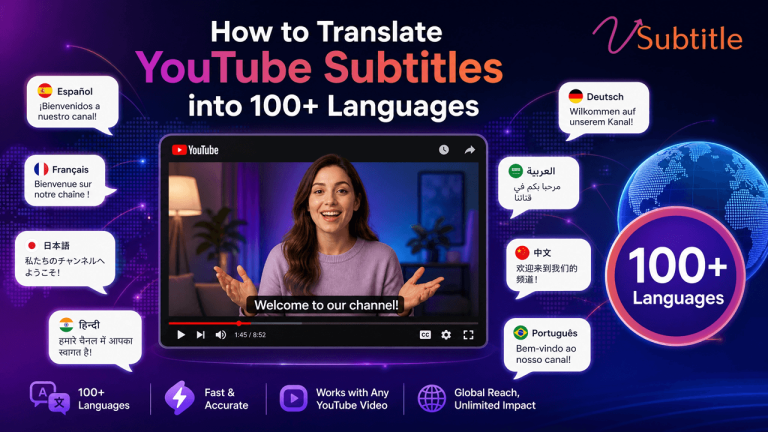
YouTube now auto-dubs video into 27 languages for free. The channels actually benefiting from that aren’t the ones who just flipped a switch — they’re the ones who built the caption foundation first.
Key Takeaways
- YouTube expanded AI auto-dubbing to all eligible creators across 27 languages in February 2026, removing the cost barrier that used to limit multi-language expansion to top-tier channels.
- On average, creators using multi-language audio tracks see over 25% of total watch time come from viewers watching in a non-primary language — audience that was previously unreachable.
- Jamie Oliver’s team saw a 3x increase in international viewership after adding Spanish, Portuguese, and Hindi audio tracks; MrBeast’s team runs over 30 language dubs per video.
- YouTube’s own guidance is explicit that audio alone isn’t enough — a channel needs captions, translated titles and descriptions, and enough localized content for algorithmic recommendation loops to actually take hold in a new language market.
- Captions should come before dubbing in the rollout sequence: they’re faster, cheaper, and serve as a reliable test of language demand before investing in audio localization.
- YouTube officially supports two global strategies — one consolidated multi-language channel, or separate localized channels per region — and the right choice depends on channel size and content type, not a universal best practice.
YouTube has spent the last two years quietly rebuilding itself around multilingual discovery. Multi-language audio tracks rolled out to millions of creators starting in late 2025, and by February 2026 AI auto-dubbing had expanded to every eligible creator across 27 languages — a feature that used to require a dedicated localization budget now runs automatically on a free upload. According to YouTube’s own official guidance on reaching global audiences, this shift is explicitly positioned as a growth strategy, not a convenience feature.
The channels actually capturing that growth aren’t simply the ones who flipped on auto-dubbing and waited. They’re the ones who built the underlying caption and localization foundation first — because, as YouTube’s own creator guidance makes clear, audio translation alone rarely moves the needle without captions, localized metadata, and a critical mass of content in the target language behind it. This guide covers what the current data shows, how YouTube’s own recommended global strategies work, and a practical workflow for building toward genuine international reach rather than a superficial multi-language label.
Which Channels Benefit Most From This Strategy
Not every channel stands to gain equally from a global push, and being realistic about this up front saves wasted effort. Mid-size creators with broadly applicable content — tutorials, science explainers, entertainment, product reviews — tend to see the strongest returns, since they’re often operating in increasingly saturated English-language markets while sitting on content that translates cleanly into other languages. Channels built around culture-specific humor, highly local references, or content tightly tied to a single region’s context typically see a smaller lift, since the barrier isn’t really the language — it’s the relevance of the content itself to an audience outside that original context.
This distinction matters when deciding where to invest first. A travel or cooking channel with broadly relatable content is a strong candidate for an aggressive multilingual push; a hyper-local news commentary channel may get more value from treating international expansion as a smaller, lower-priority experiment rather than a core growth strategy.
What YouTube’s Own Data Shows About Going Global
| Finding | Why It Matters |
|---|---|
| AI auto-dubbing expanded to all eligible creators across 27 languages in February 2026 | The cost barrier that limited multi-language expansion to top-tier, well-resourced channels has largely been removed |
| On average, over 25% of watch time on multi-language-audio videos comes from the non-primary language | A substantial share of a channel’s real growth potential may already be sitting in an audience it isn’t currently reaching |
| Over 40% of watch time in some of YouTube’s own multi-language tests came from dubbed tracks specifically | In certain niches, non-native-language viewers can become the majority of a video’s actual audience |
| Jamie Oliver’s team saw 3x international viewership growth after adding Spanish, Portuguese, and Hindi audio | A single, well-established channel can meaningfully multiply its reach without producing new content |
| MrBeast’s team runs 30+ language dubs per video using an in-house localization operation | The ceiling on language expansion is operational capacity, not audience demand — demand clearly exists well beyond 30 languages’ worth of viewers |
| Non-English-market creators are growing faster than English-only channels in many niches as of 2026 | Betting entirely on English-only content is an increasingly conservative strategy, not a neutral default |
YouTube’s Two Official Global Growth Strategies
According to YouTube’s own creator documentation, there are two broadly supported approaches to reaching a global audience, and choosing between them is a real strategic decision rather than a formality:
Strategy 1: One Consolidated Multi-Language Channel
Keep all content on a single channel, adding captions, translated titles and descriptions, and multi-language audio tracks to existing videos. This consolidates subscribers and viewership in one place, keeps branding and tone consistent, and is the lower-overhead option for a single creator or a small team to manage — one channel, one analytics dashboard, one community to maintain, with language access layered on top.
Strategy 2: Separate Localized Channels Per Region
Create dedicated channels for specific languages or regions, each with fully localized branding, community management, and content tailored to that audience. This gives each regional audience a more tailored, native-feeling experience, but splits subscribers and watch-time data across multiple channels and requires meaningfully more ongoing management — generally the approach larger, better-resourced creators and media companies adopt once a specific regional audience has already proven itself.
For most creators and growing channels, starting with the single consolidated-channel approach and expanding into dedicated regional channels only once a specific language shows strong, proven traction is the lower-risk path — exactly the sequencing the real-world case example of testing a dedicated Portuguese channel before folding it back into multi-audio tracks on higher-performing channels illustrates.
Why Captions Come Before Dubbing in a Global Rollout
- Captions are faster and cheaper to produce, letting a channel test demand in a new language within days rather than committing to a production-heavy dubbing investment up front.
- Captions and translated metadata directly feed YouTube’s search and recommendation system, which is how a video actually gets discovered by a non-native-language audience in the first place — dubbed audio alone doesn’t change what text YouTube indexes.
- Reviewed, accurate captions reduce errors that would otherwise carry into an eventual dubbed version, since translated audio is typically built from the same underlying translated text.
- Caption performance data — which translated languages actually earn watch time — gives a channel real evidence for which markets justify the bigger investment of dubbing, rather than guessing based on population size alone.
This progression mirrors what’s covered in more depth in our piece on multilingual captions and YouTube watch time — captions are frequently the fastest, lowest-risk way to validate a language market before layering on audio localization.
A Step-by-Step Workflow for Building a Global Channel
- Identify candidate languages using existing channel data — YouTube Analytics shows watch time and viewer geography by country, which usually reveals non-English-speaking audiences already watching despite the language barrier.
- Start with your best-performing videos, not the full back catalog. YouTube’s own 2026 guidance specifically recommends testing with top-performing content first, adding one additional language at a time.
- Caption those videos accurately in the target language first, reviewing for errors before anything else is built from that translated text.
- Translate titles, descriptions, and thumbnails for the same videos — captions alone don’t change what surfaces in a non-English search or suggested-video feed.
- Layer on multi-language audio once a language shows measurable caption performance, using either YouTube’s free AI auto-dubbing or custom-uploaded dubbed tracks for more control over quality.
- Adapt community-facing elements — pinned comments, channel description, community posts — in the target language once there’s a critical mass of content for that audience to engage with.
- Decide between consolidating on one channel or spinning off a dedicated regional channel only after a language has shown sustained traction, not before.
Auto-Dubbing vs. Custom Multi-Language Audio Tracks
As of 2026, YouTube offers two distinct tools for adding non-English audio to a video, and they serve different purposes in a global growth strategy:
| Option | How It Works | Best For |
|---|---|---|
| Automatic dubbing | Free, AI-generated voice dubs applied automatically across 27 supported languages | Fast, low-cost testing of a video’s performance in a new language with minimal production effort |
| Custom multi-language audio tracks | Creator-uploaded dubbed audio, with full control over voice quality and matching localized metadata | Proven, high-value languages where quality and brand consistency matter more than speed |
A practical pattern many creators follow: use free auto-dubbing to quickly gauge interest across a wider set of languages, then replace the automatic dub with a custom, higher-quality track — human-voiced or carefully reviewed AI dubbing — once a specific language has proven itself through sustained watch time, the same way captions are used to test demand before investing further.
Measuring Whether a Global Strategy Is Actually Working
YouTube Analytics breaks down watch time and audience geography by language and region, which makes it possible to track global strategy performance directly rather than guessing:
- Watch time share by audio or caption language, to see which non-primary languages are actually converting into real engagement, not just technically available.
- Drop-off rate by language, since a translated track with high early viewership but a steep early drop-off usually signals a quality or cultural-fit problem worth investigating, not just a language worth abandoning.
- Subscriber growth attributable to specific regions, tracked over the weeks following a language’s initial rollout rather than judged immediately.
- Comment and community engagement in the target language, which often signals whether an audience is sticking around past a single video, a leading indicator for whether dedicated regional content is worth the investment.
Common Mistakes in Global Channel Strategy
- Turning on auto-dubbing and expecting it alone to drive growth — YouTube’s own guidance is explicit that audio without captions, translated metadata, and enough localized content rarely triggers meaningful algorithmic uplift in a new region.
- Dubbing the entire back catalog into a new language before confirming there’s enough content for recommendation loops to actually take hold — a single dubbed video surrounded by untranslated content gives viewers little reason to stay in the ecosystem.
- Treating every language identically rather than tracking drop-off rates by language and adjusting investment based on what the data actually shows.
- Launching a dedicated regional channel before a language has proven itself through captions and multi-audio tracks on the main channel first.
- Skipping community localization — comments, pinned posts, channel branding — while still expecting an international audience to engage the way a native-language audience would.
- Assuming the strategy is one-size-fits-all: YouTube’s own guidance notes that culture-specific or highly local content often sees less benefit from dubbing than broadly applicable topics like tutorials, science, or entertainment.
Making the Caption Foundation Fast Enough to Actually Test Languages
Every strategy above depends on the same first step: accurate, reviewed captions in each candidate language, produced quickly enough to actually test demand before committing to dubbing. vSubtitle’s AI subtitle generator is built for exactly this — it transcribes a video’s audio into an accurate, editable caption track, then translates it into 100+ languages while preserving the original timing, so a channel can caption its top-performing videos across several candidate markets in a single pass rather than a separate manual project per language.
For a closer look at how AI-generated captions compare to YouTube’s own built-in auto-captions specifically, our comparison guide covers the accuracy and control differences that matter most for a channel building a serious international strategy. Our beginner’s guide to AI subtitling and our guide to AI subtitles and video SEO are useful next steps for turning this into a repeatable part of a channel’s publishing workflow.
Frequently Asked Questions (FAQs)
Is YouTube’s free AI auto-dubbing enough to grow internationally on its own?
Not reliably on its own. YouTube’s own guidance notes that adding audio without captions, translated metadata, and enough localized content often won’t trigger meaningful algorithmic uplift in a new region. Auto-dubbing works best layered on top of an existing caption and localization foundation, not as a standalone switch to flip.
Should a growing channel use one multi-language channel or separate regional channels?
YouTube officially supports both strategies. A single consolidated channel is generally the lower-overhead option for smaller teams and is a reasonable default starting point, while dedicated regional channels suit larger creators with proven, sustained traction in a specific language who can support the added management overhead.
How much of a channel’s watch time can come from non-primary-language viewers?
YouTube’s own data shows creators using multi-language audio tracks see, on average, over 25% of total watch time coming from the video’s non-primary language, with some tests showing over 40% — a substantial, often underestimated share of a channel’s real audience potential.
Why do captions matter if YouTube can auto-dub videos for free?
Captions and translated metadata are what actually feed YouTube’s search and recommendation systems in a given language — dubbed audio alone doesn’t change what text gets indexed. Captions are also faster and cheaper to produce, making them a practical way to test language demand before committing to a dubbing investment.
How many languages should a channel target when starting out?
YouTube’s own 2026 guidance recommends starting with a channel’s best-performing videos and testing one additional language at a time, rather than translating the full catalog into many languages at once. Expanding further should follow the performance data from that initial test.
Does every type of content benefit equally from going multilingual?
No. Broadly applicable content — tutorials, entertainment, science, and similar topics — tends to see stronger results from dubbing and translation than highly culture-specific or locally rooted content, which YouTube’s own guidance suggests treating as more of an experiment than a core growth strategy.