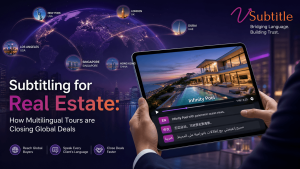
A buyer in Seoul or Mexico City can already see the property. What they can’t do is understand the agent describing it — until the video is subtitled.
Real estate has quietly become one of the most international transaction categories in consumer purchasing. Foreign buyers purchased tens of billions of dollars’ worth of U.S. existing homes over a recent 12-month period alone, with a large share paying entirely in cash and moving fast once a property earns their confidence. Similar patterns show up across other markets with international demand — Swiss cantons bordering three language regions, Gulf-facing luxury markets, and vacation-property hotspots that draw buyers from a dozen countries for a single development.
Video has already become the default way these buyers evaluate a property before ever booking a flight. Listings with video draw dramatically more inquiries than listings without, and video walkthroughs now rank as the single most useful content type for buyers, ahead of photos and floor plans. What most of that video still doesn’t do is speak the buyer’s language. A property tour narrated only in English, or only in the local listing language, quietly excludes a large and often highly qualified share of the exact audience it’s trying to reach. Subtitling — not necessarily full dubbing — is the fastest, most practical fix, and it’s becoming a genuine competitive differentiator for agents and developers working international pipelines.
Why Video Already Closes Deals — and Why Language Is the Remaining Gap
The case for real estate video itself is no longer in question. Listings with video receive substantially more inquiries than listings without, generate significantly more organic search traffic, and are associated with homes selling for a measurable premium over comparable properties marketed without it. The large majority of buyers say they’d watch a video tour if one were available, and an overwhelming share of buyers who use a video walkthrough report being more likely to move forward with a purchase.
| Finding | Why It Matters for International Buyers |
|---|---|
| Video listings receive far more inquiries and organic search traffic than listing without video | International buyers researching remotely rely on video even more heavily, since a site visit isn’t an option early in their search |
| Homes marketed with video sell for a measurable premium over comparable listings | The premium logic extends further when video actually reaches — and is understood by — the full pool of qualified buyers, not just local-language ones |
| Video walkthroughs are the single most useful content type for buyers, ahead of photos and floor plans | A walkthrough only delivers that value if the narration is actually comprehensible to the viewer watching it |
| Tens of billions of dollars in existing-home purchases came from foreign buyers in a recent 12-month period, with roughly half paying cash | This is not a marginal segment — it represents a sizable, well-resourced, remote-first buyer pool that transacts quickly once confident |
| A large share of international buyers researching a property never see it in person before making an offer | Video is effectively standing in for the in-person walkthrough — and if it isn’t understandable, it fails at exactly the moment trust needs to be built |
Put together, these numbers describe an audience that’s already primed to buy remotely, already relying heavily on video to do it, and already large enough to matter to any agent or developer with genuine international exposure. The missing piece isn’t more video — it’s video that a non-native-language buyer can actually follow.
Why Subtitles Are the Right First Move — Not Full Dubbing
Full multilingual dubbing exists and works well for high-end developments with the budget to support it, but for the majority of listings and agencies, subtitles deliver most of the benefit at a fraction of the cost and turnaround time:
- Speed to market: A property tour can be subtitled in hours, not the days or weeks professional dubbing and voice casting require — critical in a market where listing freshness matters and international buyers are often comparing several properties at once.
- Preserves the agent’s voice and credibility: Buyers evaluating a property remotely are also evaluating the agent representing it. Subtitles keep the agent’s actual voice, tone, and presence intact rather than replacing it with a dubbed voiceover that can feel impersonal for a transaction this significant.
- Works for muted, on-the-go viewing: International buyers frequently first encounter a listing while scrolling on a phone, often in a public or shared setting where sound isn’t an option — subtitles reach that viewer immediately, where dubbed audio does nothing until they choose to unmute.
- Scales across many languages at once: A single tour can be subtitled in a dozen languages faster and more cheaply than it could realistically be dubbed into even two or three, letting an agency cover a genuinely global buyer pool from one recorded walkthrough.
- Doubles as searchable, indexable text: A subtitled tour’s transcript can be published alongside the listing, giving search engines a language-matched version of the property description that plain video and photos never provide.
What Multilingual Subtitles Actually Signal to a Buyer
Beyond comprehension, subtitling a property tour sends a specific, trust-building message to an international buyer: this agent, developer, or brokerage is set up to work with someone like them. For a transaction where a buyer may be moving tens or hundreds of thousands of dollars across currencies and time zones without ever setting foot on the property beforehand, that signal matters as much as the production quality of the video itself. Reports on international buyer behavior consistently point to the same underlying pattern: if a property and the process around it can’t be understood remotely, it struggles to earn serious consideration from a buyer evaluating it from another country — no matter how strong the property itself is.
This is especially pronounced in regions with inherent linguistic diversity even within a single national market. Property marketing across Swiss cantons, for example, routinely needs German, French, and Italian versions depending on the canton, with English added for the expatriate and foreign-investor audience that increasingly drives premium transactions — a pattern that repeats, in different language combinations, across most markets with meaningful cross-border buyer activity.
Where This Matters Most: Market Patterns Worth Knowing
Luxury and Resort Markets
High-value vacation and resort properties routinely draw buyers from a dozen or more countries for a single development. Here, subtitled tours in the top four or five buyer languages — often English plus regional variants like Mandarin, Arabic, Russian, or Spanish depending on the destination — can meaningfully widen the qualified buyer pool for a listing that would otherwise lean on English alone.
Multilingual Domestic Markets
Countries or regions with multiple official or widely spoken languages — Switzerland’s cantons, Canada’s English/French split, parts of Belgium — need multilingual video even for buyers who never cross a border. A German-language tour of a Geneva property, or an English-only tour of a Ticino listing, can lose a domestic buyer just as easily as an international one.
Investment and Cash-Buyer Segments
Foreign cash buyers, who represent a substantial share of international real estate purchasing activity, often move quickly once confident in a property and are more likely to transact remotely without an in-person visit. For this segment specifically, a clear, subtitled walkthrough often functions as the primary — sometimes only — substitute for physically seeing the property before committing.
A Practical Workflow for Multilingual Property Tours
- Identify buyer-language priorities before shooting. Review past inquiry data, referral sources, and the specific market the listing or development is targeting — a coastal vacation-property market and a gateway-city luxury condo tower will likely need very different language shortlists.
- Record one clean, well-narrated tour in the agent’s or presenter’s original language, prioritizing steady pacing and clear enunciation of property details — room dimensions, included features, HOA or strata terms — since these are the details most likely to matter to a serious buyer and most likely to be mistranscribed if rushed.
- Generate an accurate source caption track and review it. vSubtitle transcribes the tour’s narration automatically into an editable caption file, which becomes the foundation every translated version is built from — reviewing this file for property-specific terms and numbers before translating protects accuracy across every language downstream.
- Translate into the shortlisted buyer languages. vSubtitle translates the reviewed caption file into 100+ languages while preserving the original timing, so subtitles in every language stay in sync with the walkthrough without manual re-timing for each one.
- Export and attach the translated subtitle tracks to every version of the tour — the listing page embed, YouTube upload, and any version shared directly with international buyers or referral partners — so the same recorded walkthrough serves every language market from one production.
- Publish a transcript in each language alongside the video where possible, giving international buyers a text version they can scan quickly and giving search engines language-matched content tied to the listing.
- Track engagement by language where analytics allow, and prioritize future dubbing or dedicated-language marketing for whichever regions show the strongest response — treating subtitled tours as the low-cost test before committing to a bigger production investment in a specific market.
Common Mistakes in Multilingual Real Estate Video
- Relying on a viewer’s browser or platform auto-translate instead of publishing real, reviewed subtitle tracks — machine auto-translate on the fly is far more error-prone with property-specific numbers and terms than a reviewed file.
- Skipping language prioritization and guessing which markets matter, rather than checking actual inquiry and referral data first.
- Leaving numbers, measurements, and currency figures unreviewed in translated captions — an error here isn’t just embarrassing, it can misrepresent material facts about the property.
- Producing a tour in only one language for a market or development with clearly documented multilingual buyer demand, such as a Swiss canton or an internationally marketed resort community.
- Treating subtitles as a one-time task rather than updating them whenever price, availability, or key details about the listing change.
Making Multilingual Tours Realistic for Every Listing
The barrier to multilingual property video has never really been the video — most agents and developers already have walkthrough footage. The barrier has been the time and cost of translating it into enough languages to actually reach a global buyer pool. vSubtitle removes most of that friction: it generates accurate captions directly from a tour’s narration, translates them into 100+ languages while keeping every cue timed to the walkthrough, and exports clean subtitle files ready to attach to a listing page, a YouTube upload, or a direct link shared with an international buyer or referral partner.
For an agency or developer working genuinely international pipelines, that turns a single recorded walkthrough into a dozen language-ready versions of itself in an afternoon — letting the video do what the data already shows it can do, for the full breadth of buyers actually watching it, not just the ones who happen to share the agent’s native language.
Key Takeaways
- Real estate video already drives measurably more inquiries, search traffic, and even sale price — but only for the audience that can understand the narration.
- International buyers represent a large, well-resourced, and increasingly remote-first segment of real estate demand, and video is effectively standing in for the in-person visit many of them skip entirely.
- Subtitles are the faster, cheaper, and often more credible first move compared to full dubbing — preserving the agent’s actual voice while reaching muted, on-the-go, and non-native-language viewers immediately.
- Multilingual video signals more than comprehension — it tells an international buyer the agent or developer is genuinely set up to work with them.
- A repeatable subtitle-first workflow, prioritizing languages by actual buyer data, lets one recorded tour serve many markets without a full re-shoot or costly dubbing investment up front.
The property doesn’t need to change to reach a bigger, more qualified pool of buyers — the video attached to it just needs to speak their language. For agents and developers with any real international exposure, that’s one of the highest-leverage, lowest-cost upgrades left on the table.
Frequently Asked Questions (FAQs)
Do international real estate buyers really rely on video that much?
Yes. Video walkthroughs consistently rank as the most useful content type for buyers, ahead of photos and floor plans, and a large share of international buyers evaluate a property remotely, often without visiting in person before making an offer. For that audience specifically, video is doing much of the work an in-person showing normally would.
Should I subtitle my property tours or fully dub them?
Subtitles are usually the better starting point. They’re faster and cheaper to produce, preserve the agent’s actual voice and credibility, and reach muted or on-the-go viewers immediately. Full dubbing can be worth the added investment for high-end developments or languages that subtitled tours have already shown strong engagement in.
How many languages should a property tour be subtitled into?
It depends on the market. Start with languages supported by actual inquiry, referral, or regional buyer data — a Swiss canton bordering multiple language regions or a resort market with documented international demand will justify a longer shortlist than a purely local listing.
Are auto-translated captions on YouTube or a listing platform good enough?
They’re a reasonable stopgap, but not a substitute for reviewed, creator-published subtitle tracks — machine auto-translate run live has a higher error rate, which is a particular risk for property-specific numbers like square footage, price, and dimensions where mistakes can misrepresent material facts.
Does multilingual video actually help a listing sell, or just get more views?
Both, in practice. Video listings already draw more inquiries and command a measurable sale-price premium over listings without video; extending that video’s comprehension to more of its actual audience — rather than just the local-language share — is a logical extension of the same effect, particularly for markets with documented international buyer activity.
How long does it take to subtitle a property tour in multiple languages?
With an AI subtitling tool like vSubtitle, translating a reviewed source caption file into several languages typically takes a fraction of the time manual translation would — often turning a single recorded tour into multiple language-ready versions within the same day.
Should the subtitle translations be reviewed by a native speaker?
Yes, at least for key details. Machine translation handles everyday phrasing well, but property specifics — measurements, pricing, legal or HOA terms — deserve a quick native-speaker check before publishing, since errors in these details carry more consequence than a stylistic imperfection elsewhere in the tour.