

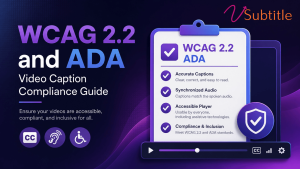
For years, digital video accessibility was treated by many organizations as a “nice-to-have” checklist item or an afterthought handled by unedited, automated platform toggles.
With the formalization of Web Content Accessibility Guidelines (WCAG) 2.2 and strict regulatory updates to Title II of the Americans with Disabilities Act (ADA), basic auto-generated text is no longer legally or operationally sufficient. State and local government bodies, public universities, medical systems, and major enterprises face hard compliance deadlines to bring their entire multi-media ecosystems up to par.
Failing to meet these standards leaves organizations vulnerable to expensive civil rights lawsuits and digital accessibility demand letters. More importantly, it locks out millions of deaf, hard-of-hearing, and neurodivergent individuals from safely engaging with your content.
Achieving true WCAG 2.2 and ADA video caption compliance requires moving beyond automated defaults toward frame-accurate, speaker-aware media workflows.
The Legal Landscape: ADA Title II and WCAG 2.2
Digital accessibility is governed across two primary regulatory frameworks: the technical standards (WCAG) and the civil rights laws that enforce them (ADA).
Web Content Accessibility Guidelines (WCAG) 2.2
Developed by the W3C, WCAG 2.2 builds on previous frameworks by expanding the criteria required to make web content accessible. Media compliance falls strictly under Guideline 1.2 (Time-based Media). To meet standard Level AA compliance—the benchmark standard for most corporate and legal requirements—organizations must satisfy multiple layers of media criteria:
- Success Criterion 1.2.2 (Captions – Prerecorded – Level A): Captions must be provided for all prerecorded audio content in synchronized media.
- Success Criterion 1.2.4 (Captions – Live – Level AA): Live streams, webinars, and real-time virtual events must offer synchronized live captions.
- Success Criterion 1.2.5 (Audio Description – Prerecorded – Level AA): Visual context (such as text on screen, chart data, or physical actions) must be narrated via an audio track or detailed in an adjacent descriptive transcript.
The ADA Title II Mandate
The Department of Justice (DOJ) updated its rule under Title II of the ADA, explicitly mandating that public entities—including state and local municipalities, public higher education institutions, and transit authorities—ensure their web content and mobile apps align with WCAG Level AA standards.
The implementation timeline leaves no room for stalling:
- Public entities with populations over 50,000 must ensure full digital compliance.
- Public entities with populations under 50,000 must fulfill these requirements shortly thereafter, depending on state-level grace windows.
This rule covers not only public-facing websites, but also internal intranet portals, human resource training videos, and password-protected Learning Management Systems (LMS) like Canvas or Blackboard.
Why Default Auto-Captions Fail Legal Compliance
Many production teams assume they are compliant because they click the “auto-generate captions” button on platforms like YouTube, Zoom, or native web players. This is a critical misconception.
Traditional Automatic Speech Recognition (ASR) software typically achieves an accuracy rate of 80% to 90%. While this sounds high, a 15% error rate means that 15 out of every 100 words are wrong. Technical jargon, brand names, regional accents, and overlapping conversations quickly degrade auto-generated outputs into nonsensical text.
W3C/DOJ Clarity: Regulatory bodies do not explicitly ban ASR technology, but they state that uncorrected auto-captions do not satisfy compliance standards. If your automated caption misinterprets a vital instructional step, medication name, or safety warning, your organization is non-compliant. Legal compliance requires 99%+ accuracy thresholds.
Technical Specifications for Compliant Captions
To withstand an accessibility audit, captions must conform to specific presentation, structural, and behavioral metrics. Simply displaying words on screen is not enough.
1. Complete Synchronization
Captions must appear on screen in perfect sync with the spoken audio track. The industry tolerance for legal compliance is within 3 frames or 100 milliseconds of the sound onset. Delays confuse users who rely on lip-reading or residual hearing alongside text.
2. Comprehensive Sound Descriptions (Non-Speech Audio)
Deaf and hard-of-hearing viewers must receive the exact same contextual experience as hearing viewers. Captions must document meaningful atmospheric audio elements using brackets:
- Sound Effects: [door slams], [glass shatters], [laughter]
- Musical Cues: [tense orchestral music playing], ♪ upbeat pop melody ♪
- Manner of Speech: [whispering], [sarcastically]
3. Clear Speaker Identification
When multiple individuals interact on camera, or when a narrator speaks over b-roll footage, the caption text must identify the source. This is achieved by printing the speaker’s name or title in brackets before their dialogue lines:
[Dr. Sarah Evans] The clinical trial yields promising baseline metrics.
[Tom] Were there any notable adverse reactions in group B?
[Dr. Sarah Evans] Minimal. We noted mild fatigue in under 4% of participants.
4. Layout, Readability, and Line Breaking
To prevent cognitive overload, text layout must follow explicit spatial limits:
- Line Caps: Maximum of 2 lines on screen at any given moment.
- Character Limits: 32 to 42 characters per line to ensure rapid readability.
- Duration: A caption chunk must remain on screen for a minimum of 1 second, and no single frame should exceed a reading speed of 15 to 20 characters per second.
- Placement: Captions must be positioned cleanly to prevent obscuring critical visual content, burnt-in lower thirds, or presentation slide titles.
Media Player Accessibility: The Forgotten Half of Compliance
Even if your subtitle file (.srt or .vtt) is perfectly accurate, your video presentation can still fail compliance checks if the media player framework itself blocks accessibility tools.
Under WCAG Guidelines 2.1.1 (Keyboard) and 2.4.7 (Focus Visible), your embedded video players must meet strict interface rules:
- Total Keyboard Operability: Users must be able to control every video feature (Play, Pause, Volume, Seek, Full Screen, Caption Toggle) using only standard keyboard inputs (Tab, Enter, Space, Arrow keys). If a user gets “trapped” inside the video frame and cannot tab out, your site fails compliance.
- Screen Reader Semantics: Every playback button must feature explicit ARIA labels. A screen reader should announce “Play video,” rather than reading out an unlabelled asset like “Button graphic 04.”
- Preference Persistence: If a user selects closed captions on your initial introductory video, that setting must dynamically persist across every successive clip played within that digital session.
Operational Blueprint: Auditing and Remediating Video Backlogs
If your organization owns an existing catalog of uncaptioned or poorly auto-captioned legacy video assets, you must implement a structured “Remove or Remediate” workflow to mitigate liability.
Step 1: Run an Asset Inventory
Locate and log every video hosted across your organization’s digital web footprints, help centers, landing pages, and training portals. Categorize them into two core buckets:
- Active Assets: Videos actively used for operations, public education, marketing, or current course curricula.
- Archived Assets: Historical records or long-inactive media that qualify for safe-harbor legal archiving exceptions under local guidelines.
Step 2: Automated Batch Processing via vSubtitle
Upload your active catalog to a dedicated caption management engine like vSubtitle. Use the advanced AI transcription tools to rapidly establish base-layer timelines, speaker separation, and structural formats across your content.
Step 3: Human Verification and Alignment Review
Task your team or an internal accessibility editor to audit the generated transcript outputs. Fix any spelling mistakes in specialized jargon, confirm that music cues are noted correctly, and adjust line breaks to stay under the 42-character cap per line.
Step 4: System Integration and File Deployment
Export the compliant transcripts as sidecar files. For modern web environments, prefer .vtt formats because they natively support styling configurations and precise screen placement data. Re-upload these files to your media host to verify that accessibility controls function properly.
FAQs: Video Caption and ADA Compliance
What is the specific difference between open captions and closed captions regarding legal compliance?
Closed captions (.srt, .vtt) can be toggled on or off by the viewer via the media player interface. Open captions are permanently burned directly into the video frames during rendering and cannot be hidden. Both formats are acceptable for ADA compliance, provided the text meets accuracy, timing, and formatting metrics. However, closed captions are generally preferred because they remain readable by screen readers and allow users to customize text sizing.
Are internal, password-protected videos exempt from ADA Title II requirements?
No. ADA Title II explicitly applies to all programs, services, and activities of public entities. This includes internal employee training modules, workplace intranet announcements, and academic lectures hosted inside password-protected Learning Management Systems (LMS). If an employee or student with a hearing disability requires access, the content must be compliant.
What are the legal penalties for failing to provide compliant video captions?
Non-compliance can result in formal civil rights investigations by the Department of Justice, loss of federal funding for educational institutions, and class-action lawsuits. Civil penalties for violating Title II or Title III of the ADA can result in significant financial fines for a first violation, alongside mandatory court-ordered remediation timelines and coverage of the plaintiff’s legal fees.
Does WCAG 2.2 require transcripts in addition to synchronized captions?
For Level AA compliance on synchronized media (videos containing both audio and visual tracks), synchronized captions and audio descriptions are the core requirements. However, providing a descriptive transcript (which combines both dialogue and visual descriptions into a single text file) is a required step for audio-only assets (like podcasts) and serves as an excellent, highly recommended baseline asset to achieve Level AAA status.
By anchoring your post-production and media distribution processes around verified, highly accurate caption files, you isolate your organization from compliance risks while opening your brand to a larger audience.