

Medical education is arguably the most demanding environment for video content. A single lecture on pharmacokinetics, a surgical technique walkthrough, or a case-based pathology session can contain hundreds of highly specific clinical terms — words that students are encountering for the first time, in a second language, at high speed, from an instructor with a regional accent.
Without captions, these videos ask students to absorb dense, unfamiliar terminology purely through listening — a task that cognitive science tells us is significantly harder than reading alongside audio. With well-produced AI captions, the same content becomes dramatically more comprehensible: every term is visible on screen, spellings are confirmed, and students can pause, re-read, and cross-reference in real time.
In 2026, leading medical schools, nursing programmes, CME providers, and health sciences eLearning platforms have made AI captioning a standard part of their content production workflow. This article explains exactly how they’re doing it, what results they’re seeing, and how any medical educator can implement the same approach — starting today, for free.
| 🏥 This post is written for medical educators, health sciences instructors, CME content producers, nursing programme directors, and anyone producing clinical or healthcare video content for students or professionals. |
1. The Challenge: Why Medical Video Content Is Especially Hard to Follow
Medical education faces a unique set of comprehension challenges that make captions more valuable here than in almost any other field. Understanding these challenges explains why AI captioning has been adopted so rapidly in health sciences education.
Density of Unfamiliar Terminology
A first-year medical student encounters an estimated 10,000–13,000 new vocabulary terms in their first two years of study. A 20-minute anatomy lecture may contain 80–100 unique clinical terms — many of which the student has never heard spoken aloud before. When the term appears only in audio, the student is simultaneously trying to parse phonetics, map spelling, understand meaning, and retain context. Captions eliminate the phonetic parsing step entirely — the term is visible on screen exactly as it should be spelled and written.
Non-Native English Speakers
Medical schools globally increasingly enrol students whose first language is not English. In the US alone, roughly 22% of medical students report English as a second language. For students in international medical programmes — taught in English in countries where English is not the primary language — the comprehension gap is even wider. A student who can read and understand “subcutaneous haematoma” with confidence may struggle to identify it by ear from a fast-speaking lecturer with an unfamiliar accent.
High-Stakes Retention Requirements
In most fields, misunderstanding a lecture is inconvenient. In medicine, it can have consequences that extend to patient care. The stakes of medical education demand a higher standard of comprehension than general eLearning — which means any tool that measurably improves retention and understanding has outsized value. Captions are one such tool.
Accessibility and Disability Compliance
Medical schools and health sciences programmes are educational institutions subject to accessibility laws — including Section 504, the ADA, and WCAG 2.1 AA in the US; and equivalent frameworks in the UK, EU, Canada, and Australia. All video content must have accurate closed captions. Given the complexity of medical terminology, standard auto-captions frequently fail accuracy requirements in this domain — making a tool with high accuracy and a robust editor essential.
| 10K+New terms a medical student encounters in year 1–2 | 22%Of US medical students report English as a 2nd language | 40%Better comprehension scores with captions vs audio-only | 95%+AI caption accuracy with vSubtitle on clear audio |
| 📊 Research from multiple medical education studies shows that captions improve terminology retention by 25–40% compared to audio-only video — particularly for non-native English speakers and students encountering terms for the first time. |
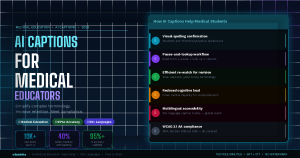
2. How AI Captions Specifically Help With Medical Terminology
The benefits of AI captions in medical education go well beyond basic accessibility. Here are the specific mechanisms through which captions improve comprehension of complex clinical content:
Visual Confirmation of Spelling
Medical terminology is notoriously difficult to spell — and spelling matters enormously in clinical practice. A student who hears “thrombocytopenia” for the first time can approximate the sound, but seeing it displayed in a caption simultaneously anchors the spelling, the syllable structure, and the pronunciation in a single moment. This multi-modal encoding — hearing and reading simultaneously — produces significantly stronger memory traces than audio alone.
| 🧠 The dual-coding effect: cognitive science research consistently shows that information encoded through two sensory channels simultaneously (audio + text) is retained more effectively than information encoded through a single channel. Captions exploit this effect directly. |
Pause-and-Look-Up Behaviour
When a student encounters an unfamiliar term in a captioned video, they can pause the video, read the term on screen, and look it up in a medical dictionary or textbook — then resume. Without captions, this workflow requires the student to guess the spelling of a term they’ve only heard once in order to search for it. Captions make the pause-and-reference workflow frictionless, which means it actually happens — rather than students simply moving on and hoping the gap in understanding resolves itself later.
Re-Watch Efficiency
Medical video content is routinely re-watched for revision. With captions, a student re-watching a pharmacology lecture to prepare for an exam can read along at their own pace, scan forward to specific sections by tracking caption text, and quickly identify the moments where new terms are introduced. This makes revision sessions significantly more efficient — a meaningful advantage in a curriculum where time pressure is constant.
Reduced Cognitive Load
Following a dense medical lecture requires students to simultaneously listen, decode unfamiliar phonetics, retain meaning, take notes, and connect new information to existing knowledge. Each of these tasks draws on the same limited cognitive resource pool. Captions offload the phonetic decoding task — freeing up cognitive capacity for comprehension, connection-making, and retention. This effect is most pronounced for non-native English speakers, but is measurable across all student groups.
Terminology Consistency Across Lectures
AI captions — especially when produced by a tool with high accuracy and an editorial review step — create a consistent written record of the exact terminology used across an entire curriculum. When a term like “myocardial infarction” is captioned consistently in every lecture it appears, students see the same written form repeatedly — reinforcing the connection between spoken and written form faster than audio exposure alone.
3. Real-World Applications: How Medical Educators Are Using AI Captions
Here are the most common ways medical education programmes and healthcare content producers are integrating AI captioning into their workflows in 2026:
| 📚 Medical School Lecture Capture🔴 Challenge: A 200-hour pre-clinical curriculum delivered via recorded lectures. Students include international learners with varying English proficiency. Auto-captions on the LMS were riddled with errors on terms like ‘glomerulonephritis’ and ‘cholecystokinin’.🔵 Solution: Programme coordinator uploads all recorded lectures to vSubtitle in batches. AI generates captions at 95%+ accuracy. Faculty review and correct a small set of programme-specific abbreviations and eponyms. Corrected SRT files uploaded to Canvas LMS.✅ Result: International students report significantly higher confidence in terminology. Faculty receive fewer ‘how do you spell X’ queries. Programme achieves WCAG 2.1 AA compliance across all lecture content. |
| 💉 Nursing Skills Training Videos🔴 Challenge: A nursing school produces 60+ procedural training videos (IV insertion, catheterisation, wound care). Videos narrate complex equipment names and step-by-step clinical procedures. Students watching on mobile in clinical placements had difficulty following audio in noisy ward environments.🔵 Solution: Each skills video captioned using vSubtitle. Captions include equipment names, clinical terms, and step-count callouts from the narration. Burned-in MP4 versions created for mobile viewing in clinical settings where SRT file upload isn’t practical.✅ Result: Students report being able to reference procedure steps on-screen mid-practice without replaying audio. Errors in procedural recall decrease. Videos repurposed as patient education materials — same captions serve dual audience. |
| 🏥 CME (Continuing Medical Education) Platform🔴 Challenge: An online CME provider offering 500+ accredited video modules across specialties including cardiology, oncology, and neurology. Platform needed to meet ADA and WCAG 2.1 AA compliance. Manual captioning of 500 hours of content was cost-prohibitive.🔵 Solution: vSubtitle used to process entire video library in batches. Medical review team performs targeted correction of specialty-specific terminology (drug names, diagnostic criteria, clinical guidelines). Multi-language tracks added for modules targeting international audiences.✅ Result: Full compliance achieved across 500+ modules. Average correction time per module: 8 minutes. Total captioning project completed in 6 weeks vs 18-week estimate for manual captioning. Platform achieves accreditation renewal without accessibility findings. |
| 🔬 Pathology and Histology eLearning🔴 Challenge: A pathology department produces video walkthroughs of histological slides — narrating findings like ‘poorly differentiated adenocarcinoma with perineural invasion’. Auto-generated captions consistently mis-transcribed diagnostic language, producing meaningless text.🔵 Solution: vSubtitle’s AI correctly transcribes most pathological terminology at first pass. Department creates a standard review checklist of 40 most commonly miscaptioned terms. Review pass takes 10–12 minutes per 30-minute module.✅ Result: Students use captioned videos as primary study resource for board exam preparation. Caption text searched and referenced alongside pathology atlases. Completion rates on revision modules increase by 34%. |
| 🌍 Global Health Education Initiative🔴 Challenge: A nonprofit publishing open-access global health video lectures for students in low-resource settings. Students span 40+ countries with diverse English proficiency levels. Videos previously inaccessible to students in non-English-speaking regions.🔵 Solution: vSubtitle used to generate captions in English first, then AI-translated to Spanish, French, Hindi, Portuguese, and Swahili. Each language track uploaded to YouTube as a separate caption file — making the same lecture accessible to students in five additional language communities.✅ Result: Total views increased 3× within 90 days of adding multilingual captions. Students from Brazil, India, and Francophone Africa — previously unable to follow lectures — now complete full course sequences. Initiative cited as a model for open-access global health education. |
4. The Medical Terminology Accuracy Challenge — And How to Solve It
The most significant concern medical educators have when evaluating AI captioning tools is accuracy on clinical terminology. This is a legitimate concern — and it’s worth addressing directly.
Why Medical Terminology Is Hard for AI
Clinical terminology presents specific challenges for AI speech recognition:
- Rare occurrence in training data: Terms like ‘eosinophilic granulomatosis with polyangiitis’ appear far less frequently in the text data used to train AI models than everyday language.
- Phonetic ambiguity: Terms like ‘ileum’ and ‘ilium’, ‘mucus’ and ‘mucous’, or ‘complement’ and ‘compliment’ are phonetically similar or identical and require contextual disambiguation.
- Eponyms and abbreviations: “Addison’s disease”, “the ICU”, “STEMI” — these require the AI to match spoken forms to written conventions.
- Latin and Greek roots: Medical Latin (“per os”, “ad libitum”) and Greek-derived terminology follow phonetic patterns that differ from standard English.
What vSubtitle’s AI Gets Right (and Where to Review)
vSubtitle’s AI achieves 95%+ accuracy on clear medical audio — significantly better than platform auto-captions. In practice, this means:
| Term Type | vSubtitle Accuracy & Recommendation |
| Common clinical terms | Excellent — ‘hypertension’, ‘diabetes’, ‘fracture’, ‘antibiotics’. Rarely errors. |
| Anatomical terminology | Very good — ‘tachycardia’, ‘myocardium’, ‘hepatic’, ‘renal’. Occasional review needed. |
| Drug names (generic) | Good for common drugs. Review brand names and newer agents introduced post-2024. |
| Drug names (brand) | Moderate — review all brand names. AI may transcribe phonetically rather than correctly. |
| Latin phrases | Good for common phrases. Review less-common Latin abbreviations. |
| Rare eponyms | Review all — ‘Addison’s’, ‘Cushing’s’, ‘Wolff-Parkinson-White’ etc. |
| Specialty abbreviations | Review all — ‘STEMI’, ‘ARDS’, ‘DVT’. AI may spell out or abbreviate differently. |
| Non-English medical terms | Variable — review all Latin, Greek, and non-English terms in full. |
The Medical Review Workflow
The most efficient approach for medical content is to build a two-stage review process:
- AI generation pass: vSubtitle generates the first-pass captions. For a 30-minute lecture, this takes 10–15 minutes of processing time.
- Targeted medical review: A reviewer with clinical knowledge scans the captions for the category of terms in the table above. For most medical lectures, this takes 10–15 minutes.
Total time investment for a compliant, accurate 30-minute medical lecture caption: approximately 25–30 minutes. Compare this to 3–4 hours for fully manual captioning of the same content.
| 💡 Pro tip for medical programmes: Build a corrections template — a running document of 30–50 terms your AI most frequently miscaptions. Share this with all reviewers so corrections are made consistently across your entire video library. |
5. Step-by-Step: Adding AI Captions to Medical Education Videos with vSubtitle
| 🎁 vSubtitle gives you 100 free minutes of AI captioning — no credit card, no watermark. That’s enough to caption 3–4 standard lecture videos to test the workflow before committing to any plan. |
| 🚀 Medical Content Captioning Workflow |
Step 1: Prepare Your Audio for Better AI Accuracy
Before uploading, brief audio optimisation pays dividends:
- Record lectures in a quiet room with a close-proximity microphone where possible
- Ask instructors to speak at a measured pace when introducing new terminology
- If re-recording isn’t possible, note sections with background noise or fast speech for targeted review
Step 2: Upload to vSubtitle
Go to vsubtitle.com and create your free account. Upload your video file (MP4, MOV, AVI, MKV) or paste in a YouTube or Vimeo URL if the lecture is already hosted. For batch processing, upload multiple files in your queue and let vSubtitle process them sequentially.
Step 3: Select Language and Generate
Select the lecture language. For English-language medical content, select English. vSubtitle’s AI will generate captions at 95%+ accuracy, with timestamps synced to the lecture audio. A 30-minute lecture takes approximately 10–15 minutes to process.
Step 4: Medical Terminology Review
Open the project in vSubtitle’s built-in timeline editor. Work through the captions with your corrections template to hand. Focus your review on:
- Drug names — both generic and brand
- Eponyms and syndrome names
- Specialty-specific abbreviations
- Latin and Greek phrases
- Any section where the instructor spoke particularly fast or quietly
For most 30-minute medical lectures, this review pass takes 10–15 minutes. Consider assigning this step to a graduate student, teaching assistant, or clinical staff member with the relevant subject knowledge.
Step 5: Add Accessibility Enhancements (Recommended)
For full deaf-friendly accessibility, add:
- Speaker labels where multiple faculty members or clinicians are present
- Sound descriptions for significant non-speech audio: [ X-ray imagery displayed ], [ Histology slide shown ]
- On-screen text descriptions: [ Slide title: Pathophysiology of Type 2 Diabetes ]
Step 6: Export and Upload to Your LMS
Export your caption file:
- SRT file: for Canvas, Moodle, Blackboard, Teachable, Kajabi, and most LMS platforms
- VTT file: for Coursera, edX, and web-based players
- Burned-in MP4: for videos distributed via WhatsApp groups, USB drives, or platforms without caption file support
Log into your LMS, navigate to the video settings, and upload the SRT or VTT file. Verify that captions display correctly and are toggleable by students. Document the captioning date and tool used for your compliance records.
6. Multilingual Medical Captions — A Game-Changer for Global Health Education
Perhaps the most transformative application of AI captioning in medical education is the ability to make English-language clinical content accessible to students and practitioners worldwide — in their own language.
vSubtitle’s translation feature allows medical educators to:
- Generate captions in the lecture’s original language first
- Translate those captions into 50+ additional languages automatically
- Export separate SRT files for each language
- Upload multiple caption tracks to YouTube, Vimeo, or LMS platforms
The implications for global health education are significant:
- Medical schools in non-English-speaking countries can supplement English-language lectures with caption tracks in the local language — making international medical content accessible to their students without re-recording.
- Global health nonprofits can multiply the reach of English-language public health videos across language communities with a single additional step in their production workflow.
- CME providers can serve international medical professional audiences with translated caption tracks — expanding accreditation reach without producing new content.
- Nursing programmes in multilingual cities can provide caption tracks in the first languages of their student cohort — improving outcomes for students for whom English is an additional language.
| ⚠️ AI translation of medical content requires careful review by a native-speaking clinical professional before being used as an official educational resource. Use translated captions as a comprehension aid — not as a replacement for professionally translated clinical material. |
7. Accessibility Compliance in Medical and Health Sciences Education
Medical schools and health sciences programmes face the same accessibility legal obligations as any educational institution — in some cases, heightened ones given the federal funding most US medical schools receive.
| Law / Standard | Application to Medical Education |
| ADA & Section 504 | All US medical schools receiving federal funding must caption all video course content. No exemption for complexity of terminology. |
| Section 508 | Medical schools with federal research grants or contracts must meet Section 508 — which references WCAG 2.1 AA for all digital content. |
| WCAG 2.1 AA | The technical standard for caption quality. Auto-generated captions with uncorrected medical terminology errors do not meet this standard. |
| IDEA | Programmes receiving federal education funding must provide accessible content for students with disabilities — including hearing impairment. |
| EU Web Accessibility Dir. | European medical schools must meet WCAG 2.1 AA for all online course content including lecture videos. |
| AODA (Canada) | Canadian health sciences programmes with 50+ employees must caption all internet video content. |
| ⚖️ A 2023 survey of US medical schools found that over 60% had received at least one accessibility complaint relating to uncaptioned or poorly captioned video content in the previous two years. The most common issue: auto-captions with uncorrected medical terminology errors. |
8. Frequently Asked Questions
How accurate is vSubtitle’s AI on medical terminology specifically?
vSubtitle achieves 95%+ overall accuracy on clear audio. For medical content, common clinical terms (diagnoses, anatomical terms, common drug names) are transcribed accurately in the vast majority of cases. Terms that require targeted review include rare eponyms, brand-name medications, specialty abbreviations, and Latin phrases. A 10–15 minute review pass by someone with clinical knowledge is sufficient to achieve compliance-level accuracy for most medical lectures.
Can vSubtitle handle non-English medical lectures?
Yes. vSubtitle supports 50+ languages including Spanish, French, Hindi, Portuguese, Arabic, German, Japanese, and many more. For medical programmes delivering content in languages other than English, vSubtitle can generate accurate captions in the original lecture language and optionally translate them into additional languages. Medical terminology in non-English languages follows the same review workflow as English content.
How do we handle drug name accuracy — both generic and brand?
Generic drug names (e.g. ‘metformin’, ‘atorvastatin’, ‘amoxicillin’) are generally transcribed correctly by vSubtitle’s AI for common medications. Brand names (e.g. ‘Glucophage’, ‘Lipitor’, ‘Amoxil’) and newer medications approved post-2024 should be reviewed as a matter of course. The most efficient approach is to maintain a running corrections list of the medications most commonly covered in your curriculum and check for these specifically during the review pass.
Can we use vSubtitle for live medical webinars or grand rounds?
vSubtitle is optimised for pre-recorded video content. For live events like grand rounds, CME webinars, or case conferences, live captioning (CART — Communication Access Realtime Translation) is the appropriate solution. For the recorded archive of these events, vSubtitle can caption the recording efficiently after the event.
What format should we export for our LMS?
SRT is the most universally accepted format and works with Canvas, Moodle, Blackboard, Brightspace, Teachable, and Kajabi. VTT is required by some web-based players and Coursera/edX integrations. When in doubt, export both and check your platform documentation. vSubtitle exports both formats from the same project at no additional cost.
How do we manage captioning across a large video library efficiently?
For programmes with large libraries (50+ hours of content), the most efficient approach is to batch-process videos through vSubtitle in groups, assign terminology review to teaching assistants or clinical staff with subject expertise, and maintain a shared corrections document for consistent terminology treatment across the library. A dedicated 2-person team can caption, review, and upload 8–10 hours of medical lecture content per working day using this workflow.
AI Captions Are Now a Core Component of Medical Education Infrastructure
The case for AI captioning in medical education rests on three pillars that reinforce each other:
- Comprehension: Captions demonstrably improve retention of complex terminology — especially for non-native English speakers and students encountering terms for the first time.
- Accessibility: Medical schools are legally required to provide accessible video content. Unreviewed auto-captions don’t meet the standard — but AI captions with a targeted review pass do.
- Efficiency: AI captioning at 95%+ accuracy reduces the time needed to caption a 30-minute lecture from 3–4 hours (manual) to 25–30 minutes — making comprehensive captioning of entire curricula operationally feasible.
vSubtitle brings all three together in a single workflow — with 100 free minutes to get started, no watermark on any export, and full support for the SRT/VTT formats used by every major LMS platform.
If your medical programme still has uncaptioned video content, there has never been a better time — or a faster way — to fix that.
| 🏥 Caption Your Medical Education Videos — Start Free100 free minutes. No watermark. SRT + VTT for all major LMS platforms. No credit card.Create your free account at vsubtitle.com |