

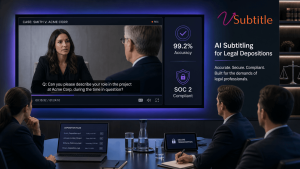
Introduction: The Digital Transformation of the Courtroom
In 2026, the legal industry reached a tipping point. The traditional methods of court reporting and deposition transcription, while storied, are being augmented—and in many cases, replaced—by advanced AI subtitling technologies. For law firms, court reporting agencies, and corporate legal departments, the shift toward AI isn’t just about speed; it’s about meeting the rigorous demands of accuracy, security, and compliance in a digital-first world.
Legal depositions are the backbone of the discovery process. Every word matters. A single mistranscribed term can alter the course of a multi-million dollar litigation. This guide explores how AI subtitling has evolved to meet these high stakes in 2026, and why vSubtitle is at the forefront of this legal tech revolution.
1. The Accuracy Threshold: Beyond 99%
In the legal world, “good enough” is never enough. While early AI transcription tools struggled with legal jargon, overlapping speech, and diverse accents, the 2026 generation of AI—powered by specialized neural networks—has shattered previous limitations.
Specialized Legal Models
Unlike generic AI tools, professional platforms like vSubtitle utilize models specifically trained on millions of hours of legal proceedings. This allows the AI to:
- Identify Complex Terminology: Correctly transcribe Latin phrases, obscure case law citations, and technical medical or engineering terms often found in expert witness testimony.
- Handle Overlapping Speech: Advanced “diarization” (speaker identification) can now distinguish between multiple attorneys, the witness, and the court reporter, even when they speak simultaneously.
- Contextual Awareness: The AI understands the flow of a deposition, reducing errors in homophones (e.g., “statute” vs. “statue”) based on the surrounding legal context.
For legal professionals, this means a “rough draft” transcript is available in real-time, with a final, certified-ready version delivered in a fraction of the time it takes for manual transcription.
2. Security First: Protecting Privileged Information
In 2026, data breaches are more sophisticated than ever. For legal depositions, which often contain highly sensitive, proprietary, or personal information, security is non-negotiable.
SOC 2 Type II and HIPAA Compliance
A professional AI subtitling partner must adhere to the highest security frameworks.
- SOC 2 Type II: This is the gold standard for service organizations. It ensures that vSubtitle has rigorous controls in place for security, availability, processing integrity, confidentiality, and privacy.
- HIPAA Compliance: For depositions involving medical records or personal health information (PHI), HIPAA compliance is a legal requirement. vSubtitle’s infrastructure is designed to handle PHI with end-to-end encryption and strict access controls.
Data Sovereignty and Encryption
In 2026, where your data lives matters. vSubtitle offers:
- End-to-End Encryption (E2EE): Data is encrypted at rest and in transit, ensuring that only authorized personnel can access the deposition content.
- Zero-Knowledge Architecture: In many configurations, even the service provider cannot access the raw audio or video files, providing an ultimate layer of privacy for sensitive litigation.
3. Compliance in the Era of AI Regulation
As AI becomes more prevalent, so does the regulation surrounding its use in the legal field. In 2026, compliance means more than just following the rules; it means being able to prove you followed them.
Audit Trails and Chain of Custody
Every deposition processed through vSubtitle generates a comprehensive audit trail. This includes:
- Timestamped Logs: Exactly when the file was uploaded, processed, and accessed.
- Version Control: A clear history of any edits made to the transcript, ensuring the integrity of the record.
- User Permissions: Granular control over who can view, edit, or download deposition materials.
Ethical AI and Bias Mitigation
The legal industry is rightfully concerned about AI bias. In 2026, vSubtitle’s models are regularly audited for “algorithmic fairness” to ensure that accents, dialects, and speech patterns from diverse backgrounds are transcribed with equal accuracy, upholding the principles of justice and equity.
4. The ROI of AI Subtitling for Law Firms
Beyond compliance and security, the move to AI subtitling offers a significant competitive advantage.
- Real-Time Collaboration: Attorneys can highlight, tag, and comment on real-time subtitles during a remote deposition, allowing for immediate follow-up questions.
- Searchable Video Archives: Instead of scrolling through hours of video, legal teams can search for specific keywords within the subtitles to jump directly to the relevant testimony.
- Cost Efficiency: AI reduces the “per-page” cost of transcription by up to 60%, allowing firms to pass those savings to clients or reallocate resources to higher-value legal strategy.
5. Implementation Checklist for Legal Teams
If your firm is looking to integrate AI subtitling in 2026, here is your roadmap:
- ☐Verify Compliance: Ensure the provider is SOC 2 Type II certified and offers a Business Associate Agreement (BAA) for HIPAA.
- ☐Test Accuracy: Run a “blind test” with a complex legal recording to evaluate the AI’s handling of technical jargon.
- ☐Evaluate Integration: Does the tool work with your existing remote deposition platforms (Zoom, Teams, etc.)?
- ☐Review Data Retention Policies: Ensure the provider allows for permanent deletion of files once the matter is closed.
- ☐Train Your Staff: Ensure your paralegals and attorneys know how to use the real-time tagging and search features to maximize the tool’s value.
Frequently Asked Questions (FAQ)
1. Can AI subtitles be used as an official court record?
In 2026, while AI provides the “rough” and “real-time” transcript, most jurisdictions still require a certified court reporter to sign off on the final record. However, the AI-generated transcript serves as the primary working document, drastically speeding up the certification process.
2. How does vSubtitle handle “off the record” moments?
Our platform includes a “Pause” feature for both the recording and the subtitling. Additionally, sensitive segments can be easily redacted or deleted from the final transcript and video file to maintain attorney-client privilege.
3. Is my data used to train the AI?
No. For our legal and enterprise clients, vSubtitle operates on a “Private Model” basis. Your data is never used to train our public models, ensuring that your firm’s proprietary information and client secrets remain entirely private.
4. How does the AI handle multiple speakers in a heated deposition?
vSubtitle uses advanced Speaker Diarization and Beamforming technology to isolate individual voices based on their unique acoustic signatures and spatial location (in multi-mic setups), ensuring high accuracy even during cross-talk.
5. What file formats are supported for legal exports?
We support all standard legal formats, including LEF (LiveNote), SBF (Summation), and TXT (ASCII), as well as modern formats like SRT, VTT, and JSON for video integration.
Conclusion: Embracing the Future of Litigation
The legal deposition of 2026 is a data-rich, highly efficient, and secure event. By embracing AI subtitling, legal professionals are not just keeping up with technology—they are enhancing the very nature of the discovery process. Accuracy is higher, security is tighter, and justice is served faster.
Discover how vSubtitle is redefining legal transcription. Start your secure trial today.